Inverter Battery Guide: How to Choose the Right Inverter Battery Size, Capacity & Backup for Home (2026)
Inverter Battery guide: learn how to choose the right inverter battery, calculate inverter capacity, battery Ah, and pick the best inverter battery for your home backup in 2026.
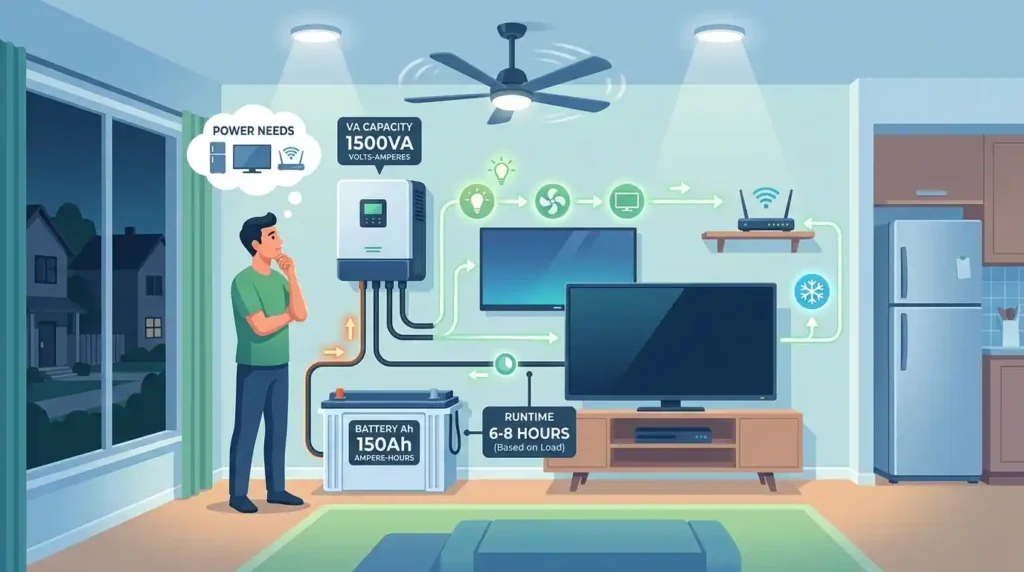
Choosing the right inverter and battery for your home boils down to three simple things: which type of inverter to buy, how much inverter capacity you need, and how big the battery should be. Get these three decisions right and you’ll have a reliable backup system that matches your usage, budget, and space.
Three Key Things to Know Before Buying an Inverter Battery and Inverter
- Type of inverter: square wave, pure sine wave, hybrid/solar compatible, or integrated lithium units.
- Inverter capacity (VA/W): size the inverter to handle the peak load of the appliances you want to run.
- Battery capacity (Ah): size the battery for how long you want the inverter to run (run time), and pick the chemistry that fits your life (lead-acid vs lithium).
1. Pure Sine Wave vs Square Wave Inverter Battery Systems: Which One Should You Choose?
Always prefer a sine wave inverter for home use unless you are on an extremely tight budget and only powering simple bulbs and fans. Square wave inverters are cheaper but noisy and can damage sensitive electronics because they do not transition smoothly from grid to inverter. Pure sine wave inverters run TVs, computers, modems, and modern appliances reliably.
2. How to Calculate the Right Inverter Battery Inverter Capacity (VA)
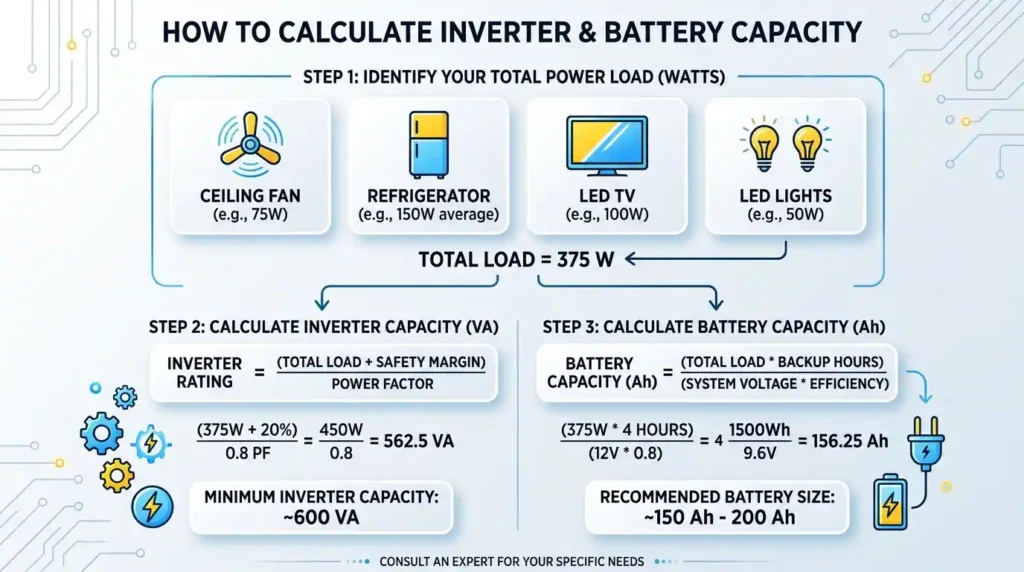
Start by listing the appliances you want to run at the same time and their typical power consumption (in watts). Add them up to get the total running watts. Inverter capacity is usually given in VA, and real-world usable capacity is lower than the published peak because inverters rarely operate at 100% continuously.
Example Calculation for Choosing the Correct Inverter Battery and Inverter Size
Suppose you want to run:
- Fridge — 200 W
- Two BLDC ceiling fans — 2 × 30 W = 60 W
- TV — 150 W
- Four LED lights — 4 × 10 W = 40 W
Total running load = 450 W.
Convert watts to VA (practical sizing)
Inverters typically operate at around 70–80% of their published peak continuously. To find a safe minimum VA size:
Required VA ≈ total watts ÷ 0.7
Example: 450 W ÷ 0.7 ≈ 643 VA → choose next available higher VA (800 VA recommended)
Rule of thumb: for most non-heating homes (lights, fans, fridge, TV, computer) a 800–1200 VA inverter covers the majority of needs. For heavier usage move up to 1500–2000 VA and above if you intend to run ACs or other high-power loads.
3. How to size the battery (Ah) for the runtime you want
Battery capacity depends on how long you want the inverter to run and the total load. Use this formula:
Battery Ah = (Total watts × Hours runtime) ÷ Battery voltage

Example: 450 W × 4 hours = 1800 Wh
At 12 V battery: 1800 Wh ÷ 12 V = 150 Ah
So a 450 W load for 4 hours needs around 150 Ah at 12 V. Batteries commonly come in 135 Ah to 260 Ah in tubular lead-acid formats. If your required Ah exceeds what a single battery supports, check if the inverter supports dual-battery setups.
Practical notes on battery selection
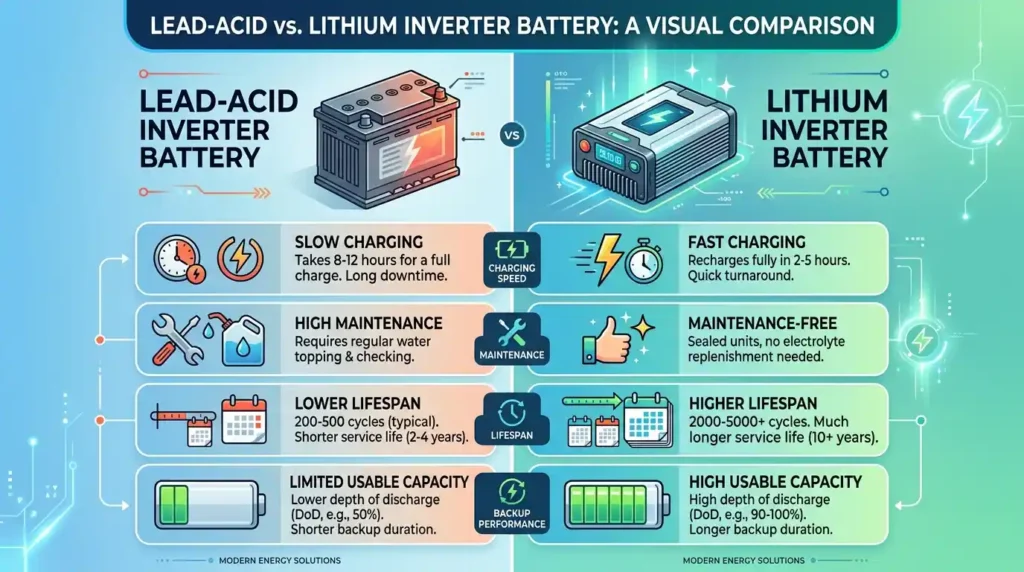
- Lead-acid (tubular/sellable): lower upfront cost but higher maintenance (water topping), slower charging, and shorter cycle life.
- Lithium-ion integrated units: higher initial cost but low maintenance, faster charging (2–4 hours vs 8–10 for lead-acid), and longer cycle life (3,000–6,000 cycles → 7–12 years).
- Always confirm inverter support: ensure the inverter supports the battery Ah you pick and whether it supports dual batteries if you plan to expand runtime.
Solar and Hybrid Inverter Battery Systems: Should You Buy One?
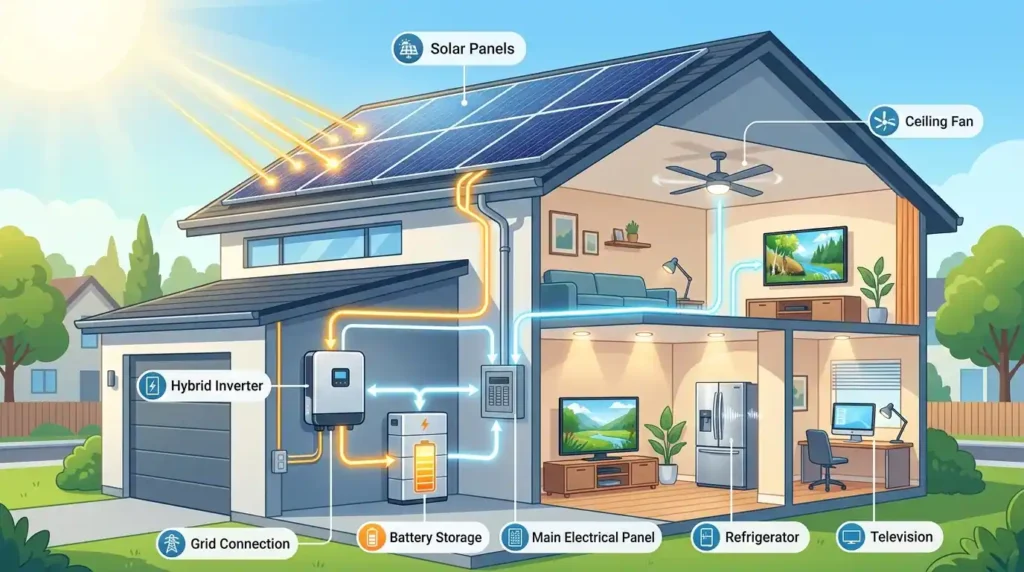
If you plan to add solar now or later, buy a solar-compatible (hybrid) inverter. These inverters can:
- Charge batteries from both solar and grid
- Convert DC from solar panels to AC for home loads
- Switch intelligently between solar and grid
Hybrid inverters cost a bit more but are worth it if solar is on your roadmap.
Important Features to Look for in an Inverter Battery System
- App control and smart monitoring: check backup time left, battery health, receive reminders for maintenance.
- Safety features: short-circuit protection, overload protection, over-temperature protection, low-battery shutdown.
- Warranty and service network: 2–5 year warranty is common; some brands offer transformer warranty or extended coverage.
- Dual-battery support: important if you want to extend runtime later.
Best Inverter Battery Brands and Service Networks in India
After reviewing many user experiences and product reviews, a few patterns emerge:
- Luminous — consistently reliable products and a strong service network; good warranties.
- Microtek — versatile models across price segments; watch for service quality in some regions.
- V-Guard — solid quality and useful smart features on several models; good warranty.
- Genus — strong lithium options and integrated units geared for apartments.
- Livguard — good hybrid and lithium offerings with decent after-sales support in many cities.
Model recommendations by usage (practical picks for 2026)
Best Inverter Battery Models for Basic Home Usage
- Microtek Super Power 700
- Capacity: ~600–700 VA (check specific variant)
- Pros: Budget-friendly, LED display for backup and charging time
- Cons: Some listings call it square wave; verify the official spec for sine wave
- Best for: Tight budgets and very light household loads
- Luminous NXG 850e (hybrid)
- Capacity: 500 VA class hybrid
- Pros: Solar-compatible, can run lights/fans/fridge and charge from solar/grid
- Cons: Not for heavy appliances
Best Inverter Battery Systems for Medium Household Power Needs
- Livguard LGS1100i
- Peak load ~756 W
- Supports batteries up to 260 Ah
- Good for: Homes that need to run several non-heating appliances simultaneously
- Luminous Zelio+ 1100 / Microtek Super Power 1000 / V-Guard Smart Pro 1200s
- Capacity range: 800–1200 VA
- Pros: Common and versatile all-rounders; some offer app monitoring and turbo charge modes
Best Inverter Battery Options for High Usage and Long Backup
- Okaya ATSW 1700
- Capacity: ~1450 VA (peak ~1160 W)
- Pros: Strong protections, good for heavier household loads
- Cons: Many inverters of this size expect two-battery setups
- Microtek Super Power 1700
- Supports two batteries up to 200 Ah each
- Good choice if you want to extend runtime without going to a heavy-duty unit
Heavy-Duty Inverter Battery Systems for AC and Large Appliances
- Microtek Heavy Duty 2350
- Dual battery support up to 200 Ah — long run times
- Can run an AC for a few hours depending on load and battery
- Also suitable for small offices
- Genus MaxiLion 2400
- Integrated lithium options exist in Genus lineup for heavy usage
- Long-term lower cost of ownership due to lithium battery life
Best Integrated Lithium Inverter Battery Systems for Apartments
- Genus MaxiLion 1000 / 2400 (Li-ion integrated)
- Pros: Compact, wall-mount options, low maintenance, long battery life (10+ years)
- Cons: Higher upfront cost, but lower 10-year ownership cost
- Karacus / Karacus Version 1000
- Wall mount designs for limited-space apartments
- C Karacus 1000 wall-mount (example)
- Some models advertise 15-year battery life and compact form factor — validate local availability and service
Inverter Battery Buying Checklist: What to Check Before Purchasing
- Does the inverter output a pure sine wave? (Prefer pure sine for sensitive devices.)
- Is the inverter solar/hybrid compatible if you might add solar later?
- What is the peak and continuous VA/W rating and how does that compare to your calculated load?
- Battery compatibility — maximum Ah supported and single vs dual battery support.
- Available after-sales service in your city and the warranty length.
- Extra features you care about: app monitoring, turbo charge, display of backup time.
Final Tips for Choosing the Best Inverter Battery for Your Home
For budget basic home setups: Microtek Super Power 700 or similar 600–800 VA units. Verify sine wave output on the official spec sheet.
For most households (best balance): go for 800–1200 VA models such as Livguard LGS1100i, Luminous Zelio+ 1100, Microtek Super Power 1000, or V-Guard Smart Pro 1200s. These cover fans, lights, fridge, TV, and computers for 3–4 hours with a single battery set.
For heavy usage or AC support: pick 1700 VA and above — OKAYA ATSW 1700, Microtek Super Power 1700, Microtek Heavy Duty 2350 or Genus MaxiLion 2400. Prefer dual-battery capable models for longer runtimes.
For apartments and low-maintenance setups: choose integrated lithium-ion inverter-battery combos like Genus MaxiLion or compact wall-mount options. Higher upfront cost, but far lower maintenance and better lifetime economics.
Final Tips for Choosing the Best Inverter Battery for Your Home
Pick a sine wave inverter sized a little above your calculated requirement, pair it with a battery Ah sized for your desired run time, and decide between lead-acid and lithium based on budget and maintenance tolerance. Consider hybrid/solar-compatible options if you plan to add panels. Check warranty and after-sales support in your area—service quality often matters more than a small difference in specs.
Pricing, Affiliate, and Sponsorship Disclosure:
All prices are subject to change and may be higher or lower than prevailing market prices. We make no guarantees regarding price accuracy. This content may include affiliate links and/or sponsored placements, through which we may receive compensation. Such compensation does not impact pricing or product representation. Consumers are responsible for verifying final prices with the retailer. 😊 Check: Affiliate Disclosure Page. and check out another social media account: Click Here.