
Best 1-Ton AC in India: BEE Rating Changes, Top Models & Smart Buying Guide
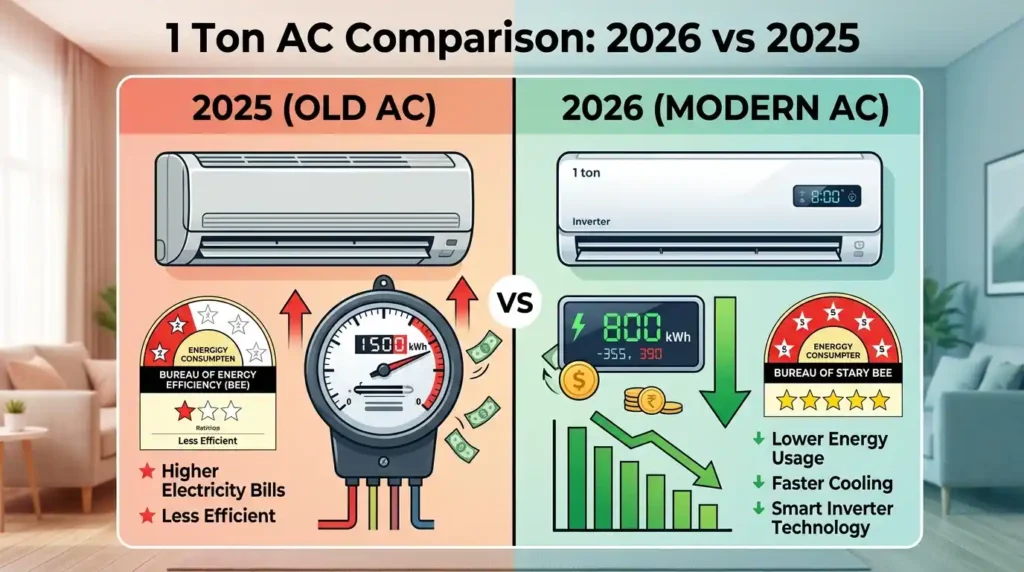
Looking for the best 1-ton AC 2026? Discover BEE rating changes, top models, energy savings, and expert tips to choose the right AC for your room.
Choosing between the best 1.5 ton AC and a budget 1-ton model depends on your room size and cooling needs.
Why Buying a 1 Ton AC Is Different This Year
Buying a 1 ton AC in 2026 should feel easier than it does. But the reality is that the rules have changed. Across brands like Panasonic, Carrier, Midea, Samsung, Blue Star, and LG, 2026 models are now aligned to the new BEE efficiency rating system.
The key promise of these new 2026 models is simple: you are expected to use about 10% less electricity than what older rating periods implied. That matters a lot in Indian summers when you run your AC daily.
1 Ton AC 2026 vs 2025: What Changed in BEE Ratings and Power Consumption
In the 2026 model year, many 1 ton ACs are either re-certified or re-rated under the updated BEE efficiency framework. Practically, it means electricity consumption targets have been adjusted downward.
Concrete example (standard test conditions):
- A 2025 Carrier 1 ton 5-star AC consumed around 536 units per year.
- A 2026 model for the same series consumed around 470 units per year.
That is roughly a 10% reduction per year under testing conditions.
Why you should care
If you are an AC-heavy user, those “label” differences turn into real savings over the long run. The upfront price may be a little higher, but the efficiency gains often compensate, especially if you run the AC for many months.
How to Shortlist a 1 Ton AC: Cooling Capacity and Energy Efficiency First
When choosing an AC, focus on two things above everything else:
- Cooling capacity (tonnage)
- Energy efficiency (BEE stars and ISEER/ICU rating)
Everything else is “nice to have” like WiFi, app control, extra filters, or smart-home compatibility.
Calculate Your Appliance Electricity Cost
Check the estimated daily, monthly and yearly electricity consumption of your AC, refrigerator, fan, air fryer, geyser and other appliances.
Step 1: 1-Ton AC 2026: How to Choose the Right Cooling Capacity for Your Room
✔ Pros & Cons Table (1 Ton AC)
| Pros of 1 Ton AC | Cons of 1 Ton AC |
|---|---|
| Lower electricity consumption due to new BEE ratings | Slightly higher upfront price |
| Ideal for small rooms (up to 150 sq ft) | Not suitable for large or hot rooms |
| Improved efficiency (ISEER ratings up to ~5.8) | Performance depends on correct sizing |
| New models offer better cooling optimization | Some brands reduce real cooling capacity |
| Smart features like WiFi and convertible modes available | Smart features are often unnecessary |
| Better long-term savings on electricity bills | Service quality varies by brand |
A “1 ton” AC is a good starting point for many small rooms, but it is not automatically correct for every space. Buying a unit that is too weak makes the room feel sticky and under-cooled. Buying one that is too strong can cool the room quickly but may not remove humidity properly.
Rule of thumb: When a 1-Ton AC 2026 Is Perfect for Small Rooms (Under 150 sq ft)
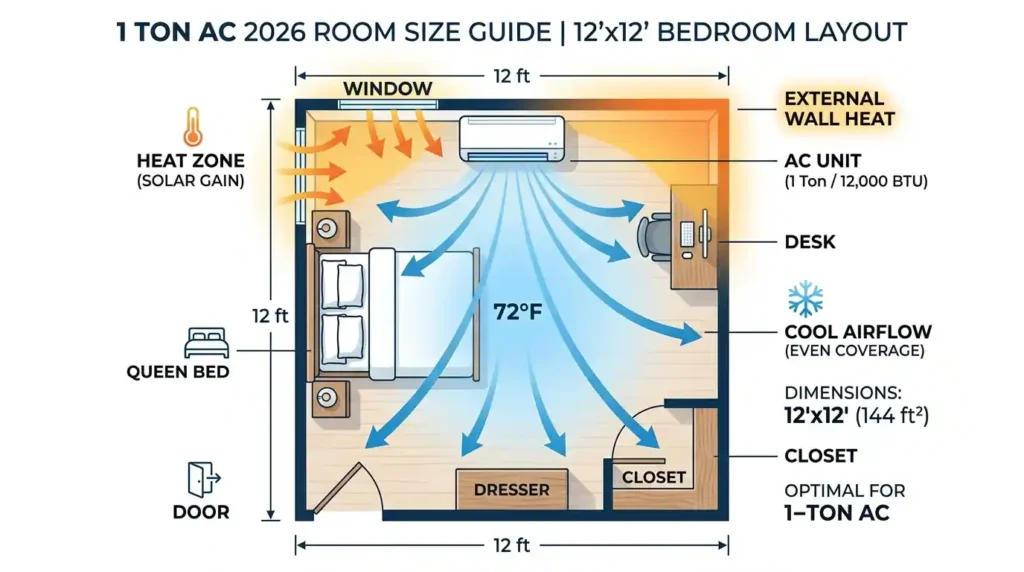
A 1 ton AC is generally fine if your room is under about 150 sq ft. A common example is roughly 12 ft x 12 ft.
Also consider how harsh the room conditions are:
- If the room does not get direct harsh sunlight from east or west-facing windows
- If it is not on the top floor
If you have any of these “hard conditions,” consider a higher capacity like 1.5 ton or 2 ton.
Why Proper Sizing Matters in a 1-Ton AC for Better Cooling and Humidity Control
Higher cooling capacity often removes moisture faster. With an AC that’s sized too low, the room can reach a lower temperature quickly, but humidity may remain longer. The result is the classic “cold but sticky” feeling.
AC Cooling Capacity Explained (kW, BTU & Real Performance)
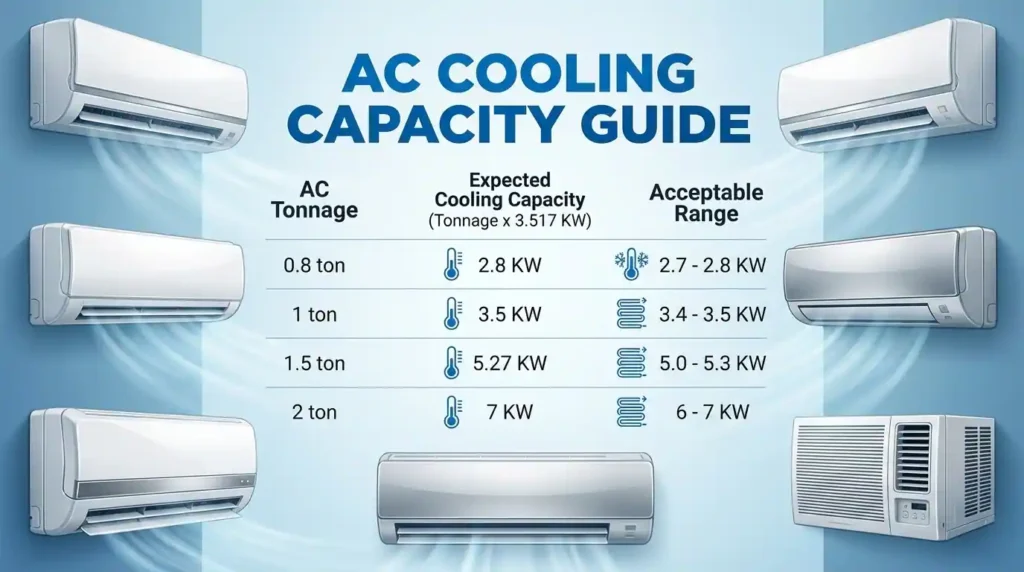
Just because it says “1 ton” on the box does not guarantee the same cooling output. The standard industry conversion typically expects:
- 1 ton cooling = about 3.517 kW = 12,000 BTU/h
And for your 1 ton AC, the acceptable cooling capacity range you may see around the lower threshold is often around 3.4 to 3.5 kW (depending on how the rating is displayed and the acceptable range for that category).
Some brands have delivered models where the cooling capacity is lower than expected for “1 ton.” If you buy at a great price and your room truly is smaller than average, it can still be okay. But if you stretch it, performance can disappoint.
Step 2: How to Read the BEE Label on AC (Stars vs Real Efficiency)
Stars matter, but how you interpret the label matters more. For 2026 models, you should understand the efficiency figures like:
- ICU rating (Indian Seasonal Energy Efficiency Ratio concept)
- ISEER details as shown by BEE style labeling across periods
- Expected annual electricity consumption shown as units, under 1600 hours per year test conditions
Also remember: your actual usage depends on your real habits. But if everything else is similar (room size, tonnage, star rating), then the label gives you a solid comparison baseline.
2026 5-star vs 2025 5-star: the energy numbers shift
Many 2025 “5-star” ACs effectively become “4-star” in the new rating period, because BEE recertifies how stars are assigned.
In practice, the expected annual electricity consumption is where you’ll see the meaning. For 2026 models:
- Most 1 ton 5-star models consume around 450 to 470 units/year
- One exception mentioned is Blue Star, consuming around ~57 units less than others in that comparison set
Meanwhile, 2025 models often sit around 510 to 530 units/year, meaning they can reflect effectively higher electricity usage compared to the re-rated 2026 models.
When upgrading to 2026 models is worth it
Even if the new models are slightly more expensive upfront (due to rating framework differences and efficiency improvements), the long-term electricity savings can be better, especially if you use AC frequently across the year.
Best Settings to Use Your Ac for Maximum Energy Savings
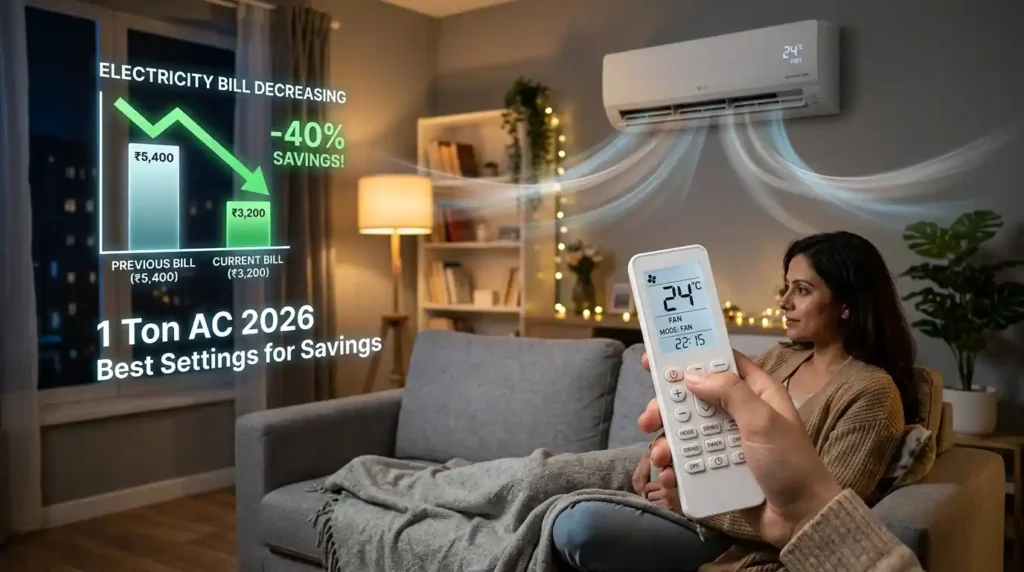
If you want the savings benefits of an efficient AC, usage settings matter. A good starting point:
- Set temperature to 24°C or higher
- Pair with the fan mode for better circulation and efficiency
Step 3: Think About Star Rating Based on Your Usage Hours
Do not blindly buy “5-star” if your usage is minimal. A simple heuristic:
- If you use AC for more than 12 hours per day and run it for 3 to 4 months or longer, a 5-star model is usually more justified.
- If your usage is lower, a 3-star AC can be sufficient and value-friendly.
The best choice is the one that matches how many hours you will truly run the AC, not how high the star rating looks on the online listing.
Smart Features: What Matters and What to Skip
Most “value features” are helpful only if they solve a real problem for you.
- Smart home and app control can be convenient if you routinely switch AC on/off remotely.
- AI branding in ACs is largely not “real AI.” In most models, it is more about capacity adjustment based on ambient conditions.
Air purification claims are also often over-hyped. Many ACs can support filters (including PM2.5 compatible filters), but it is still usually better to use a dedicated air purifier if air quality is a major concern.
Do You Need a Stabilizer for a 1-Ton AC
Many modern ACs support stabilizer-free operation over a voltage range (example mentioned: 110V to 285V). That helps in areas with frequent power fluctuations.
If your locality has frequent large voltage swings, a stabilizer can protect sensitive electronics and the PCB, which can be expensive to replace.
Warranty and Service Guide for 1-Ton AC: What You Must Check
Installation charges and service responsiveness can affect your overall satisfaction.
Installation cost: Many AC installations may cost an extra ₹700 to ₹1500 that you may need to pay to the installation engineer.
Typical warranty structure mentioned:
- Often 1 year overall warranty
- Commonly 5 years on PCB and 10 years on inverter compressor, with certain exceptions
But warranty coverage can differ by brand and series. Some brands (like Midea, Blue Star, and others mentioned in specific categories) may have a less extended PCB warranty.
Service networks can also be a mixed bag. In non-tier-1 cities, many brands rely on third-party service providers, which can lead to delays and variable customer experience.
Best 1-Ton AC in India: Top Recommended Models
📊 Comparison Table (Top Picks – 1 Ton AC)
| Brand | Star Rating | Cooling Capacity | ISEER | Units/Year | Best For |
|---|---|---|---|---|---|
| Panasonic | 5 Star | ~3450W | 5.8 | ~460 | Best overall efficiency |
| LG | 4 Star | ~3400W | ~5.2 | ~500 | Quiet operation |
| Daikin | 5 Star | ~3500W | ~5.2+ | ~480 | Reliable cooling |
| MarQ | 3/5 Star | ~3480W | ~4.5–5 | ~500+ | Budget buyers |
| Cruise | 3/5 Star | ~3400W | ~4.6 | ~510 | Affordable inverter |
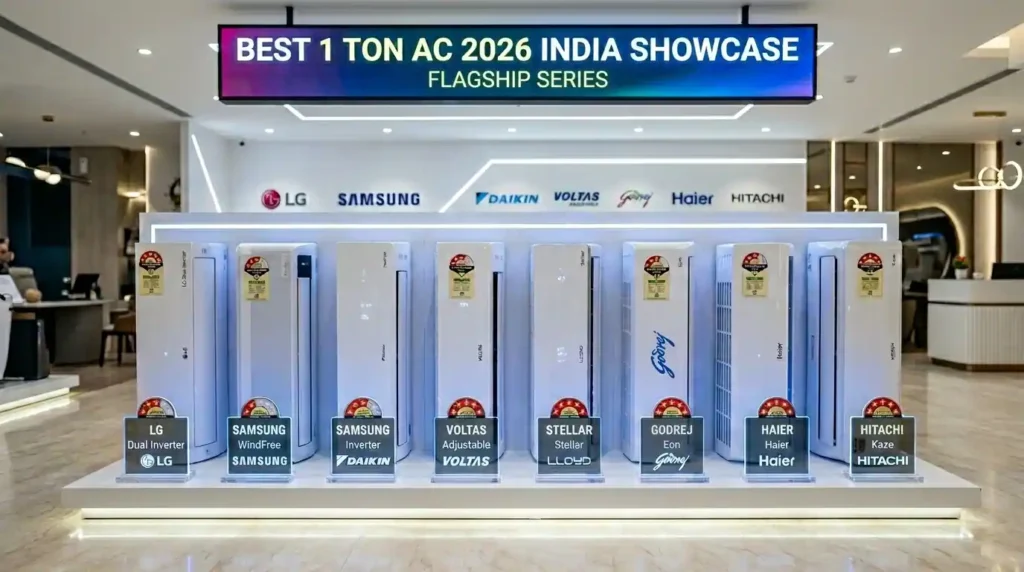
Here are the key recommendations highlighted, with the reasoning in plain language.
1) Panasonic 1 ton 3-star and 5-star
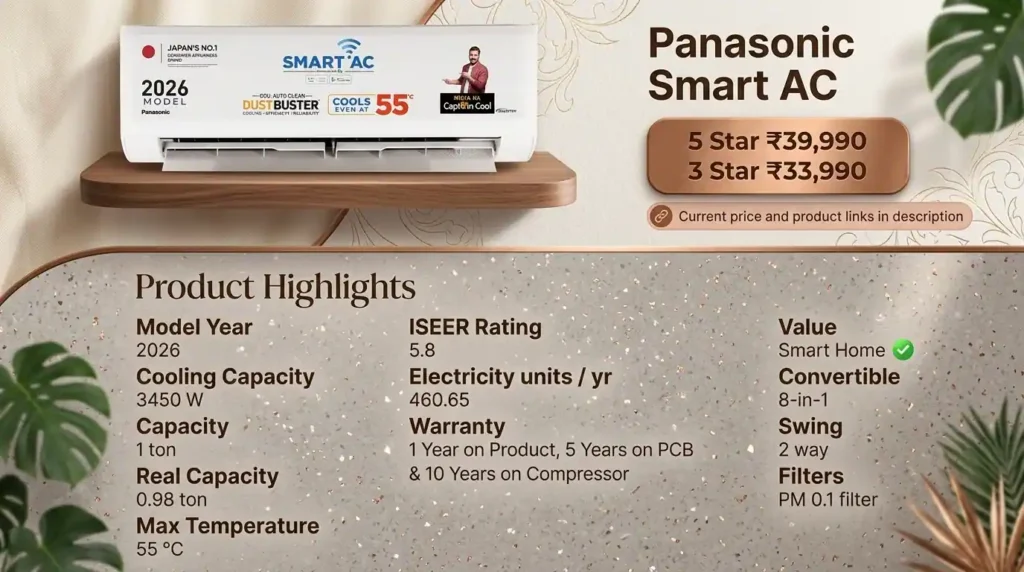
Why it stands out:
- Excellent ICU rating for the 5-star category (mentioned: 5.8) which positions it well for future BEE frameworks
- Cooling performance within the acceptable range (over 3.4 kW)
- Good overall value proposition, including a version with WiFi and an essential version without WiFi at lower cost
What to watch: Panasonic’s indoor blower sound level may be louder than some competitors because it targets air throw performance.
2) LG 1 ton 4-star Ac (quiet operation focus)
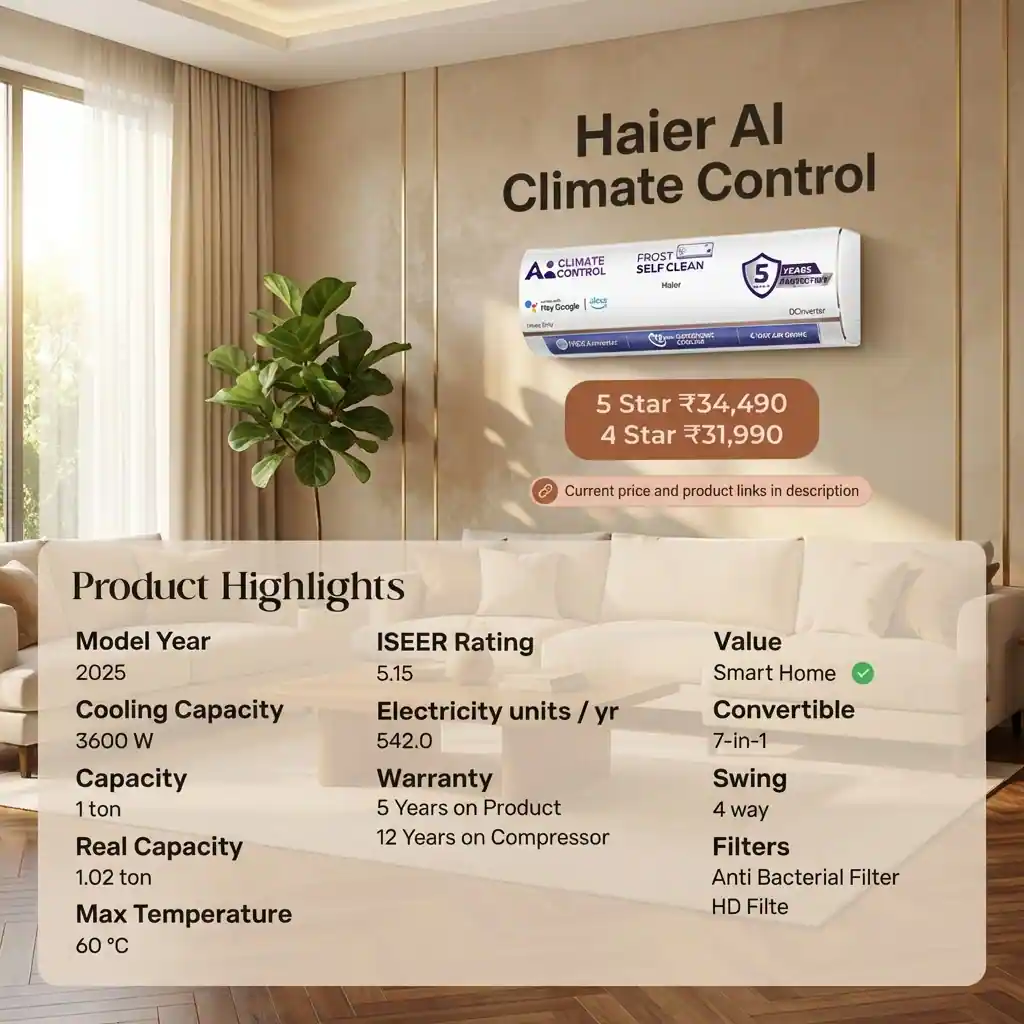
Why it stands out:
- Very quiet operation, suitable for light sleepers
- Dual inverter compressor designed to reduce vibration and noise
- Essential AC configuration (non-WiFi) gives you LG performance without the premium of extra connectivity features
Context note: This LG 2026 model is described as a re-certified 2025 model with a rating downgrade from 5-star to 4-star in the new period.
3) Daikin 1 ton 3-star and 5-star (cooling output reliability)
Why it stands out:
- Cooling capacity aligns well with what you expect from a 1 ton class
- Supports higher ambient temperatures (mentioned: up to around 55°C for the relevant category)
- Coatings on outdoor unit designed to handle rust, salt, and moisture degradation, making it attractive for coastal areas
Note: Smart functions may not feel as smooth compared to premium competitors, but for cooling performance and durability, it is positioned as strong.
4) If you want budget efficiency under ₹30,000: MarQ by Flipkart (1 ton 3-star or 5-star)
Why it stands out:
- Aggressive pricing for value
- Still delivers solid cooling performance (mentioned: around 3.48 kW) and decent efficiency
- For budget shoppers, this can be a practical alternative when you accept compromises
Trade-off: Budget models can compromise either cooling capability, star rating, or both. The strategy is: buy the best possible within your price band, but be realistic.
5) Cruise 1-ton Ac (budget-friendly inverter option)
Why it stands out:
- Affordable pricing
- Energy-efficient inverter approach (capacity adjustment based on room load)
- Anti-rust condenser tech and suitability for coastal climates
Trade-off: Service support through third-party partners in some cities is described as average rather than top-tier.
Quick Buying Checklist for Choosing the Best 1-Ton AC
- Confirm room sizing: under 150 sq ft for typical 1 ton, unless your room conditions are exceptionally harsh
- Check cooling capacity (kW) on specs, not only “1 ton” marketing
- Compare energy efficiency using BEE label metrics like ISEER/ICU and annual units consumption
- Match star rating to usage hours: heavy daily usage favors 5-star
- Consider service and warranty coverage, not only price
- Optimize settings: 24°C or higher with good fan mode use
🔗 Related Guide
If you’re unsure between sizes, don’t miss this detailed comparison and recommendations:
👉 Best 1.5 Ton AC 2026: 5 Star Buying Guide, Top Picks & Energy Saving Tips
https://ratingsage.com/best-1-5-ton-ac-in-2026-buying-guide/
Final Verdict: How to Choose the Best 1-Ton AC 2026 for Your Needs
In 2026, the AC market is shifting with updated BEE ratings, and most 2026 models are positioned to consume around 10% less electricity than earlier rating periods. That is a real advantage, but only if you buy correctly.
Choose the right cooling capacity first. Then pick the right energy efficiency from the BEE label. WiFi and “smart” features are optional. Warranty and installation experience can make or break satisfaction.
If you want one clear shortcut: pick a brand and model where the cooling output matches a genuine 1 ton expectation, and where the new-label efficiency numbers look meaningfully better for your usage pattern.
Pricing, Affiliate, and Sponsorship Disclosure:All prices are subject to change and may be higher or lower than prevailing market prices. We make no guarantees regarding price accuracy. This content may include affiliate links and/or sponsored placements, through which we may receive compensation. Such compensation does not impact pricing or product representation. Consumers are responsible for verifying final prices with the retailer. 😊 Check: Affiliate Disclosure Page. and check out another social media account: Click Here.