
Best Refrigerator Buying Guide 2026: Avoid These Costly Mistakes
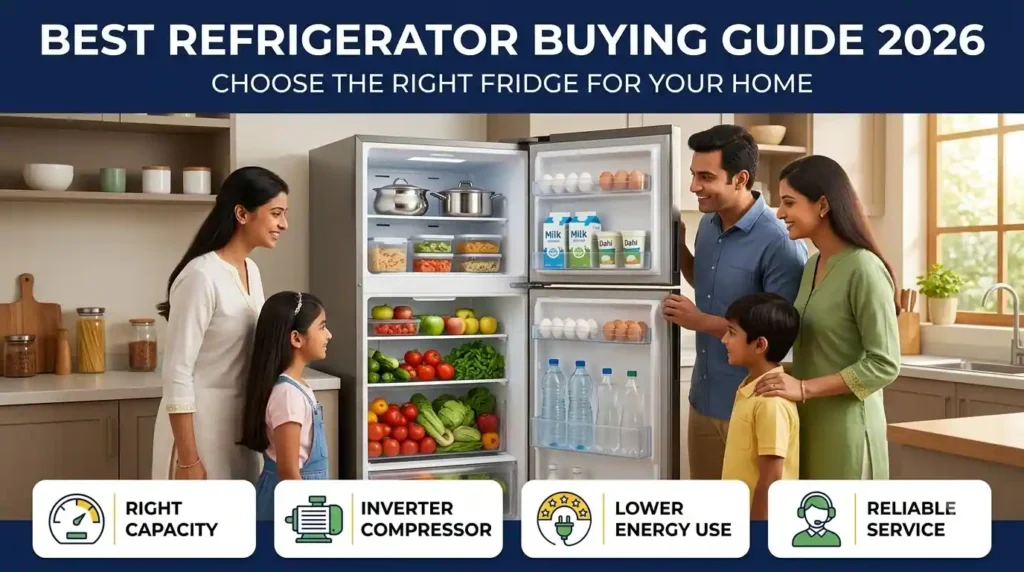
Use this refrigerator buying guide to choose the right size, type, compressor and energy rating while avoiding costly buying mistakes.
A refrigerator is not something to buy based on a glossy finish, a new model-year tag, or a salesperson’s fancy technology names. The right choice comes down to four things: capacity, refrigerator type, compressor, and local service support.
Get these basics right and you can avoid paying extra for features that barely matter in daily use. Get them wrong and even an expensive fridge can feel inconvenient every single day.
How We Prepared This Refrigerator Buying Guide
This guide was prepared by comparing refrigerator capacities, storage layouts, compressor types, BEE energy labels, warranty terms and publicly available specifications from major refrigerator brands in India. We also reviewed practical factors such as bottle storage, shelf arrangement, freezer position and local service availability. Prices and warranty information were last checked in August 2026.
Table of Contents
- Refrigerator Buying Guide: Choose the Right Type and Capacity
- Refrigerator Size Guide by Family and Storage Needs
- Refrigerator Buying Guide to Compressor Types
- Refrigerator Star Rating Guide: Compare Annual Energy Consumption
- Direct-Cool vs Frost-Free Refrigerator: Which Is Better?
- Are Smart and Wi-Fi Refrigerator Features Worth It?
- Common Refrigerator Buying Mistakes to Avoid
- Refrigerator Warranty and Service Guide
- Refrigerator Buying Guide: Four-Point Final Checklist
- Final Refrigerator Buying Recommendation for Indian Families
- Refrigerator Buying Guide FAQs
Refrigerator Buying Guide: Choose the Right Type and Capacity
India has plenty of refrigerator models, but most households only need to consider a few major formats. Pick the format around your family size, food-storage habits, kitchen space, and budget.
Single-Door Refrigerator: Best for Small Homes and Limited Budgets
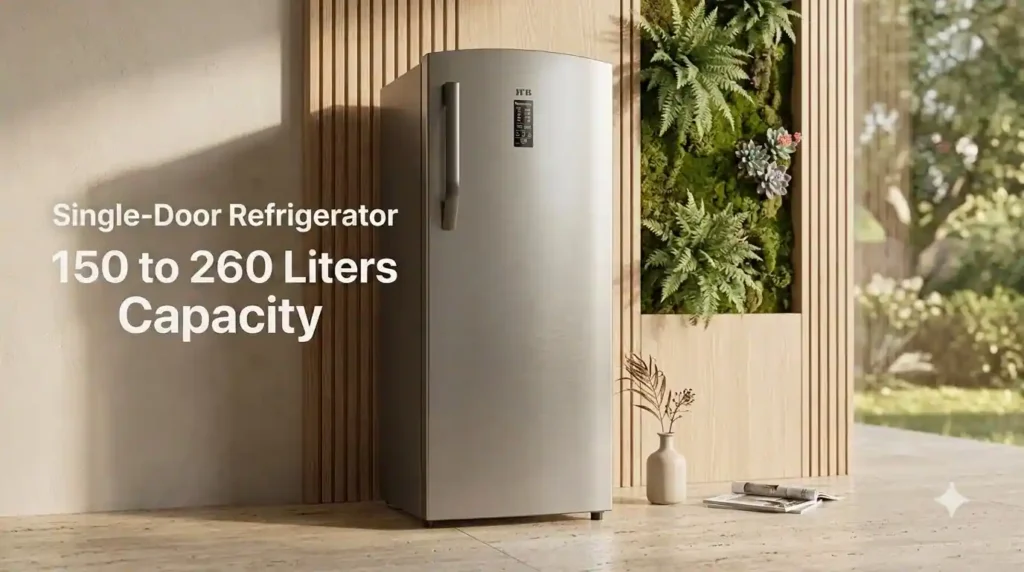
Single-door refrigerators usually come in the 150 to 260 litre range and generally cost around ₹15,000 to ₹18,000. They are a sensible choice for bachelors, compact kitchens, or people with limited food-storage needs.

The trade-off is direct cooling. Ice builds up in the freezer over time, so you will need to defrost it manually. This adds maintenance and can become annoying if you use the freezer often.
- Best for: Bachelors, small households, and budget-focused buyers.
- Capacity range: 150 to 260 litres.
- Main drawback: Manual defrosting due to ice build-up.
Double-Door Refrigerator: The Best Choice for Most Indian Families
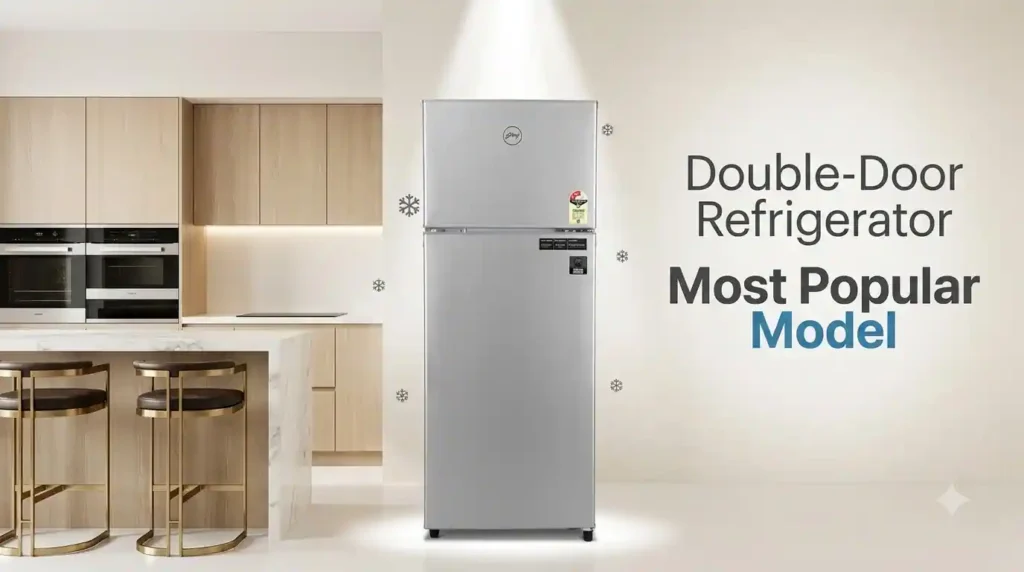
The double-door refrigerator is the most popular format in India, accounting for a major share of frost-free refrigerator sales. It places the freezer on top and the main fridge section below.
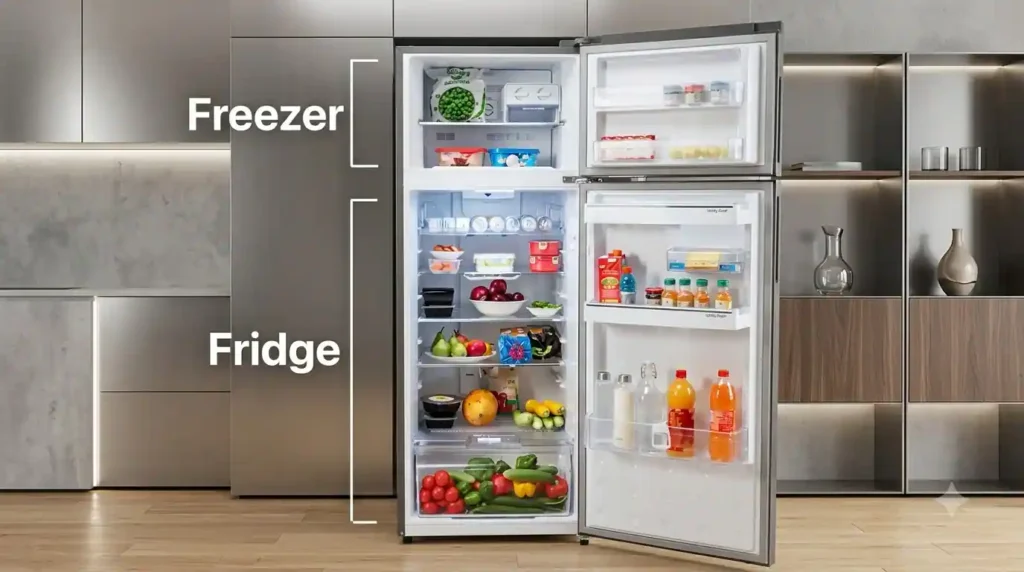
These models typically offer automatic defrosting, more uniform cooling, and capacities of about 230 to 400 litres. Prices can vary widely, from roughly ₹15,000 to ₹50,000, depending on capacity, finish, and features.
For most families, this is the safe choice. A 250 to 350 litre double-door refrigerator is enough for the majority of Indian homes.
- Best for: Small and medium-sized families.
- Capacity range: 230 to 400 litres.
- Big advantage: Frost-free operation with balanced day-to-day storage.
Still comparing capacities, features and energy ratings? Read our complete guide to the best double-door fridge in India 2026 to see recommended sizes, buying tips and top options for Indian families.
Bottom-Freezer Refrigerator: Better Access and Everyday Convenience
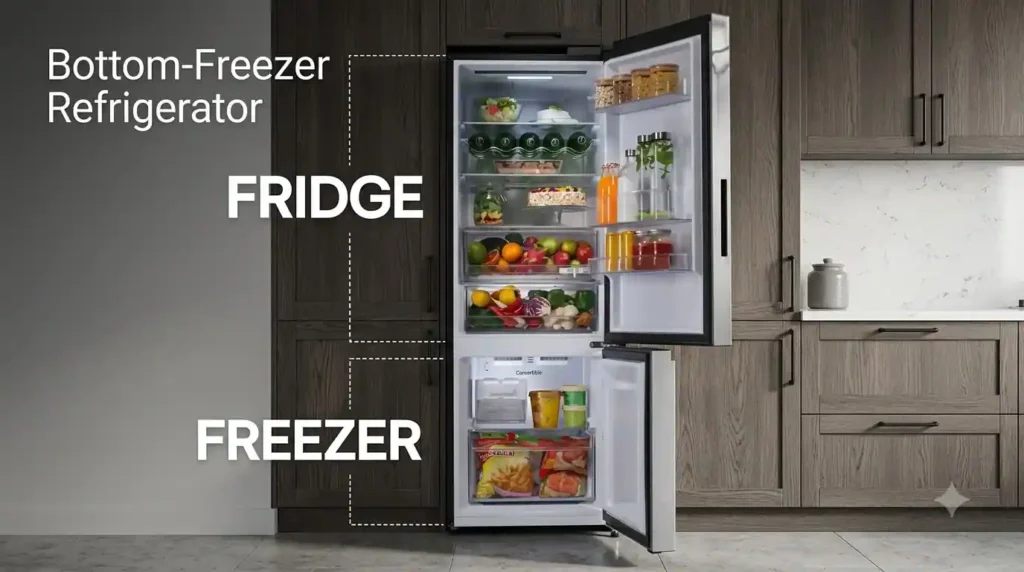
A bottom-freezer refrigerator is also a double-door design, but the layout is reversed. The freezer sits at the bottom while the refrigerator section is positioned at eye level.
This is a genuinely practical design. Most households open the fridge section 10 to 15 times a day but use the freezer only two or three times. Keeping fresh food at a comfortable height means less bending.
It is particularly useful for elderly family members or anyone who has back-pain issues. The format can cost more than a conventional top-freezer double-door fridge, so buy it for the convenience, not just because it looks premium.
Triple-Door Refrigerator: Organised Storage for Fruits and Vegetables
Triple-door refrigerators split storage into three compartments: freezer at the top, refrigerator in the middle, and a dedicated vegetable drawer at the bottom. They usually offer around 300 to 400 litres of capacity.
The separate vegetable compartment helps reduce cooling loss because you do not have to open the entire refrigerator section every time you reach for produce. Its independently managed compartment can also help fruits and vegetables stay fresher for longer.
- Best for: Households that buy lots of fruits and vegetables and want more organised storage.
- Capacity range: 300 to 400 litres.
- Big advantage: Dedicated produce storage with less cold-air loss.
Side-by-Side Refrigerator: Large Capacity for Bigger Families
Side-by-side refrigerators place the fridge on one side and the freezer on the other. They commonly offer 500 to 700 litres of total capacity and may include water dispensers or ice-crushing functions.
They are great for large households that need lots of separated storage. However, the vertical shelves are relatively narrow, so wide vessels, large trays, and broad containers can be difficult to fit.
- Best for: Large families and premium kitchens with plenty of space.
- Capacity range: 500 to 700 litres.
- Main drawback: Narrower shelves for wide utensils and serving dishes.
French-Door Refrigerator: Premium Storage with Wider Shelves
French-door models have two refrigerator doors on top and a freezer drawer below. Their upper shelves are wide enough for larger vessels and broad food containers.
They deliver a premium storage experience, but they are expensive. Expect a price range of around ₹80,000 to ₹2.5 lakh. This is for buyers who have the budget, kitchen space, and a real need for wide storage.
Choosing between these two premium refrigerator formats can be confusing. Read our detailed side-by-side vs French-door refrigerator comparison to understand the differences in shelf width, freezer space, capacity, kitchen clearance and everyday convenience.
Refrigerator Size Guide by Family and Storage Needs
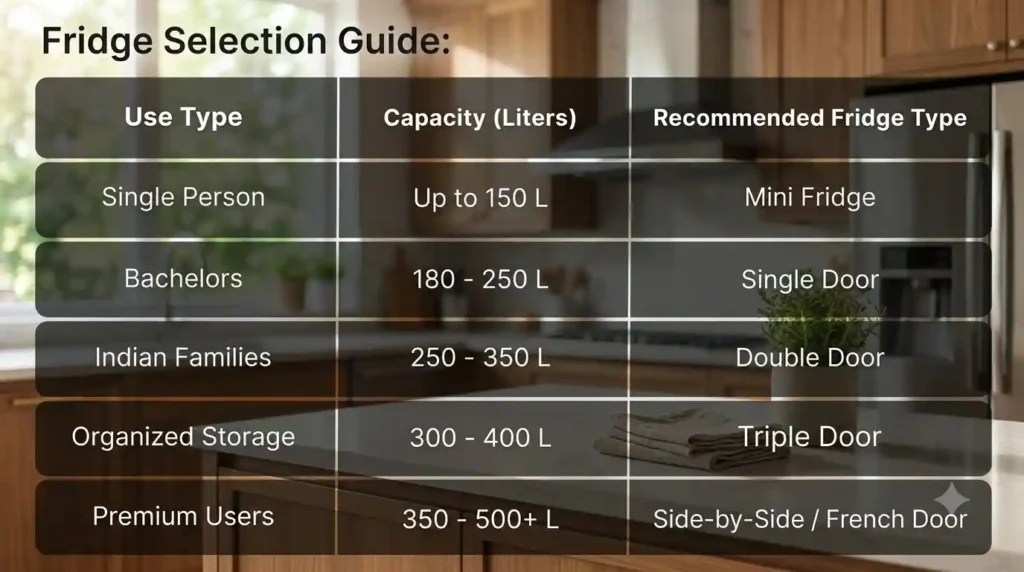
- Single person: Mini fridge or a compact refrigerator up to 150 litres.
- Bachelors: Single-door fridge, roughly 150 to 250 litres.
- Indian families: Double-door fridge, around 250 to 350 litres.
- Households wanting organised storage: Triple-door fridge, around 300 to 400 litres.
- Premium users with large storage needs: Side-by-side or French-door fridge.
Refrigerator Buying Guide to Compressor Types
The compressor is the heart of a refrigerator. Cooling performance, noise level, electricity consumption, and long-term reliability all depend heavily on it.
You will mostly find two types: non-inverter compressors and inverter compressors.
Inverter vs Non-Inverter Refrigerator Compressor
A non-inverter compressor works in a simple on-and-off cycle. It runs at full power, stops, and starts again when cooling is needed. Those repeated restarts can increase electricity use and noise.
An inverter compressor adjusts its speed based on the refrigerator’s cooling requirement. Instead of repeatedly switching fully off and on, it can keep running slowly when only a little cooling is needed. This helps maintain temperature more consistently while reducing noise and power consumption.
Non-inverter refrigerators can consume around 30% to 40% more electricity. That is why an inverter model is the better default choice, even if brands use different names for it.
- Samsung calls it Digital Inverter.
- LG calls it Smart Inverter.
- Haier uses Twin Inverter.
- Whirlpool uses its own intelligent compressor branding.
Do not overthink these names. The core inverter concept is similar. Focus on the actual model, capacity, energy-label units, warranty, and local service availability.
Refrigerator Star Rating Guide: Compare Annual Energy Consumption
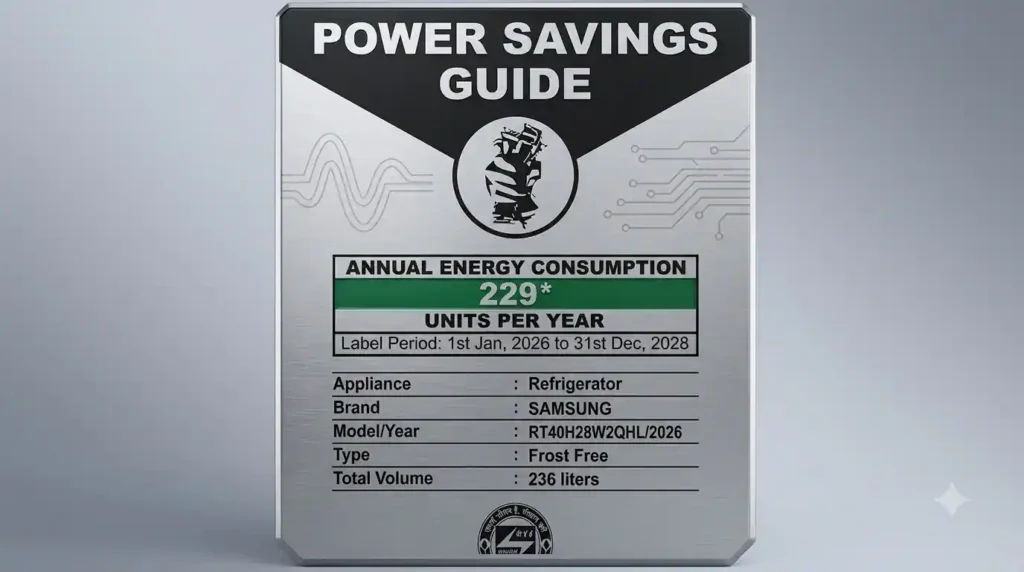
A higher star rating means the refrigerator uses electricity more efficiently. It does not automatically mean that a five-star refrigerator is the only sensible option or that a two-star model is poor.
Every refrigerator carries a BEE energy label. The useful number on that label is the annual energy consumption in units per year. Compare this number across similarly sized refrigerators before making a decision.
For most buyers, a two-star or three-star refrigerator is enough. Do not automatically spend much more for a four-star model. Consider the higher rating only when the price difference is small enough to make sense.
For a better understanding of energy labels and appliance efficiency, consult the Bureau of Energy Efficiency.
Calculate Your Appliance Electricity Cost
Check the estimated daily, monthly and yearly electricity consumption of your AC, refrigerator, fan, air fryer, geyser and other appliances.
Direct-Cool vs Frost-Free Refrigerator: Which Is Better?
Direct-Cool Refrigerator: Affordable but Requires Manual Defrosting
Direct-cool refrigerators are mostly found in single-door models. They build frost inside the freezer, which means manual defrosting is necessary from time to time.
They are typically more affordable, but they need more maintenance.
Frost-Free Refrigerator: Convenient Cooling for Families
Frost-free refrigerators defrost automatically and generally offer more uniform cooling. This is normally included in double-door refrigerators and above.
For a family refrigerator, frost-free cooling is the more convenient option. It saves time and avoids the mess of manually clearing freezer ice.
Do Refrigerator Cooling Technologies Really Matter?
Terms such as 360 Cooling, Vitamin Fresh, Microblock, Nano Shield, and similar names are often marketing labels. The fundamental cooling job remains the same, so do not pay a large premium just for a fancy name.
One exception worth considering is twin cooling if you regularly store non-vegetarian items. Separate cooling management can be useful for that use case. Otherwise, prioritise capacity, compressor type, and actual storage design first.
Refrigerator Features Worth Paying For
Is Convertible Mode Useful in a Refrigerator?
Convertible refrigerators can change the freezer section into additional refrigerator space. This can be useful during festivals, family gatherings, or when guests are staying over.
But for everyday use, many households barely use this function. If your budget is tight, a non-convertible refrigerator is the smarter buy because convertible mode can add roughly ₹2,000 to ₹3,000.
Why Toughened Glass Shelves Matter
This is one feature worth checking, especially if you keep heavy pots, steel vessels, or large containers inside the fridge. Toughened glass shelves offer better confidence for normal Indian kitchen usage.
Check Water-Bottle Storage Before Buying
Buyers often ignore door storage, then regret it in summer. Many homes need space for at least eight to 10 water bottles, but some refrigerators only fit four or five.
Check whether your regular bottles fit comfortably in the door shelves before buying. This small detail has a much bigger impact on daily convenience than many smart features.
Are Smart and Wi-Fi Refrigerator Features Worth It?
App control, Wi-Fi connectivity, food management features, and smart notifications sound impressive. But ask a simple question: Will you genuinely use them?
A refrigerator does not need frequent remote control. Do not spend extra on an app-controlled model unless the feature solves a real requirement in your home.
Common Refrigerator Buying Mistakes to Avoid
There are a few sales tactics that can push buyers toward overpriced models.
- New model-year claims: A newer model year does not automatically bring a major change in efficiency or cooling technology.
- Fancy technology names: Microblock, Nano Shield, Vitamin Fresh, and similar labels should not override core specifications.
- Feature overload: Extra modes and Wi-Fi can raise the price without adding meaningful daily value.
- Ignoring bottle storage: Door capacity matters more than people realise.
- Ignoring service access: A good refrigerator is not much help if the brand cannot support it in your area.
Always compare the actual specifications: usable capacity, compressor type, annual energy units, shelf quality, bottle storage, warranty, and service network.
Refrigerator Warranty and Service Guide
Warranty is important, but service availability is even more important. A refrigerator can be excellent on paper and still become a headache if there is no reliable service centre near your home.
What Does a Refrigerator Product Warranty Cover?
The product warranty usually covers issues with the refrigerator during the first year. If a covered fault occurs, the brand may repair or replace the unit according to its terms.
How Does a Compressor Warranty Work?
Compressor-warranty periods vary by brand, model and purchase date. Samsung India currently offers a 10-year parts-only warranty on the Digital Inverter Compressor for refrigerators purchased from April 1, 2026 onward. LG, Haier, Whirlpool and other brands may also provide extended compressor coverage on selected models. Always read the model-specific warranty terms because labour charges, gas refilling, transportation and other components may not remain covered for the full compressor-warranty period.
Refrigerator Buying Guide: Four-Point Final Checklist
- Choose capacity based on family size and budget. For most families, a 250 to 350 litre double-door refrigerator is enough.
- Prefer an inverter compressor. It is quieter, adjusts cooling output, and helps control electricity use.
- Compare annual units and choose two or three stars. Pay extra for four stars only when the price gap is small.
- Check local service availability. Confirm that the brand has an authorised service centre in your area before buying.
Final Refrigerator Buying Guide Recommendation for Indian Families
For most Indian families, the practical sweet spot is a 250 to 350 litre frost-free double-door refrigerator with an inverter compressor. A two-star or three-star rating is usually sufficient when the BEE label shows sensible annual unit consumption. Bureau of Energy Efficiency
Do not pay more just because a refrigerator is labelled as the newest model or because it has a long list of branded technologies. Spend your money on the things you will use every day: enough capacity, frost-free cooling, sturdy shelves, good bottle storage, inverter efficiency, and dependable local service.
Refrigerator Buying Guide FAQs
What Refrigerator Capacity Is Best for a Family of Four?
A 250 to 350 litre double-door refrigerator is enough for most families. Choose a larger capacity if your household stores a lot of cooked food, bulk groceries, or produce.
Is an Inverter Refrigerator Worth Buying?
Yes. Inverter refrigerators adjust compressor speed based on cooling demand, which helps reduce noise, maintain cooling more consistently, and lower electricity consumption compared with older non-inverter designs.
Should You Buy a Three-Star or Four-Star Refrigerator?
A two-star or three-star refrigerator is enough for most buyers. Compare the annual units per year on the BEE label. Consider four stars only if the price difference is small.
Is a Bottom-Freezer Refrigerator Better Than a Top-Freezer Model?
A bottom-freezer model is better for convenience because the main refrigerator section stays at eye level. It is especially useful for elderly people or anyone who wants to avoid bending often.
Are Smart Wi-Fi Refrigerator Features Useful?
They are useful only if you genuinely plan to use app controls or smart notifications. For most homes, they are not essential and should not take priority over capacity, compressor quality, energy use, and service support.
What Should You Check Before Buying a Refrigerator Online?
Check the capacity, dimensions, inverter compressor, annual units on the BEE label, shelf strength, bottle-storage space, product warranty, compressor warranty, and authorised service availability in your area.
Pricing, Affiliate, and Sponsorship Disclosure:
All prices are subject to change and may be higher or lower than prevailing market prices. Ratingsage.com makes no guarantees regarding price accuracy. This content may include affiliate links and/or sponsored placements, through which we may receive compensation. Such compensation does not impact pricing or product representation. Consumers are responsible for verifying final prices with the retailer. 😊 Check: Affiliate Disclosure Page. and Discover more expert product reviews, buying guides, and appliance recommendations on our RatingSage Medium.com profile.