Best Air Cooler 2026: Personal, Tower & Desert Cooler Buying Guide
Buying an air cooler often leads to disappointment when expectations don’t match reality. Most negative reviews come from people who didn’t consider the cooler’s limitations. Air coolers work very well — but only within their boundaries. Here’s a clear, practical guide to choose the right air cooler for your room and needs.
Air Cooler Buying Guide: 5 Important Things to Know Before You Buy
- Air coolers are noisy. BLDC motor models are quieter, but no cooler is completely silent.
- They work best below 40° Celsius. Above that, cooling effectiveness drops significantly.
- They increase indoor humidity. If you live in a coastal or already humid area, an air cooler will feel less effective — consider an AC instead.
- Initial smell is normal. New units often smell for a few days. If the smell persists, it may be bacterial or fungal growth because coolers use water.
- Good ventilation is essential. Coolers need airflow to exchange humid air; they won’t cool well in closed rooms with poor ventilation.
Air Cooler Types: Personal vs Desert Air Coolers Explained
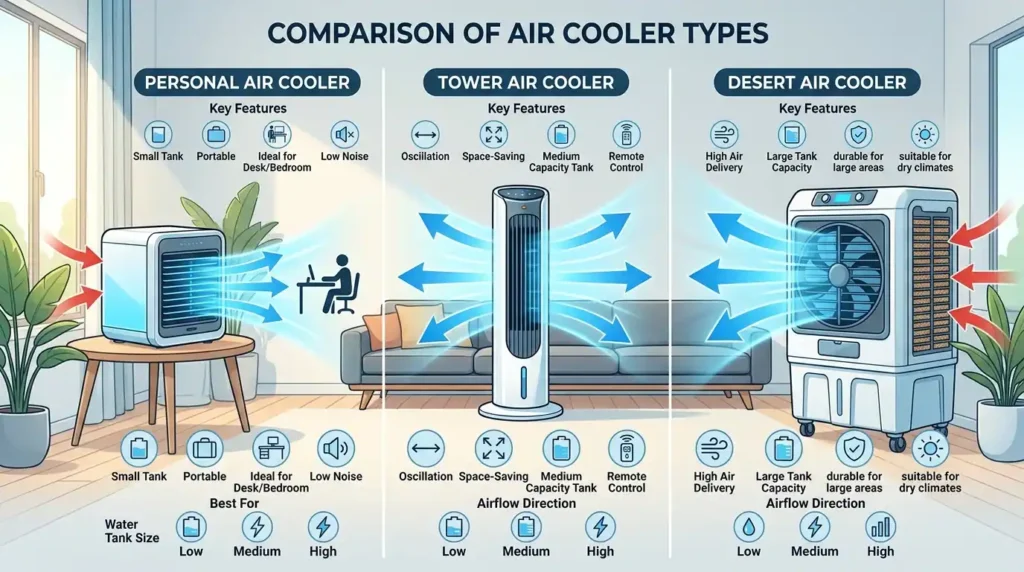
There are two main categories:
- Personal air coolers — best for bedrooms, study rooms, and home offices up to about 300 sq ft. Compact, portable, and relatively lower noise.
- Desert (or large) air coolers — built for large living rooms, dining spaces, or semi-outdoor areas up to 650 sq ft. They hold more water and deliver longer runtimes but are bulkier, louder, and less energy efficient than personal coolers.
Air Cooler Design: Regular Personal Coolers vs Tower Air Coolers
Personal coolers come in two main designs:
- Regular personal coolers — wider body, typically easier airflow distribution.
- Tower coolers — slim footprint, ideal when floor space is tight. They can be less stable when full, so check caster quality.
Comparison Table
| Model | Tank | Air Delivery | Best For |
|---|---|---|---|
| Bajaj PX97 | 36L | 1500 m³/hr | Bedrooms |
| Symphony Ice Cube | 27L | 1250 m³/hr | Small rooms |
| Hindware Frostwave | 38L | High | Long runtime |
Air Cooler Tank Capacity Guide: How Much Water Capacity Do You Need?
- 10–20 liters: Good for spot cooling (kitchen counters, study desks) and short sessions.
- ~20 liters: Minimum for a small room to run a full night without refilling.
- ~35 liters: The sweet spot for most people — balances runtime and size.
- 50–55 liters: For full-night use in larger rooms without refills, but these take up more space.
Air Cooler Cooling Efficiency: Understanding CADR, Air Delivery & Airflow
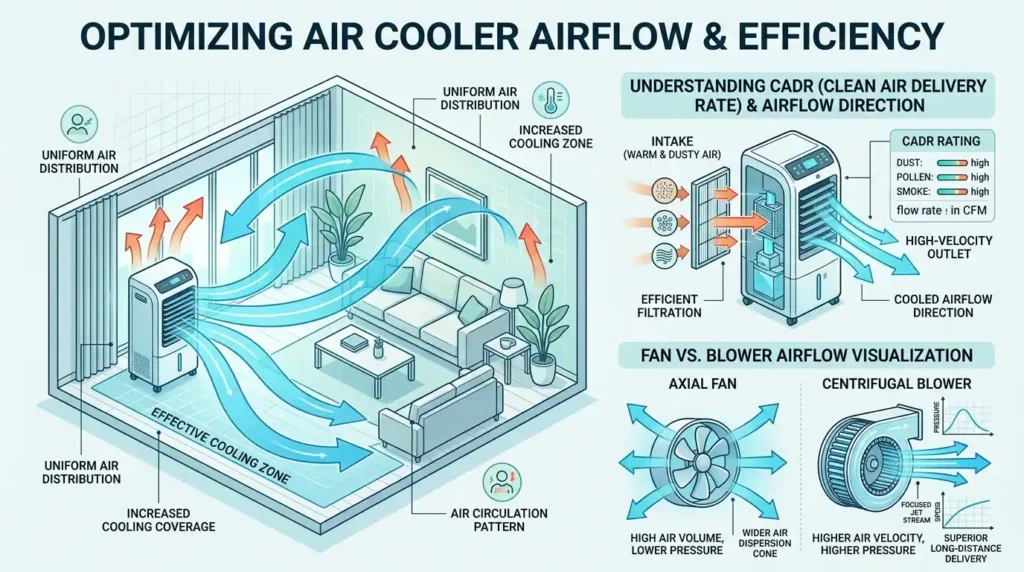
Cooling performance depends on two big things: how much cool air the unit can move and how well it distributes that air.
- CADR / Clean air delivery rate (air delivery): Higher is better. As a guideline, for a 150 sq ft room aim for air delivery around or above 1250 m³/hour.
- Fan vs blower: Fan-based coolers circulate air across the room better (recommended for full-room cooling). Blower-based coolers create a stronger directed airflow for fast, spot cooling but are noisier.
- BLDC motors: Newer BLDC air coolers are about 60% more energy efficient and make less noise than traditional motors. Good pick if you run the cooler for long hours or on an inverter.
- Power consumption: Coolers use more power than a regular fan but far less than an AC. Fan-based coolers consume less than blower-based units of similar capacity.
- Oscillation: Four-way swing (vertical and horizontal) improves distribution and cools the room faster. Vertical swing is often automatic; horizontal swing is frequently manual on many models.
Air Cooler Features to Look For: Usability, Maintenance & Hygiene
- Refilling: Check whether the unit supports an external refill pipe or has inbuilt refill ports. Some models have dedicated inlet ports for continuous water supply.
- Ice chamber: Useful but not essential — ice cubes can be added to the regular tank on most models to boost cooling briefly.
- Cooling pads: Modern coolers use honeycomb cellulose pads (longer life, 1–5 years replacement). Older aspen or woodwool pads need frequent replacement and are prone to mold.
- Filters and hygiene: Models with dust and smell filters help indoor air quality. Regular cleaning of the tank, pads, and filters prevents odor and microbial growth.
- Safety and features: Look for water level and overflow indicators, thermal overload protection, inverter compatibility, and remote control if convenience matters to you.
- Mobility and stability: Most units have castor wheels. Tower coolers can become unstable when full, so check wheel quality and overall build before buying.
Air Cooler Brands in India: Warranty, Service Network & Reliability
Most air coolers come with a one-year warranty. Some brands, like Bajaj, offer extended warranty options of one or two years. Brands with the widest and most reliable service networks include Symphony, Bajaj, Crompton, and Havells.
Air Cooler Recommendations 2026 Based on Room Size and Use
My recommendations are grouped by four main use cases: personal for up to 350 sq ft, personal for up to 200 sq ft, spot coolers, and tower coolers.
Best Personal Air Cooler for Rooms up to 350 sq ft
- Hindware Cruzo (25 L) — Compact, inverter-friendly (~100 W), runs efficiently on home inverters, and has rear nets to prevent mosquitoes entering the tank.
- Hindware Frostwave (38 L) — Larger tank, higher air delivery, slightly higher price but good for longer runtime and bigger small rooms.
- Kenstar TallDe (45 L) — Tall tower-like form factor, fits narrow spaces, long throw (good for rectangular rooms), higher capacity for extended runtime.
- Crompton Surebreeze — Solid performer in the personal cooler segment with good airflow and features.
- Bajaj Shield Series Elevate (65 L) — One of the largest personal-cooler-capacity units; runs for up to two nights without refill but needs significant floor space.
- Havells Tuono — Another reliable option in the personal category with decent delivery and build quality.
Best Personal Air Cooler for Small Rooms up to 200 sq ft
- Bajaj PX97 Torque (36 L) — 1500 m³/hr air delivery, 30 ft throw, fan-based circulation that cools evenly across medium rooms. Check Bajaj PX97 Torque New Price on Amazon
- Orient Electric Durachill (40 L) — Dense honeycomb pads that retain around 45% more water, offering longer effective cooling from the same tank.
- Symphony Ice Cube 27 L — Good mid-range option with multi-stage filtration and strong airflow for small to medium rooms.
Best Air Cooler for Spot Cooling (Single Person or Study Table)
- Bajaj Frio New — Blower-based, quick spot cooling; good for a study table or bedside. Blower units are noisier, but they cool fast.
- Symphony HiFlo 40 — Strong directional airflow for fast spot cooling with a large tank for extended runtime.
- Symphony Duet-i — Small dedicated kitchen/small-area cooler with compact tank and low noise for the category.
Best Tower Air Cooler for Apartments and Space Saving
- Symphony Diet series — Available in multiple sizes (12 L to 50 L), slim footprint, good for apartments. The Diet 3D versions add better features and remote control.
- V-Guard Arido T series — Solid tower options with good build quality and features for medium rooms.
- Crompton Optimus Neo — Popular tower cooler; comes with an ice chamber, powerful blower, and good air delivery.
- Bajaj Skive (36 L) — Good user feedback on air throw and delivery; blower-based single-direction flow makes it powerful for directional cooling.
Best Air Cooler Buying Checklist: Quick Tips Before You Choose
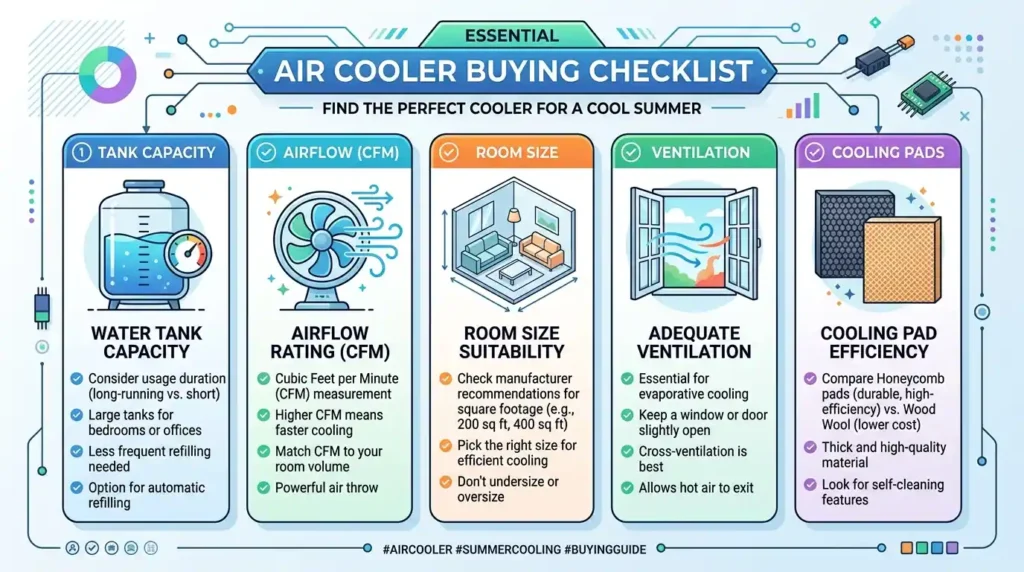
- Measure your room and pick a cooler sized for that area (use the 150–300–650 sq ft guidelines).
- Check ventilation in the room; if air cannot escape, a cooler will struggle to reduce temperature effectively.
- Consider climate: avoid coolers in high-humidity coastal regions; prefer an AC.
- Choose capacity for runtime: 20 L minimum for a night in a small room, 35 L is ideal for most, 50+ L for long runtime.
- Prefer honeycomb pads for lower maintenance and longer life.
- Opt for BLDC motor if you want better energy efficiency and lower noise.
- Check service network and warranty before you buy — it matters more than you think.
Best Air Cooler 2026: Final Thoughts and Buying Advice
Air coolers are a cost-effective, energy-efficient way to cool rooms — when used in the right conditions. Match the cooler to your room size, climate, and use-case (full-room vs spot cooling). If you focus on air delivery, tank capacity, pad type, and ventilation, you’ll avoid most common disappointments and get a cooler that performs reliably.
Make your buying decision based on room size, ventilation, and how long you want the unit to run between refills. If power and noise matter, prioritize BLDC models and fan-based circulation for full-room comfort. If you need fast directional cooling, a blower-based spot cooler will do the job.
Pick the model that fits your space and habits, and you’ll get excellent value from an air cooler in 2026.
Pricing, Affiliate, and Sponsorship Disclosure:
All prices are subject to change and may be higher or lower than prevailing market prices. We make no guarantees regarding price accuracy. This content may include affiliate links and/or sponsored placements, through which we may receive compensation. Such compensation does not impact pricing or product representation. Consumers are responsible for verifying final prices with the retailer. 😊 Check: Affiliate Disclosure Page. and check out another social media account: Click Here.