Water Purifiers Guide 2026: How to Choose the Best Water Purifiers for Your Home
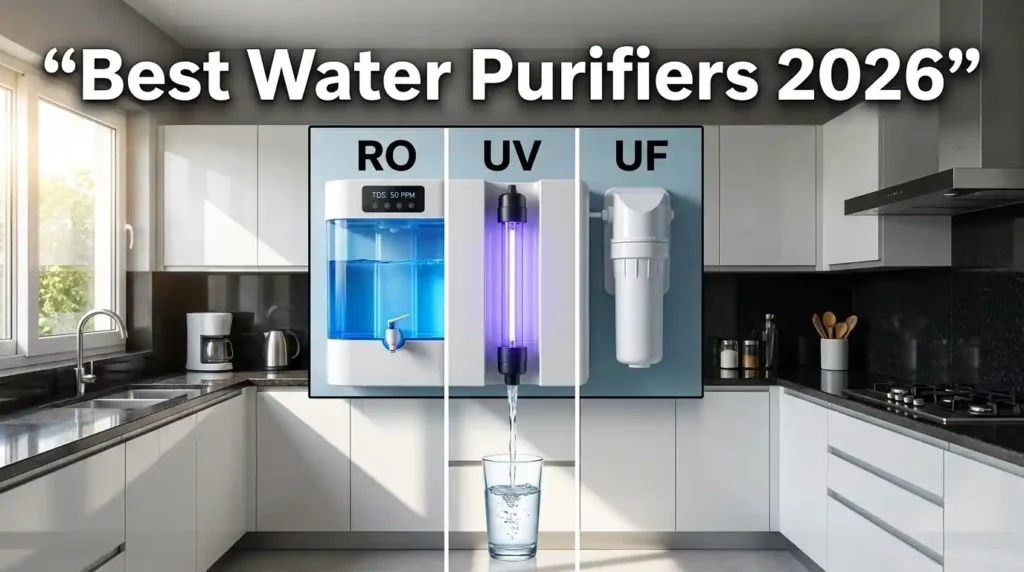
Water Purifiers buying guide 2026: Learn RO vs UV vs UF, TDS levels, and how to choose the best RO purifier for your home and budget.
Buying a water purifier should be a water-quality decision, not a marketing decision.
That is the most important thing to get right before spending on an RO water purifier. A lot of homes buy RO by default, but that can actually be the wrong choice. RO reduces TDS by almost 90%, which is great when your water really needs it. But if your input water is already low in TDS, an RO can push it too low. The result is water that tastes flat and may lack essential minerals.
So the real question is not “Which RO purifier is best?”
The real question is “Do you even need an RO purifier?”
Once that is clear, choosing the right model becomes much easier.
Start Here: The 2 Things You Need to Know Before Buying Any Water Purifier
There are two things that matter most:
- The TDS level of your water
- Whether your water has heavy metals like arsenic or lead above acceptable levels
1) Water Purifiers Explained: Check TDS Level Before Buying Water Purifiers
TDS stands for Total Dissolved Solids. You can measure this using a basic TDS meter, and these are easily available in the market.
This number is what helps decide whether UV, UF, nano, or RO makes sense for your home.
2) Water Purifiers Safety Guide: Why Testing Heavy Metals Matters in Water Purifiers
This is the part many people skip.
If your groundwater has arsenic, lead, or other heavy metals above acceptable limits, you need a purifier that can handle that, irrespective of TDS. For arsenic, anything above 10 micrograms per liter is beyond the acceptable level mentioned here.
The problem is that you generally cannot determine heavy metal contamination with the simple home meters available in the market. The most reliable option is a lab test. As a starting point, you can also refer to government water quality maps, including Central Ground Water Board data, to understand whether your area is known for heavy metal contamination.
Which water purifier is best for home?: RO vs UV vs UF vs Nano Water Purifier Explained
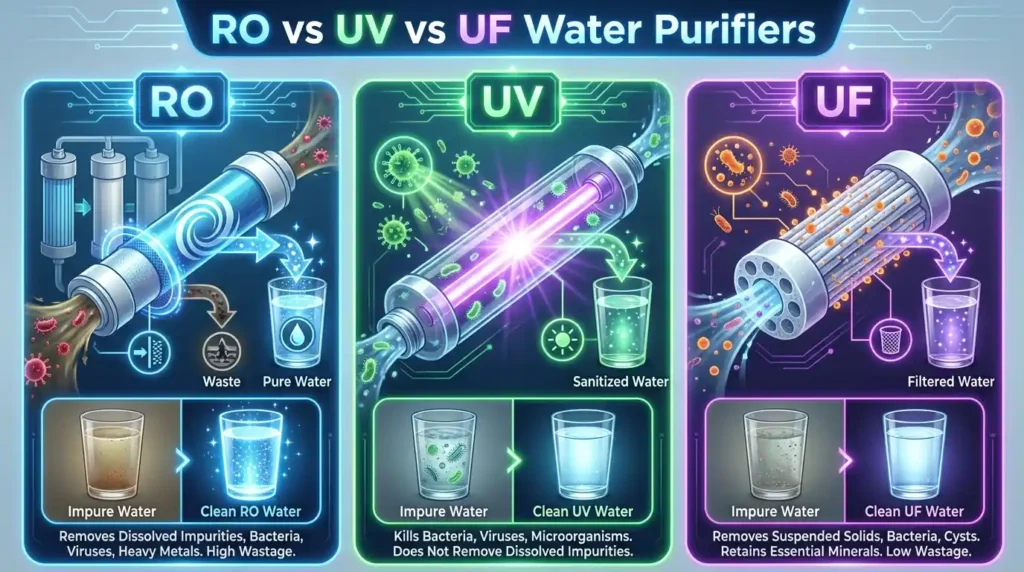
Here is the practical framework.
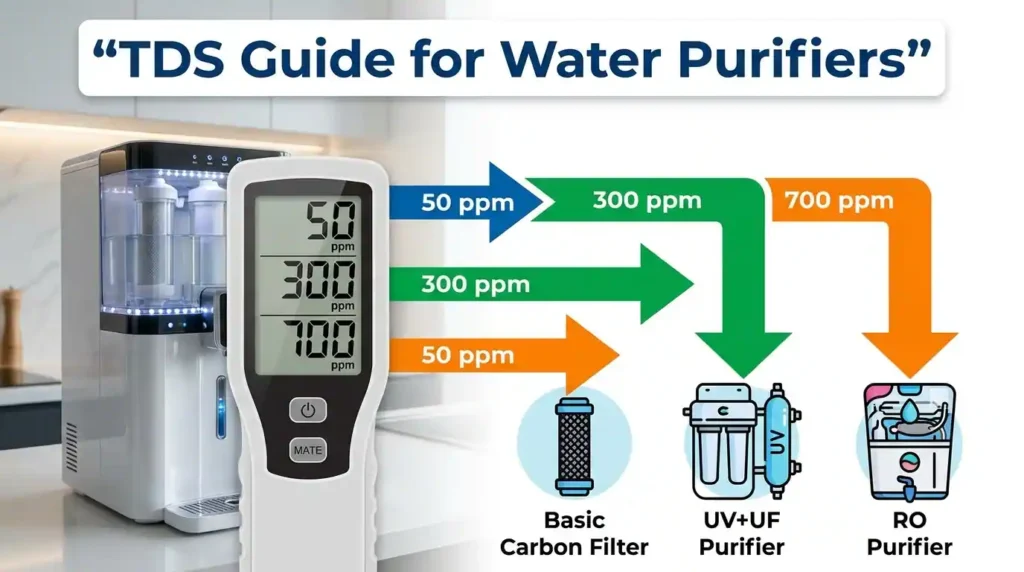
If your TDS is above 500 ppm
RO is the best choice.
At this level, RO makes the most sense because it will bring the output water into a safe and drinkable range. If your input TDS is this high, you generally do not need a TDS controller. The purified water will usually end up in the palatable range anyway, around 50 to 150 ppm.
If your TDS is between 200 and 500 ppm
This is the tricky zone. You have two sensible options:
- A nano water purifier
- An RO water purifier with TDS adjustment/control
This is also the range where many people ask: why not just buy a UV purifier?
Because UV water purifiers are generally best suited only up to around 200 to 250 ppm. Pushing them beyond the supported range does not really make sense.
If your TDS is below 200 to 250 ppm and you get municipal water
You probably do not need RO at all.
If the source is municipal water and TDS is already low, the water is typically fairly clean. In this case, a UV + UF water purifier is more than enough.
Also important: a UV+UF purifier does not reduce TDS. So if your water is already in a healthy range, it stays there.
* Want a more detailed breakdown? Read our guide to the best UV water purifiers in India for 2026, including Aquaguard, Kent, AO Smith, and other top options.
If your area has heavy metals in water
If your area is known to have arsenic, lead, or other heavy metals, then you need either a nano purifier or an RO purifier, regardless of TDS level.
Where These TDS Numbers Come From
These ranges are not arbitrary.
- BIS says drinking water is acceptable up to 500 ppm TDS
- WHO recommends an upper limit of 300 ppm for optimal health
- Packaged mineral water brands commonly keep water in a more palatable range of 50 to 150 ppm
So after filtration, a good target is to have your drinking water in that 50 to 150 ppm zone. It is both safe and pleasant to drink.
The TDS Controller Debate, Explained Simply
TDS controllers get a lot of unnecessary suspicion. Here is what they do: after RO filtration, they mix back a small amount of water to prevent the output TDS from dropping too low.
The key point is this: it is not just raw dirty source water being mixed back in. That water has already gone through at least UF filtration.
The quantity mixed back is minimal, and in many homes it is actually important because water below 50 ppm is not ideal. It can taste flat and may lack essential minerals.
So if your input TDS is in the 200 to 500 ppm range, a TDS adjuster/controller is a useful feature, not a flaw.
Water Purifiers Maintenance Guide: Cost and Filter Life of Water Purifiers in India
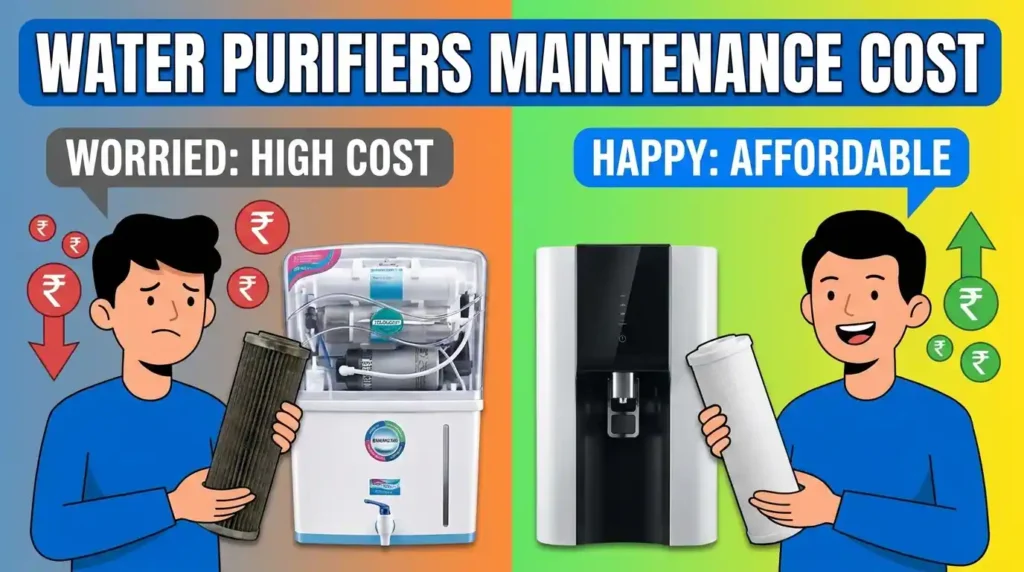
Based on water-quality mapping referenced here, RO water purifiers are suitable for roughly 60 to 70% of the country. But the most painful part of owning an RO purifier has traditionally been maintenance.
For many families, annual maintenance contracts land in the range of ₹5,000 to ₹7,000 per year, often just for filter replacement. That is where a lot of the frustration comes from. The good news is that this has started changing.
In the last couple of years, brands such as Urban Company and Atomberg started offering 2 years of unconditional filter life. Since then, more brands have joined in. Some models from Aquaguard, Livpure, Havells, and V-Guard also offer longer replacement intervals. Havells even pushes this further on select models with a 3-year or 15,000-liter filter life, whichever comes first.
Still, always read the fine print carefully.
For example, on some models the warranty period and the claimed filter life may not line up clearly after the initial ownership period. Also, some brands let you replace only the filters that actually need replacement, instead of forcing a complete set replacement every time. That can materially reduce long-term cost.
Atomberg does something especially interesting here. It uses RO only when required and relies on UV+UF at other times. If your area gets mixed water quality across the year, that can help the RO membrane last longer.
Water Purifiers Technology: Core Filtration Components in Water Purifiers
Most RO water purifiers share a similar filtration backbone. The names may vary, but these are the parts that really matter.
Sediment filter or pre-filter
This is the bouncer at the door. Its job is to stop larger particles from entering the purifier so that the expensive RO membrane does not get damaged or overworked.
Some brands include a pre-filter for free, but many do not. On several models from brands like Aquaguard, Kent, Havells, Livpure, and Pureit, the pre-filter often needs to be purchased separately.
Carbon filter
This tackles bad smell and taste in water. It is a standard inclusion in RO water purifiers.
RO membrane
This is the main event. The RO membrane filters down to extremely fine levels, around 0.0001 microns in practical RO terminology, and is the key component that removes dissolved impurities and brings TDS down.
In-tank UV sterilization
This helps keep stored water germ-free, especially when water sits in the tank for longer periods. If water often remains unused for several hours, this is a genuinely useful feature.
Water Purifiers Features: Must-Have vs Avoidable Features in Water Purifiers
TDS adjustment
If your input TDS is between 200 and 500 ppm, this is one of the most important features to have in an RO purifier. Without it, output TDS can go below 50 ppm, which is not ideal for taste or mineral retention.
Some brands skip TDS adjustment and instead add a mineralizer to compensate. That is their design choice, but the practical takeaway is simple: if there is no TDS adjuster, those purifiers are usually safer picks only for TDS above 500 ppm.
Brands mentioned here that generally skip TDS adjustment include:
- HUL
- A. O. Smith
- V-Guard
- LG
- Urban Company
Brands that generally include it on many models include:
- Havells
- Aquaguard
- Livpure
- Kent
Atomberg is the interesting outlier because it uses adaptive filtration instead of a conventional TDS controller. It adjusts RO usage based on input water quality.
Nano filters
Nano purifiers are still a smaller category, but they are especially useful in the 200 to 500 ppm range.
That is the zone where:
- UV is not enough
- RO may over-purify unless it has proper TDS control
Nano filters can also help remove lead and arsenic, making them relevant in areas with heavy metal concerns.
UF or microfiltration
If a purifier uses a TDS controller, then having a UF module becomes important.
Why? Because the TDS controller blends some filtered water back into the purified stream. If that blended water has already been through UF, you get the benefit of mineral balancing without compromising hygiene. That is why models with TDS controllers but without UF are best avoided. Some Havells and Livpure models fall into that category, and I would skip those.
Mineralizer and alkaline modules
These are optional. RO strips dissolved minerals and can slightly alter pH. Mineralizer and alkaline modules try to compensate for that. They are not necessarily bad, but they are not make-or-break features either. In most homes, a good diet can cover the mineral gap.
Copper module
Copper modules come with health claims, but there is one practical issue: they can change the taste of water. If you are particular about taste, you may want to avoid copper models entirely.
Water Purifiers Storage Guide: Choosing the Right Tank Size in Water Purifiers
The right tank size depends on two things:
- Family size
- Power-cut frequency
If power cuts are rare, a smaller tank is usually enough because the purifier can refill regularly. If you have a larger family or frequent power cuts, a bigger tank makes more sense.
Build Quality: Plastic vs Stainless Steel Water Purifiers
Most water purifiers use food-grade plastic tanks, and that is considered perfectly safe.
But if you prefer stainless steel, there are a few options. Stainless steel tanks are generally more expensive, and on some hot-water models only the hot water tank is stainless steel while the ambient tank remains plastic. If you specifically want both to be stainless steel, look carefully for dual stainless steel tank wording.
Smart Features: Hot Water, App Control & More in Water Purifiers
Hot water dispensing
If you want hot water up to around 80°C, only selected models offer it. These typically use stainless steel hot-water tanks, which is a nice touch.
Touch dispensing
Touch controls look sleek, but there is a catch. No electricity can mean no water dispensing. So if your area has unreliable power and you do not have backup, manual dispensing is safer. One exception mentioned here is the Urban Company M2 Pro, which includes an inbuilt battery for dispensing water during outages.
App connectivity
App support is useful for monitoring things like:
- TDS levels
- Filter life
- Usage data
Models from Urban Company, Atomberg Intellon, and some Aquaguard purifiers include this. It is genuinely helpful if you want maintenance reminders and more transparency.
Water Purifiers Truth: Are Zero Water Wastage Water Purifiers Real?
Take these with a pinch of salt. RO purification, by nature, wastes some water. Brands like Kent and Aquaguard market zero water wastage technology, but in practice this often requires recirculating reject water back to an overhead tank through the right plumbing setup.
Unless your home is already configured for that, this claim is usually more marketing than everyday reality. I would not make a purchase decision based on this alone.
Water Purifiers Service Guide: Warranty and Service Network for Water Purifiers
Because RO purifiers need periodic servicing, the service network matters a lot. Traditional brands like Kent, Aquaguard, Pureit, and A. O. Smith generally still lead on service reach.
Newer brands like Atomberg and Urban Company are doing well where they operate, but service availability can still vary by location.
Warranty is another point of separation:
- Many brands offer 1 year standard warranty
- Some stainless steel tank models get extra tank warranty
- Urban Company, Atomberg, some Havells, Livpure, V-Guard, and newer Aquaguard models offer 2 years on select products
- Some Livpure models even go up to 2.5 years
Best RO Water Purifiers in 2026: My Recommendations
Now that the framework is clear, here are the models that stand out in different use cases.
Top Water Purifiers for Low Maintenance Cost
This is the segment I would prioritize first for most homes because long-term cost matters more than people expect. These models cost more upfront, but save money because filter replacement is less frequent.
1) Atomberg Intellon RO Water Purifier
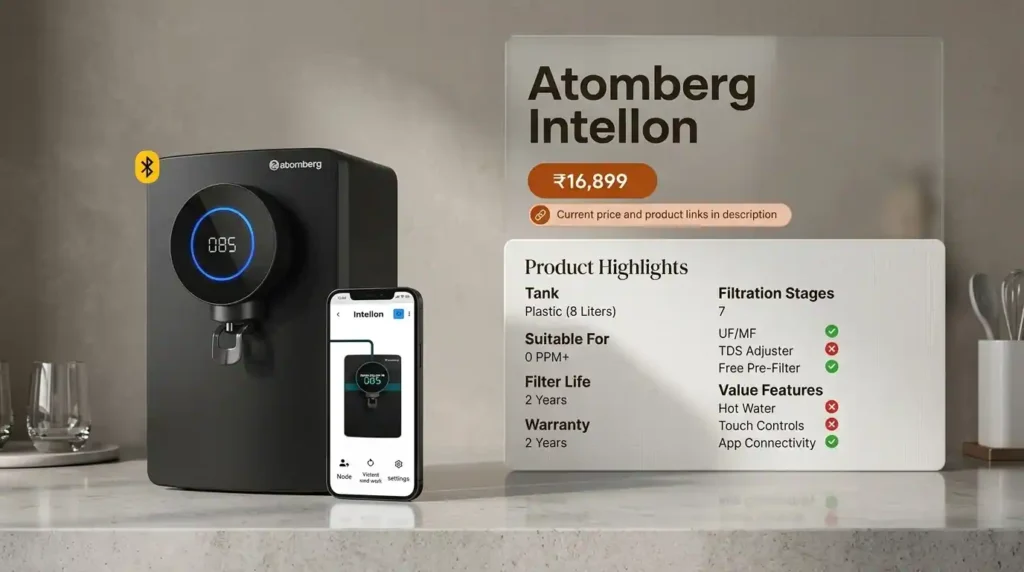
Best for: Homes with mixed water sources such as corporation water, groundwater, or tanker water. This is one of the most interesting purifiers in the market because of its adaptive filtration.
It can decide when to use RO and when not to. If the water is already clean and low in TDS, it can bypass the RO membrane. If the water is hard, it uses RO. You can also set it to use RO all the time or not use RO at all, depending on your preference. That makes it especially useful in homes where water quality changes seasonally or by source.
Pros
- Adaptive filtration is genuinely useful
- 2-year filter life
- Potentially lower membrane wear over time
- Good fit for mixed water quality
Cons
- Service network is still relatively new
- Replacement filters cost around ₹4,000 per cycle
2) Native by Urban Company M2 Pro
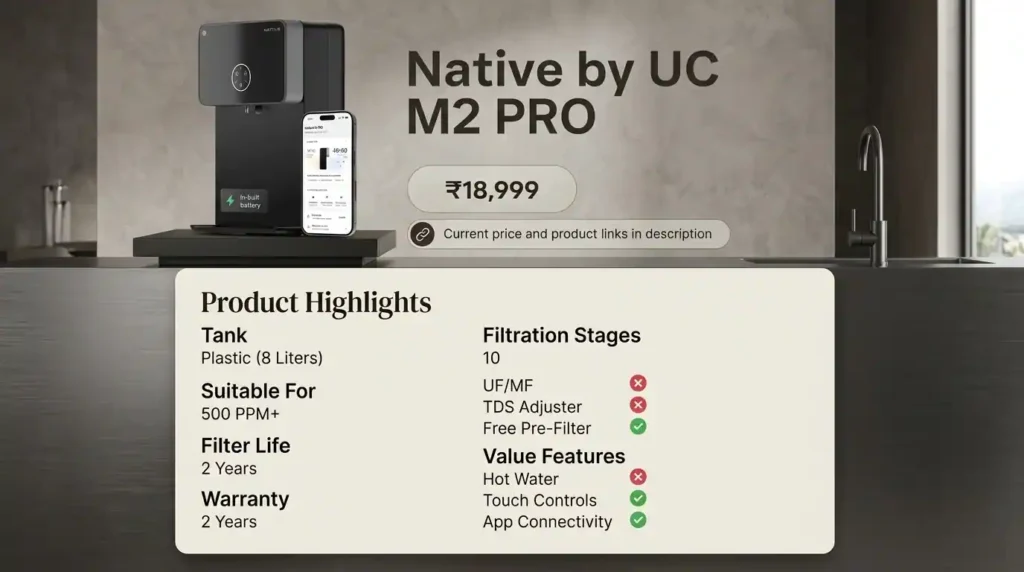
Best for: High-TDS areas above 500 ppm, especially where power cuts are common.
This one stands out for practical usability. Since it uses touch-based dispensing, Urban Company added an inbuilt power backup so you can still dispense water during outages. That solves a very real problem with touch-based purifiers. It also offers a 2-year unconditional warranty.
Important limitation: it does not have a TDS adjuster. So this is suitable only for areas with TDS above 500 ppm. Below that, the output TDS may drop under 50 ppm, which is not ideal.
If budget is tighter, the Native M0 RO is the more affordable option. It is more compact, has a 5-liter tank, fewer filtration stages, manual dispensing, and no app support.
3) Aquaguard Delight Aquasaver
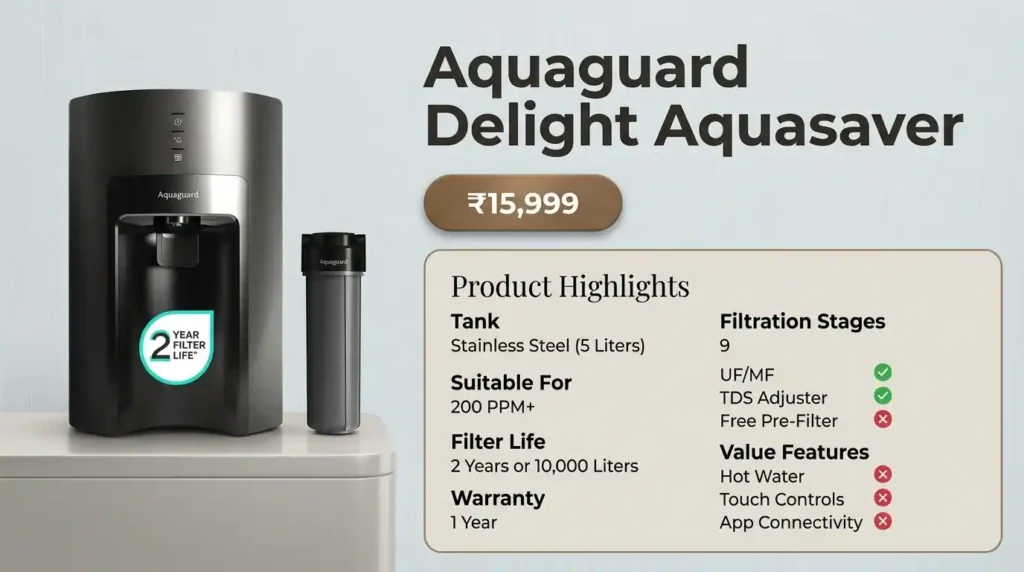
Best for: Anyone who wants a stainless steel tank plus lower maintenance frequency.
The standout feature here is the stainless steel tank. It also offers a 2-year or 10,000-liter filter life.
Aquaguard generally does not include a free pre-filter, so that may need to be purchased separately if required. This model does include a larger sediment filter that helps catch coarse particles before they hit the expensive filters.
Pros
- Stainless steel storage tank
- 2-year filter life
- Strong mainstream brand support
Cons
- No app support for monitoring usage or filter life
- The “Aquasaver”/water-saving messaging should not be overvalued
4) Livpure Glo Star Copper
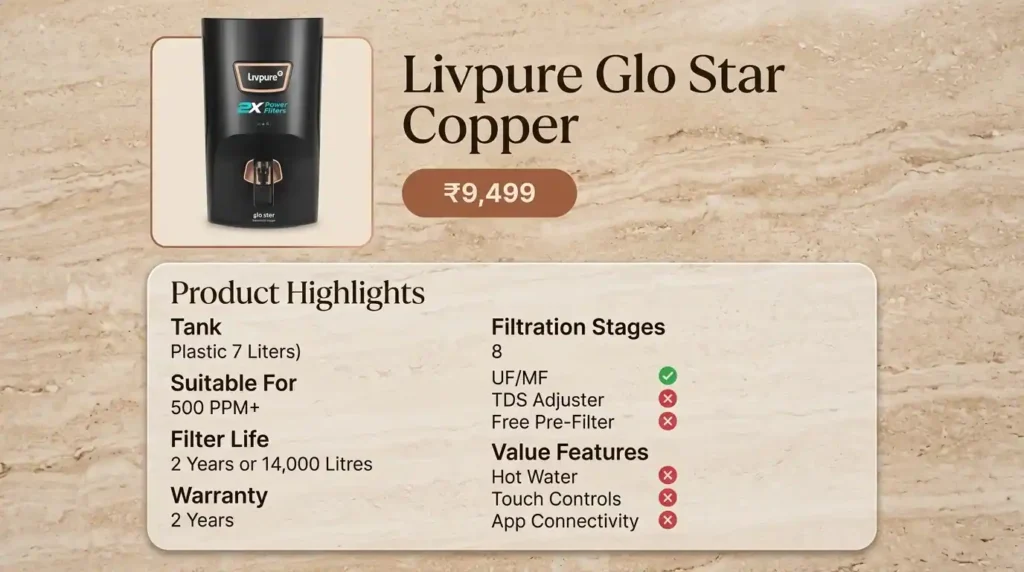
Best for: Lower upfront budget with long filter life. At under ₹10,000, this is one of the more affordable ways to get a purifier with a 2-year or 14,000-liter filter life. That can save a meaningful amount on AMC costs over time. It comes with a 7-liter tank and 8-stage purification, which is enough for a mid-sized family.
Trade-offs
- Average build quality
- Customer service is not the strongest
- Copper module may affect taste for some people
Affordable Water Purifiers Under ₹10,000
If you are shopping under ₹10,000, compromises are unavoidable. Usually it will be on build quality, filter life, or both.
1) V-Guard Zenora RO Water Purifier
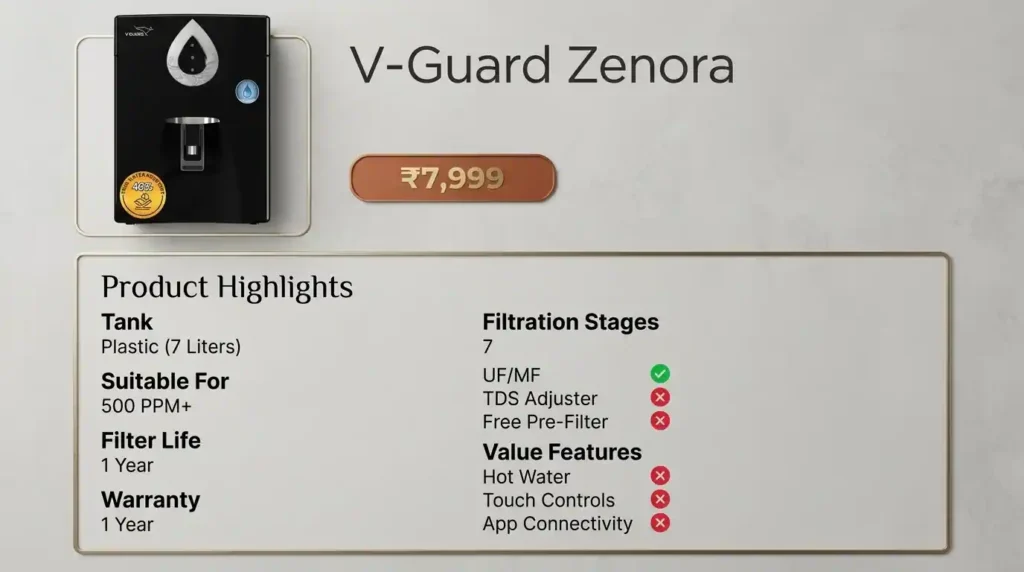
Best budget pick overall. This is a 7-liter purifier with 7-stage filtration and support for input TDS up to 2,000 ppm.
The main thing missing at this price is the 2-year filter life, so long-term running cost will be higher. It also skips the UV stage, which is acceptable here because RO is already doing the heavy lifting. For the price, it covers the essentials well.
2) MarQ by Flipkart Innopure Crux
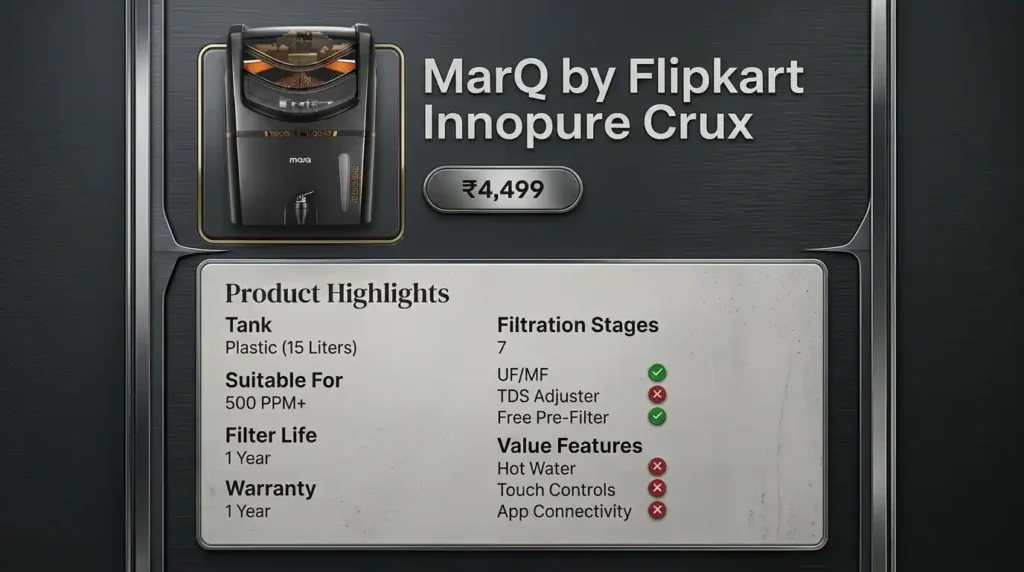
Best for: Lowest-price buyers who want large storage.
MarQ has launched aggressively priced water purifiers, and this one comes in at under ₹5,000. It also has a massive 15-liter capacity, which is especially useful in homes with irregular electricity or water supply. It even includes a pre-filter in the box, which is impressive at this price.
But the compromises are obvious:
- Service issues can be common
- Build quality feels flimsy and dated
Still, if price is the top priority, it is hard to ignore.
Best Stainless Steel Water Purifiers with Steel Tank
If you strongly prefer stainless steel storage, these are the models worth considering.
1) Aquaguard Delight Aquasaver
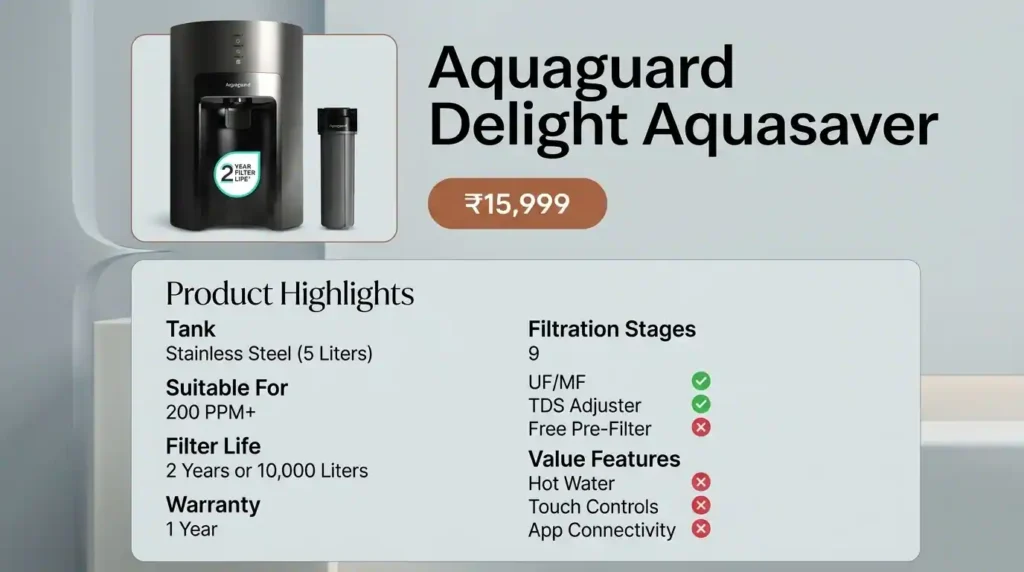
If you do not need hot water, this remains the strongest option in this segment because it gives you:
- Stainless steel tank
- 2-year filter life
- Lower long-term maintenance burden
2) LG WW156RTTB
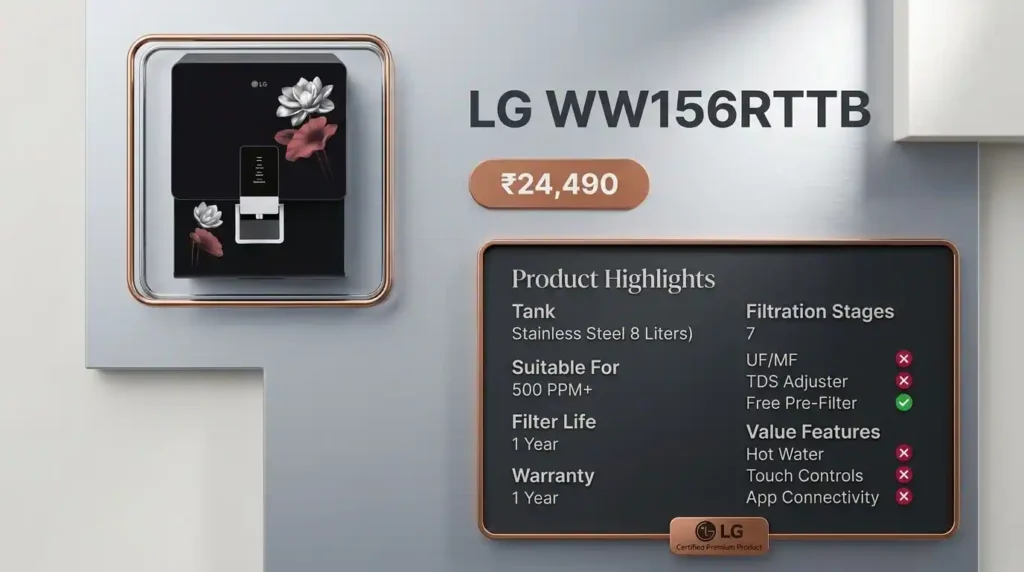
Best for: Mid-size to large families that want a larger stainless steel tank.
This purifier comes with an 8-liter stainless steel tank and in-tank UV LED sterilization that runs for 75 minutes every 6 hours. That is a useful feature if you travel often or leave water sitting in the tank for long periods.
Limitations
- Only 1-year filter life
- No TDS adjuster
- No UF filter
That means it is best used only in areas with TDS above 500 ppm.
3) Aquaguard Blaze Insta Hot & Ambient
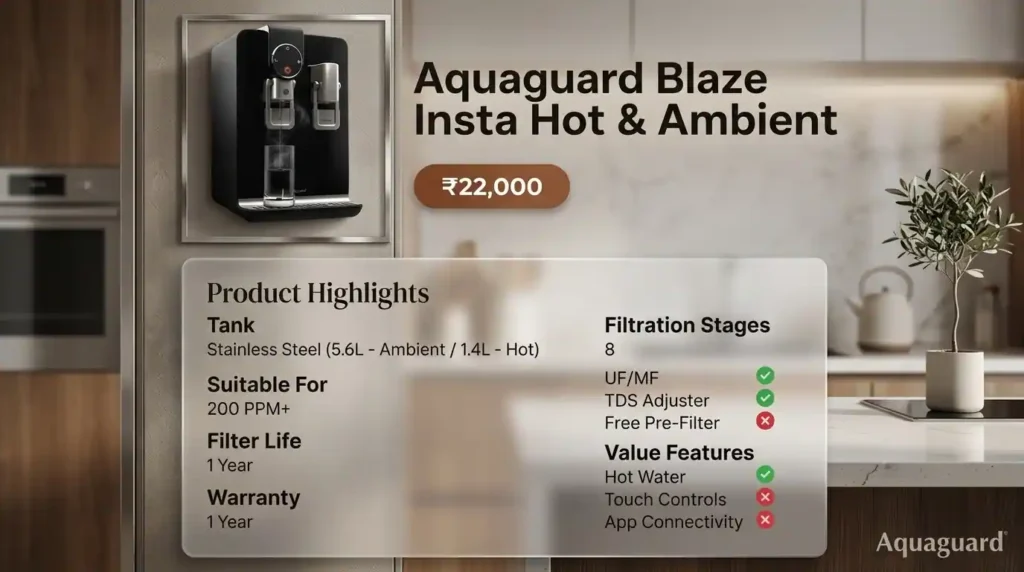
Best for: People who want hot water and dual stainless steel tanks.
This is one of the rare options with dual stainless steel tanks, meaning both hot water and ambient water are stored in stainless steel.That helps avoid algae growth concerns and avoids any worry about plastic interacting with hot water.
Trade-offs
- Only 1-year filter life
- Higher upfront and running cost
- Total 7-liter storage is split between hot and ambient water, so effective capacity feels lower
4) A.O. Smith Z9 Pro
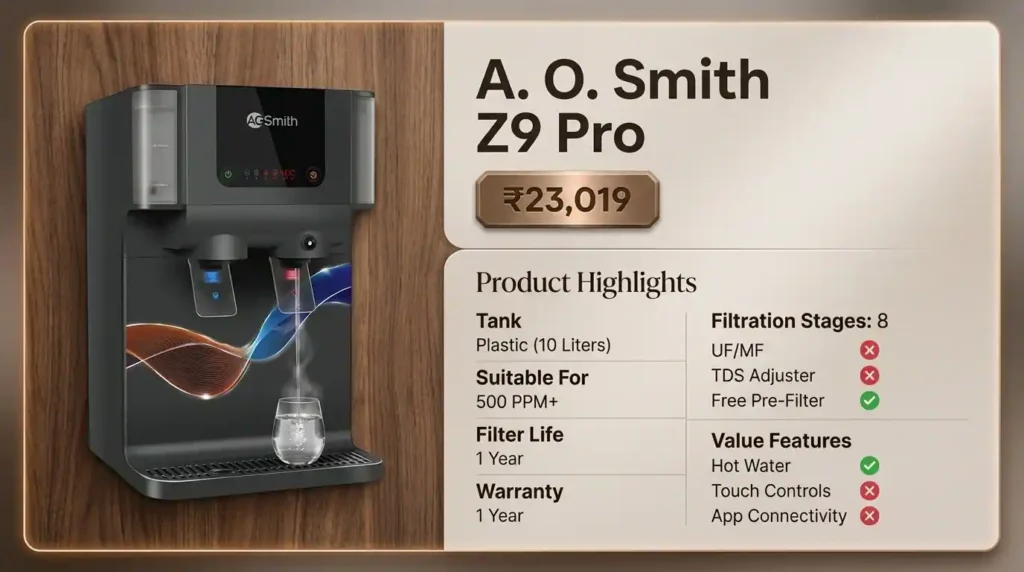
Best for: Larger families that want hot water and bigger capacity.
The Z9 Pro has a 10-liter tank, which makes it suitable for larger households. But there is one detail to be careful about: in this model, only the hot water tank is stainless steel. The ambient storage tank is still food-grade plastic.
It also does not have a TDS adjuster, so again, this is better suited for areas with TDS above 500 ppm. Filter life is just 1 year, so ongoing cost is higher.
Hidden Water Purifiers for Modern Kitchens
If you want to hide the purifier under your kitchen counter, these are the better options. Before buying one, make sure you already have:
- An extra plug point under the counter
- A water inlet under the counter
- A hole drilled in the countertop for the output tap
1) A. O. Smith Z2+ RO Water Purifier
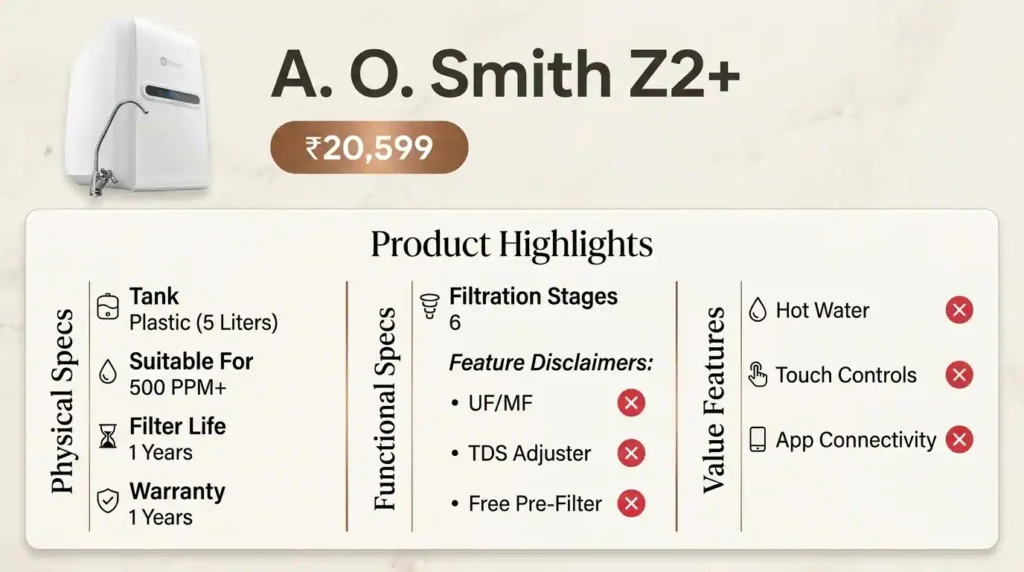
Best under-the-counter pick for high-TDS areas
A. O. Smith uses MIN-TECH technology here, which helps remineralize the water to improve taste and balance. The purifier has a 5-liter tank, which is good for mid-sized families or homes without long power cuts.
There is also a Z2+ Luxe version with a fancier design, though that matters less when the unit sits hidden under the counter.
Important: like other A. O. Smith models, it does not include a TDS adjuster. So use it only in areas with TDS above 500 ppm.
2) Aquaguard Designo NXT
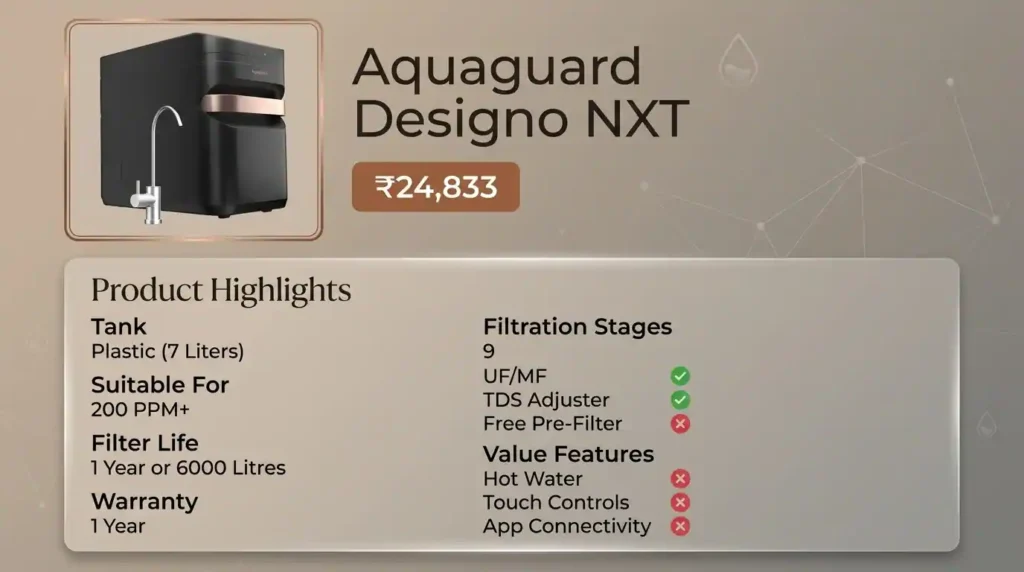
Best under-the-counter pick for 200 to 500 ppm TDS range
This is a 9-stage under-the-counter purifier with a 7-liter tank. Aquaguard models generally include both a TDS adjuster and a UF filter, which makes them usable in the 200 to 500 ppm TDS range as well.
The downside is that filter life is only 1 year, so maintenance cost will be higher than the longer-life models discussed earlier.
Quick Checklist to Choose the Right Water Purifiers
- TDS below 200 to 250 ppm + municipal water: Buy a UV+UF purifier, not RO
- TDS between 200 and 500 ppm: Buy a nano purifier or RO with TDS adjustment
- TDS above 500 ppm: Buy an RO purifier
- Heavy metals present: Buy nano or RO irrespective of TDS
Final Verdict on Water Purifiers for Every Home in 2026
If you want the most sensible long-term buy for most homes, I would strongly prioritize the segment with longer filter life. That is where the real value is.
Among them:
- Atomberg Intellon is the most interesting and flexible choice for mixed water quality
- Urban Company M2 Pro is a strong pick for high-TDS homes, especially with power cuts
- Aquaguard Delight Aquasaver is excellent if you want a stainless steel tank and lower maintenance frequency
- Livpure Glo Star Copper is a decent value pick if budget matters more than refinement
If your budget is tight, the V-Guard Zenora is the cleaner budget recommendation, while the MarQ Innopure Crux is the absolute price play if you are comfortable with compromises.
And above all, do not buy RO just because it sounds premium. Buy it only if your water quality actually calls for it. That one decision will save you money, avoid unnecessary maintenance, and get you better drinking water at home.
Pricing, Affiliate, and Sponsorship Disclosure:
All prices are subject to change and may be higher or lower than prevailing market prices. We make no guarantees regarding price accuracy. This content may include affiliate links and/or sponsored placements, through which we may receive compensation. Such compensation does not impact pricing or product representation. Consumers are responsible for verifying final prices with the retailer. 😊 Check: Affiliate Disclosure Page. and check out another social media account: Click Here.