
AC Tonnage Calculator India: Find the Right AC Size
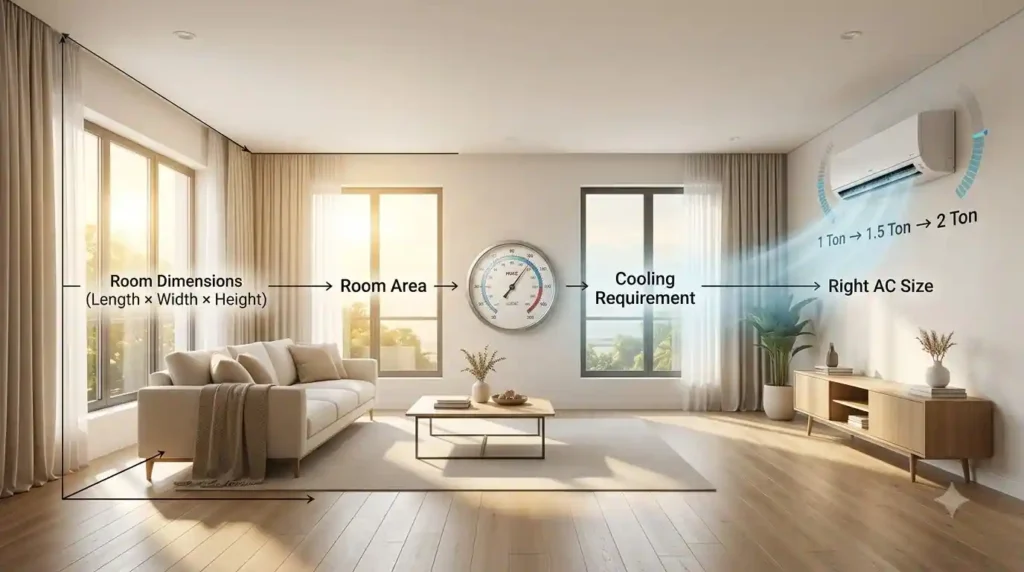
Use our AC Tonnage Calculator to find the right AC size for your room. Calculate AC capacity using room area, climate, sunlight, floor, ceiling height and occupants.
Choosing the right AC size is important for efficient cooling, comfort and electricity consumption. Our AC Tonnage Calculator estimates the suitable AC capacity based on your room size, ceiling height, climate, sunlight, floor level, occupants and other heat-load factors.
AC Tonnage Calculator
Estimate the right AC capacity for your room using size, climate, sunlight, floor, occupants, insulation and heat-producing appliances.
Enter your room details and get an estimated AC capacity based on room size and other important cooling-load factors.
Important: This calculator provides an indicative residential estimate. Actual AC sizing can vary depending on building construction, insulation, roof, windows, orientation, ventilation, local climate, and the specific AC model.
Find the Right AC After Calculating Your Tonnage
Once you know the approximate AC capacity required for your room, the next step is comparing actual AC models.
Read our Best Air Conditioners in India 2026 buying guide to compare AC options, cooling performance, efficiency, and important buying factors.
How to Use the AC Tonnage Calculator
Using the calculator is simple. Enter the details of the room where you plan to install the AC.
1. Enter Room Size
Enter your room length and width in feet.
For example:
- Length: 12 feet
- Width: 14 feet
Room area:
12 × 14 = 168 sq. ft.
If you already know your room’s total floor area, you can enter the square footage directly.
2. Select Ceiling Height
Ceiling height affects the volume of air inside a room. A room with a higher ceiling may require more cooling than a room with the same floor area and a standard ceiling.
3. Select Your Climate
Choose the climate that best matches your location. Hotter outdoor conditions can increase the cooling requirement because the AC has to remove more heat from the room.
4. Select Sunlight Exposure
Direct sunlight can increase heat entering the room. Large windows and strong afternoon or west-facing sunlight can be particularly important during hot weather.
5. Select Floor Level
Top-floor rooms can receive additional heat from the roof. A well-insulated roof can reduce this effect, while an exposed roof can increase the cooling requirement.
6. Enter Number of Occupants
People inside a room release heat. A room regularly occupied by several people may therefore require more cooling than a similarly sized room with fewer occupants.
7. Select Window and Glass Area
Large windows and glass doors can allow additional solar heat into a room. Select the option that best represents your room.
8. Select Insulation
Good insulation helps reduce heat transfer from outside to inside. Poor insulation can increase the cooling requirement.
9. Select Room Usage
Choose whether the AC will be used in a bedroom, living room, home office, kitchen, or open-plan living/kitchen area.
Different room types can have different heat loads.
What Is AC Tonnage?
AC tonnage refers to the cooling capacity of an air conditioner, not its physical weight.
One ton of cooling capacity is approximately equal to 12,000 BTU per hour.
| AC Capacity | Approx. Cooling Capacity |
|---|---|
| 0.8 Ton | 9,600 BTU/h |
| 1 Ton | 12,000 BTU/h |
| 1.2 Ton | 14,400 BTU/h |
| 1.5 Ton | 18,000 BTU/h |
| 2 Ton | 24,000 BTU/h |
| 2.5 Ton | 30,000 BTU/h |
| 3 Ton | 36,000 BTU/h |
When comparing actual AC models, always check the manufacturer’s rated cooling capacity rather than relying only on the tonnage printed in the product name.
For additional room-air-conditioner guidance, see ENERGY STAR’s room air conditioner resources.
How Much AC Tonnage Do You Need for Your Room?
Room size is one of the most important factors when choosing AC capacity, but it is not the only factor.
As a general starting point:
| Room Size | Typical AC Capacity |
|---|---|
| Up to 90 sq. ft. | 0.8–1 Ton |
| 90–120 sq. ft. | Around 1 Ton |
| 120–150 sq. ft. | Around 1–1.2 Ton |
| 150–180 sq. ft. | Around 1.5 Ton |
| 180–240 sq. ft. | Around 1.8–2 Ton |
| 240–300 sq. ft. | Around 2–2.5 Ton |
These are general starting ranges, not fixed rules.
A 160 sq. ft. middle-floor room with good insulation can have a very different cooling requirement from a 160 sq. ft. top-floor room with an exposed roof and strong afternoon sunlight.
That is why a multi-factor AC sizing calculator can be more useful than relying only on a simple square-foot chart.
1 Ton AC: What Room Size Is Suitable?
A 1-ton AC is generally considered for smaller rooms, but the appropriate room size depends on climate, insulation, and heat load.
A small bedroom, study, or similar room with moderate heat gain may be suitable for a 1-ton AC.
If your calculator result falls around the 1-ton category, read our Best 1 Ton AC in India 2026 guide before choosing a model.
1.5 Ton AC: What Room Size Is Suitable?
A 1.5-ton AC is a common choice for medium-sized bedrooms and rooms.
As a broad starting point, rooms around 150–180 sq. ft. may fall into the 1.5-ton category under typical conditions.
However, room size alone should not determine the final choice.
If your calculator recommends around 1.5 tons, compare available models in our Best Air Conditioners in India 2026 buying guide.
For a real-world example, read our Cruise 1.6 Ton 3 Star Split AC review.
2 Ton AC: What Room Size Is Suitable?
A 2-ton AC is generally considered for larger rooms or spaces with a higher cooling load.
As a starting range, approximately 180–240 sq. ft. can fall around the 2-ton category depending on room conditions.
However, actual AC models sold as 2-ton units can have different rated cooling capacities. This is why checking the actual cooling-capacity specification is important.
For a detailed comparison, read our Best 2 Ton AC in India 2026 buying guide.
2.5 Ton and 3 Ton AC
Rooms above approximately 240–300 sq. ft. may require higher cooling capacity.
However, one very large AC is not always the best solution.
For very large rooms, long rooms, open-plan spaces, or commercial areas, multiple AC units may provide more uniform cooling than one oversized system.
For unusual layouts, professional HVAC heat-load assessment is recommended.
Why Room Size Alone Is Not Enough
Two rooms can have exactly the same floor area but very different cooling requirements.
Room A
- 180 sq. ft.
- Middle floor
- Good insulation
- Small windows
- Limited sunlight
- Two occupants
Room B
- 180 sq. ft.
- Top floor
- Exposed roof
- Large west-facing windows
- Poor insulation
- Four occupants
Although both rooms have the same floor area, Room B can have a higher cooling requirement.
This is why our calculator considers multiple factors instead of using room size alone.
Factors That Affect AC Tonnage
Room Size
Larger rooms generally require greater cooling capacity because there is more space and air volume to cool.
Ceiling Height
Higher ceilings increase the volume of air inside the room.
Outdoor Temperature
Hotter outdoor conditions increase the amount of heat the AC needs to remove.
Sunlight Exposure
Direct solar heat through windows and walls can increase cooling requirements.
Floor Level
Top-floor rooms can receive additional heat through the roof.
Number of People
People produce heat, so a room occupied by several people can require more cooling.
Windows and Glass
Large windows and glass doors can increase solar heat gain.
Insulation
Good insulation helps reduce heat transfer through walls and roofs.
Appliances and Electronics
TVs, computers, gaming systems, lighting, and other devices can add heat.
Kitchen Heat
Cooking can produce substantial heat, so kitchens and open-plan spaces connected to kitchens may require additional consideration.
AC Tonnage vs BTU
BTU means British Thermal Unit and is commonly used to describe cooling capacity.
Approximate conversions include:
- 1 Ton = 12,000 BTU/h
- 1.5 Ton = 18,000 BTU/h
- 2 Ton = 24,000 BTU/h
- 2.5 Ton = 30,000 BTU/h
- 3 Ton = 36,000 BTU/h
These are nominal conversions. Actual AC models should always be compared using their manufacturer-provided specifications.
For general information about air-conditioning energy use, see the U.S. Department of Energy air-conditioning guide.
Is a Bigger AC Always Better?
No.
Buying a significantly oversized AC is not automatically better.
An oversized system may cool the room quickly, but depending on the system and room conditions, it may not run long enough to provide ideal comfort and humidity control.
An undersized AC may run for long periods and struggle to maintain the desired temperature during peak summer.
The goal is to select an appropriate cooling capacity for your actual room conditions.
What Happens If You Buy an Undersized AC?
If an AC is too small for the room, you may experience:
- Longer cooling times
- Longer operating periods
- Difficulty maintaining the desired temperature
- Reduced comfort during peak summer
- Potentially higher electricity use due to longer operation
What Happens If You Buy an Oversized AC?
An AC significantly larger than necessary may have disadvantages such as:
- Higher upfront cost
- More cooling capacity than required
- Shorter operating cycles in some conditions
- Potentially poorer humidity control
- Higher purchase cost
3-Star vs 5-Star AC: Which One Should You Buy?
AC tonnage and energy efficiency are two different things.
Tonnage relates to cooling capacity, while the energy-efficiency rating helps indicate how efficiently an appliance operates.
If you use your AC for many hours every day, efficiency becomes particularly important.
For India-specific energy-efficiency information, refer to the Bureau of Energy Efficiency (BEE).
For a detailed explanation of AC star ratings, ISEER, and electricity costs, read our 3-Star vs 5-Star AC comparison.
Inverter AC vs Fixed-Speed AC
Inverter ACs can vary compressor operation according to cooling demand.
When comparing models, consider:
- Cooling capacity
- Energy efficiency
- Daily usage
- Room size
- Climate
- Warranty
- Noise
- Installation
- Service availability
- Manufacturer specifications
If you’re considering premium inverter features, read our Samsung WindFree Pro vs Standard AC comparison.
How Accurate Is This AC Tonnage Calculator?
The RatingSage AC Tonnage Calculator is designed as a practical residential sizing estimator.
It considers:
- Room area
- Ceiling height
- Climate
- Sunlight exposure
- Floor level
- Windows
- Insulation
- Occupants
- Electronics
- Room usage
However, it is not a professional HVAC heat-load calculation.
Actual requirements can vary depending on:
- Wall construction
- Roof material
- Building orientation
- Air leakage
- Ventilation
- Windows and glazing
- Doors
- Adjacent rooms
- Local peak temperature
- Building insulation
- AC model characteristics
For large rooms, open-plan spaces, commercial applications, or unusual layouts, consult a qualified HVAC professional.
AC Tonnage Calculator vs Simple Room-Size Chart
A simple room-size chart considers mainly floor area.
A multi-factor calculator can consider additional room conditions.
| Factor | Simple Chart | RatingSage Calculator |
|---|---|---|
| Room size | ✓ | ✓ |
| Ceiling height | — | ✓ |
| Climate | — | ✓ |
| Sunlight | — | ✓ |
| Floor level | — | ✓ |
| Occupants | — | ✓ |
| Windows | — | ✓ |
| Insulation | — | ✓ |
| Appliances | — | ✓ |
| Room usage | — | ✓ |
Calculate Your AC Electricity Cost
Knowing your AC’s required tonnage is only the first step.
The next question is usually: How much will the AC cost to run?
AC tonnage tells you about cooling capacity. Electricity consumption depends on factors such as:
- Rated power input
- AC efficiency
- Daily usage hours
- Electricity tariff
- Outdoor temperature
- Thermostat setting
- Room insulation
- Usage pattern
Once you know the required AC capacity, use our Appliance Electricity Cost Calculator to estimate your electricity expenses.
Frequently Asked Questions
How do I calculate AC tonnage for my room?
Start with room area and then consider ceiling height, climate, sunlight, floor level, windows, insulation, occupants, and heat-producing appliances. The RatingSage calculator combines these factors to provide an estimated AC capacity.
How much room can a 1-ton AC cool?
A 1-ton AC is generally considered for smaller rooms, but there is no single room-size rule that works for every location. Climate, sunlight, insulation, and heat load can change the required capacity.
What room size is suitable for a 1.5-ton AC?
A 1.5-ton AC may be suitable for a room around 150–180 sq. ft. under typical conditions. The actual requirement can change based on sunlight, floor level, insulation, climate, and occupancy.
What room size needs a 2-ton AC?
A 2-ton AC may be considered for rooms around 180–240 sq. ft., depending on the heat load and room conditions.
Can I choose AC tonnage based only on room size?
No. Room size is important, but climate, sunlight, ceiling height, insulation, floor level, windows, occupants, and appliances can all affect cooling requirements.
Does a top-floor room need a higher-capacity AC?
It can. A top-floor room with an exposed roof can receive additional heat, increasing the cooling requirement.
Does direct sunlight affect AC size?
Yes. Direct sunlight can increase heat entering a room, particularly through large windows.
Is a bigger AC better?
Not necessarily. An oversized AC may cost more and may not provide the best comfort or humidity control.
Is a 5-star AC always better than a 3-star AC?
Not automatically. A higher efficiency rating can be useful for heavy AC usage, but the best choice depends on purchase price, expected usage, electricity costs, and actual efficiency.
Should I buy a 1-ton or 1.5-ton AC?
It depends on the room’s cooling requirement. Instead of relying only on room size, enter your room details into the calculator.
Can this calculator be used for a living room?
Yes. Select living room or hall as the room type and enter the room dimensions, occupants, sunlight, windows, and other conditions.
Can I use this calculator for a kitchen?
Yes, but kitchens can have complex heat loads. Professional assessment is preferable for ACs installed directly in kitchens or large open-plan spaces connected to cooking areas.
Final AC Buying Tip
Don’t choose AC tonnage based only on a salesperson’s recommendation or a basic room-size chart.
First estimate the required cooling capacity based on your room’s actual conditions.
Then compare:
- Cooling capacity
- Energy efficiency
- ISEER
- Annual electricity consumption
- Warranty
- Installation requirements
- Noise
- Service support
- Actual model specifications
Once you know the required capacity, compare suitable ACs using our Best Air Conditioners in India 2026 guide.
After that, use the Appliance Electricity Cost Calculator to estimate potential running costs.
Find the right AC size first. Then choose the most efficient AC within that capacity.
Useful Resources
For additional technical and energy-efficiency information:
- ENERGY STAR – Room Air Conditioners
- U.S. Department of Energy – Air Conditioning
- Bureau of Energy Efficiency (BEE), India
- Bureau of Indian Standards (BIS)
Always check the actual specifications of the AC model you intend to purchase.
Disclaimer
The RatingSage AC Tonnage Calculator provides an indicative estimate for general residential guidance.
It is not a substitute for a professional HVAC heat-load calculation.
Actual AC requirements can vary depending on room construction, wall and roof materials, insulation, orientation, windows, air leakage, ventilation, local weather, occupancy, appliances, and the specific AC model.
For large rooms, open-plan spaces, commercial applications, or unusual building layouts, consult a qualified HVAC professional before purchasing or installing an AC.