
Beyond Appliances Quantum Gas Stove Review: Does It Really Save LPG?
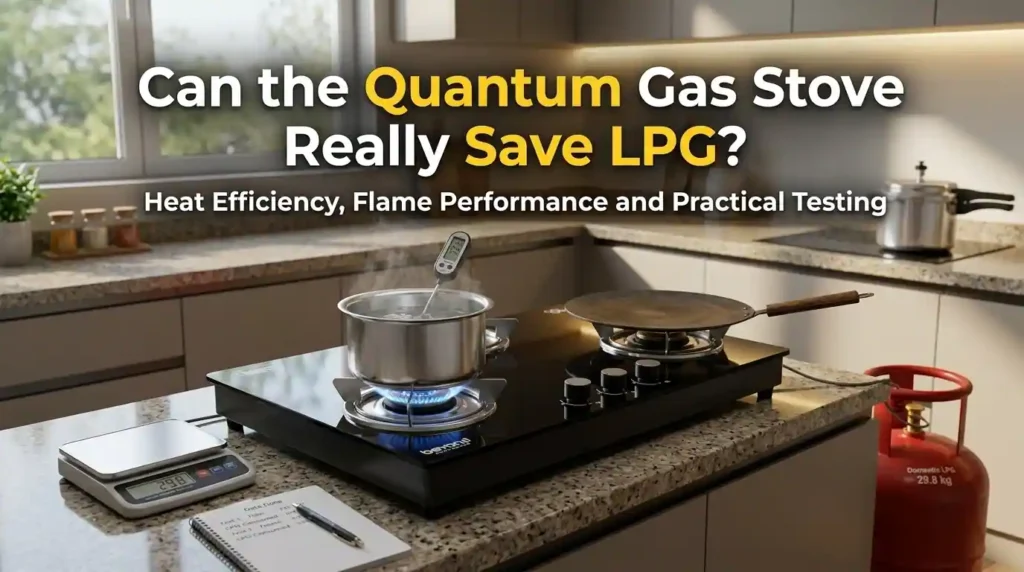
Read our Beyond Appliances Quantum Gas Stove review to learn about LPG savings, heating efficiency, flame performance, practical testing, pros and cons.
When you spend ₹1,000 on a gas cylinder, a significant part of that money can disappear as wasted heat. Many conventional gas stoves used in Indian kitchens operate at roughly 55% to 65% efficiency. Heat escapes around the vessel, gets absorbed by the pan support, or burns inefficiently before it can do useful work.
The Beyond Appliances Quantum Gas Stove is designed to address those losses. Its central claim is straightforward: direct more heat into the vessel, distribute it more evenly, and maintain a stable blue flame from ignition. The company claims efficiency of roughly 77% to 80%, with an overall improvement of almost 34% compared with regular gas stoves.
I evaluated the Quantum Stove through practical checks including a boiling test, pan heat-uniformity observations, and flame behavior. The results point to genuine improvements in how the stove concentrates and uses heat, although not every efficiency claim can be independently measured at home.
Why Conventional Gas Stoves Waste Heat and LPG
A gas stove may look like a simple appliance, but small design choices make a huge difference to fuel consumption. With a typical stove, heat often spreads outward instead of rising directly toward the cooking vessel. The pan support can also absorb heat, while uneven burner ports create a hotter center and cooler edges.

A dosa tawa is a familiar example. On many regular stoves, the middle of the tawa becomes much hotter than the corners. The result is an overcooked center, undercooked edges, and extra time spent over the flame.
The Quantum Stove tackles this with three major engineering changes:
- A patented elevated and angled pan support
- An LERC-approved burner designed for more uniform flame distribution
- A redesigned gas and oxygen mixing tube for a stable flame from the start
Patented Pan Support Directs More Heat Toward the Vessel
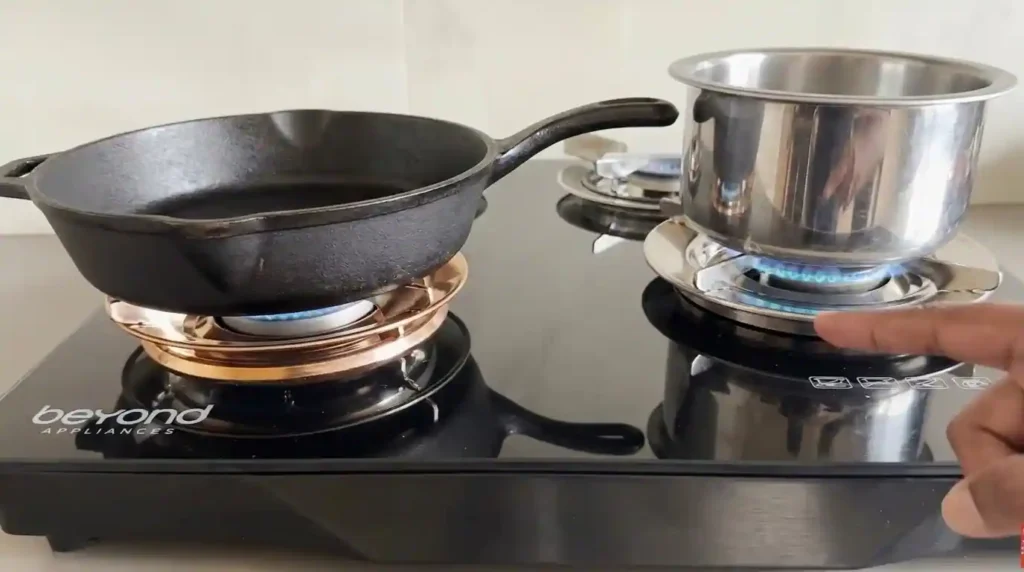
The most visible difference on the Beyond Appliances Quantum Stove is its pan support design. Instead of placing the vessel farther away from the burner and allowing heat to spread outward, the support is raised to bring the vessel closer to the flame source.
It also has an angled form that directs heat inward and upward toward the base of the vessel. This matters because the goal is not simply to produce more flame. The goal is to ensure that the heat produced is actually transferred to the food or water being heated.
Stainless-Steel Pan Support Reduces Unnecessary Heat Absorption
The material of the pan support is equally important. Conventional supports are often made from cast iron, which can absorb a substantial amount of heat. That heat is effectively lost to the cookware.
The Quantum Stove uses a stainless-steel pan support to reduce heat absorption. In practical terms, more of the burner’s heat is available for the vessel instead of heating up the support beneath it.
Quantum Gas Stove Boiling Test and LPG Consumption Results
A simple way to judge heat concentration is to boil the same quantity of water on a regular hob and on the Quantum Stove. In a test using 3 litres of water, the Quantum Stove brought the water from room temperature to around 90°C noticeably faster.
That result supports the basic design logic. When heat is better focused under the vessel, heating should happen faster.
Measuring the gas cylinder weight before and after the test also showed lower gas use for boiling the same amount of water on the Quantum Stove. Faster heating alone is useful, but lower fuel use is the bigger benefit when gas prices continue to rise.
LERC-Tested Burner for More Uniform Heat Distribution
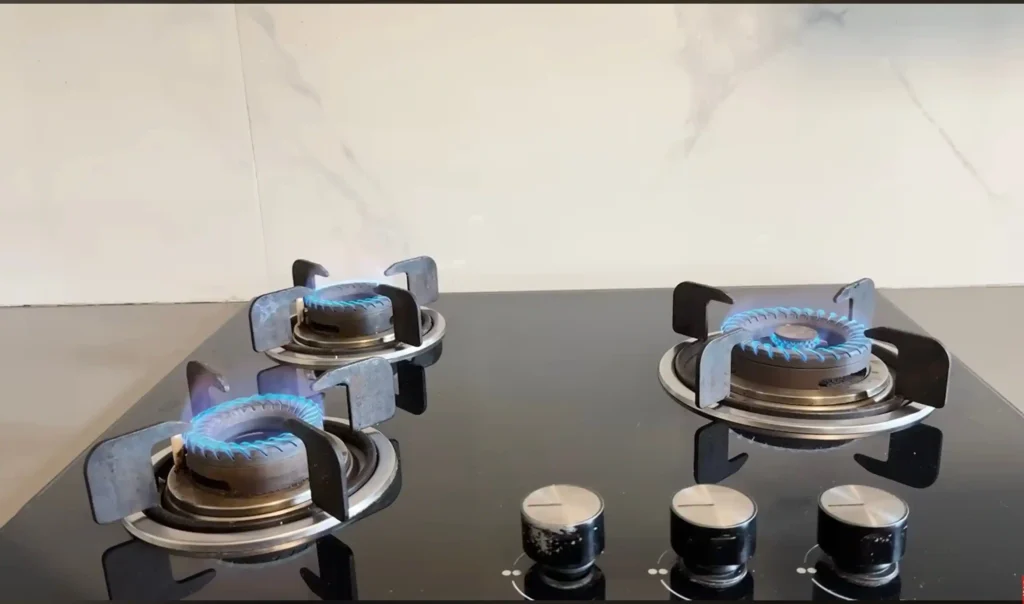
The second major source of stove inefficiency is the burner itself. A burner that distributes gas unevenly creates uneven flames, which then create uneven cooking temperatures.
That is why food can cook quickly at the center of a pan while the outer portion remains undercooked. It can be especially frustrating with rotis, dosas, large tawas, and wide cookware used in Indian kitchens.
The Beyond Appliances Quantum burner is LERC-approved and is designed to distribute heat more evenly across its burner ports. Temperature checks taken at different areas of the pan showed a more consistent temperature pattern than what is commonly seen with standard burners.
This does not mean every millimetre of a large pan will be identical in temperature. It means the stove is better at reducing the sharp hot-center and cool-edge effect that often leads to inconsistent results.
How Even Heating Improves Everyday Indian Cooking
More even heat can improve everyday cooking in a few practical ways:
- Food cooks more consistently across the pan.
- There is less need to keep moving cookware around the flame.
- Large flat cookware is easier to use without overcooking the center.
- Cooking time may reduce because the entire vessel base receives useful heat.
For households that cook frequently, this is not just a technical specification. It can make routine cooking less inefficient and less frustrating.
Redesigned Mixing Tube for a Stable Blue Flame
There is one more issue that many people overlook: the flame at startup. If your stove produces an orange or yellow flame, or if you notice a gas smell when turning it on, the gas and oxygen may not be mixing properly.
A healthy flame should generally be blue and odorless. A yellow or orange flame can indicate incomplete combustion, which means some gas is not being used as effectively as it should be.
The Quantum Stove uses a redesigned mixing tube that controls the volume of gas entering the combustion chamber when the stove is ignited. By limiting and optimizing the gas-to-oxygen interaction at startup, the stove aims to deliver a stable flame immediately instead of wasting gas during ignition.
Beyond Appliances claims up to 98% combustion efficiency for this design. That specific figure is not something that can be reliably measured through a basic home test, so it is best treated as a manufacturer claim. However, the stable blue flame behavior does align with the stove’s stated focus on better combustion and reduced wastage.
Beyond Appliances Quantum Gas Stove Specifications
Beyond its efficiency-focused engineering, the Quantum Stove includes the core features expected from a premium Indian gas stove.
- Three burners: One large burner, one medium burner, and one small burner
- Brass Indian-style burners: Suitable for high-heat, prolonged cooking and heavy vessels
- LPG and PNG compatibility: Useful whether you rely on a cylinder or piped gas supply
- 75 cm width: A spacious three-burner format for regular family cooking
- 8 mm toughened glass top: A durable, modern-looking cooking surface
The use of brass Indian-style burners is worth noting. They are well suited to the kind of high-heat cooking, large kadhais, pressure cookers, tawas, and heavy-bottomed vessels commonly used in Indian kitchens. This is a practical advantage over burner styles that may be less suited to prolonged high-heat use.
Can the Quantum Gas Stove Really Reduce LPG Consumption?
The biggest question is whether the Quantum Stove can save enough gas to justify its price. Based on the claimed efficiency improvement of nearly 34%, a household using one LPG cylinder every month could potentially extend that cycle to around 40 to 45 days.
Factors That Affect Actual Gas Savings
- How often you cook at home
- The size and type of cookware used
- Whether you usually cook on high flame
- Your current stove’s condition and efficiency
- Whether you use LPG cylinders or PNG
Still, the boiling test and heat-distribution observations show that the Quantum Stove’s benefits are not merely cosmetic. Its raised pan support, lower heat absorption, and focused heat direction can produce tangible efficiency gains.
With gas prices moving upward, an efficient stove can recover its additional upfront cost over time. The more frequently a kitchen uses gas, the more meaningful that long-term saving becomes.
Beyond Appliances Quantum Gas Stove Pros and Cons
Pros
- Heat is directed inward and upward toward the vessel.
- Raised, angled pan support helps reduce outward heat loss.
- Stainless-steel support absorbs less heat than conventional cast iron.
- Boils water faster while using less gas in comparative testing.
- LERC-approved burner is designed for more uniform heat distribution.
- Stable blue flame design aims to reduce gas wastage during ignition.
- Includes three useful burner sizes for everyday Indian cooking.
- Compatible with both LPG and PNG.
- Brass burners are suitable for heavy vessels and high-heat cooking.
Cons
- The 98% combustion-efficiency figure cannot be independently verified through basic home testing.
- Actual cylinder savings will vary depending on cooking habits and the condition of the existing stove.
- The 75 cm three-burner format may require more counter space than a compact stove.
Who Should Buy the Quantum Gas Stove?
This stove makes the most sense for households that cook regularly and use substantial amounts of gas every month. If you frequently make rotis, dosas, curries, tea, rice, pressure-cooked meals, or other daily Indian dishes, the efficiency improvement can add up over time.
It is also a strong option for anyone frustrated by uneven cooking on a large tawa or by a stove that gives inconsistent flames and visible heat loss around the cookware.
It may be less compelling for a household with very limited cooking needs, where gas usage is already low and long-term savings would take more time to become noticeable.
Final Verdict: Is the Beyond Appliances Quantum Gas Stove Worth Buying?
The Beyond Appliances Quantum Gas Stove stands out because its efficiency claims are backed by sensible engineering choices rather than vague marketing language. The raised and angled pan support, stainless-steel construction, uniform burner design, and optimized mixing tube all address real sources of gas wastage.
The faster boiling performance and lower gas use in a like-for-like water test are particularly meaningful. They show that the stove is able to concentrate heat more effectively than a regular hob.
If you want a three-burner gas stove that can help reduce fuel consumption, improve heat uniformity, and handle typical Indian cooking demands, the Beyond Appliances Quantum Stove is a compelling option. It is not magic, and savings will depend on how you cook, but the efficiency improvements appear real enough to make it worth serious consideration.
Pricing, Affiliate, and Sponsorship Disclosure:
All prices are subject to change and may be higher or lower than prevailing market prices. Ratingsage.com makes no guarantees regarding price accuracy. This content may include affiliate links and/or sponsored placements, through which we may receive compensation. Such compensation does not impact pricing or product representation. Consumers are responsible for verifying final prices with the retailer. 😊 Check: Affiliate Disclosure Page. and Discover more expert product reviews, buying guides, and appliance recommendations on our RatingSage Medium.com profile.