
Air Purifier Reality Check: Philips vs Coway vs Xiaomi in Real Indian Homes
Air purifiers are no longer optional in many Indian homes, especially across North India. When PM2.5 levels keep sitting in the poor, very poor, and severe range, and every year around October and November the numbers shoot up brutally, a good air purifier becomes a basic home essential.
That is exactly why choosing the right one matters. A purifier that looks good on paper but struggles in real rooms is not going to help much when indoor PM2.5 levels are already crossing 300 or 400. On the other hand, a properly sized and genuinely effective air purifier can make a very noticeable difference in half an hour to an hour.
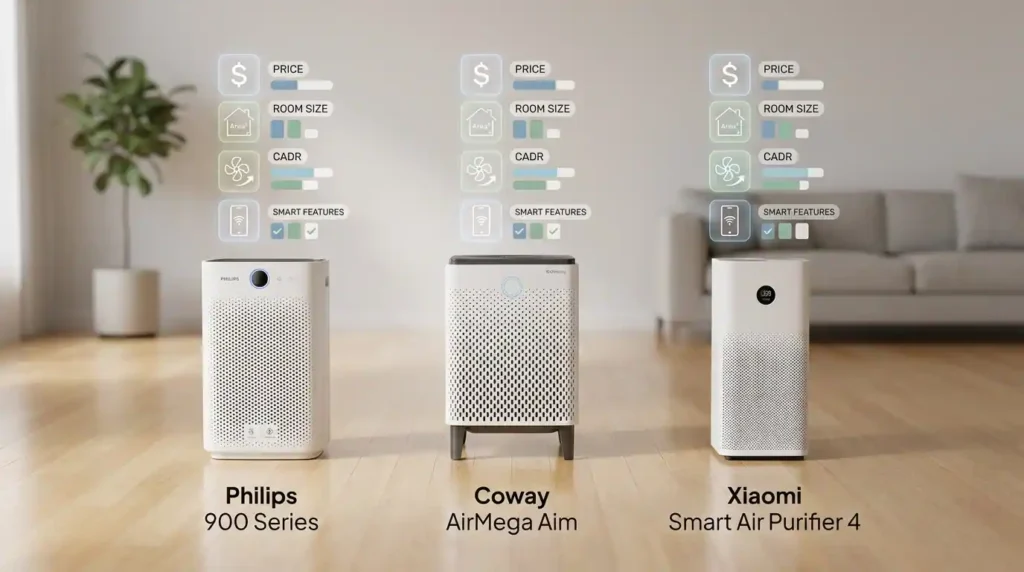
Here I am comparing three popular options across different price segments:
- Philips 900 Series Smart Air Purifier at around ₹8,000 to ₹10,000
- Coway AirMega Aim at around ₹12,000
- Xiaomi Smart Air Purifier 4 at around ₹20,000
The focus here is not just features. It is also about real-world effectiveness, room size suitability, sensor accuracy, filter cost, and which one actually makes sense for your usage.
Why an Air Purifier Is a Must-Have in Many Indian Homes
If you live in a city where AQI regularly goes bad, especially in Delhi NCR and other North Indian regions, indoor air often does not stay clean on its own. PM2.5 levels outside can hit 300, 400, 700, and in extreme situations even cross 1000. Once that polluted air gets indoors, your room may still feel closed and safe, but the particulate load can remain dangerously high.
That is where an air purifier helps. A good unit continuously pulls in room air, filters out dust, allergens, fine particles, and odors, and circulates cleaner air back into the room.
But there is one catch. Not every air purifier works equally well in every room size. That is why price alone should never be the deciding factor.
How to Choose the Best Air Purifier for Your Room
The comparison was based on practical home use and air quality testing, not just marketing claims. The key things considered were:
- Room coverage
- CADR, or Clean Air Delivery Rate
- Filter type and filter replacement cost
- Smart features and app support
- Display quality and PM2.5 readings
- Actual purification performance
- Sensor accuracy compared with a dedicated air quality monitor
That last point is especially important. Many air purifiers show PM2.5 readings, but not all of them are equally reliable. A purifier can still clean the air well even if its built-in sensor is not perfect, but accurate readings definitely make the whole experience better.
Philips 900 Series Air Purifier Review (Best Budget Air Purifier in India)
The Philips 900 Series is the compact and more affordable option in this comparison. It comes in two variants:
- Without Wi-Fi for around ₹8,000
- With Wi-Fi for around ₹10,000
If you want app control and smartphone connectivity, the Wi-Fi model is the obvious one to consider. If you just want a straightforward purifier for a smaller room, the non-Wi-Fi version saves some money.
Design and Room Suitability
This is a compact air purifier with a modular design. It does not take up much space, which makes it a good fit for bedrooms, study rooms, or small to medium-sized rooms.
Coverage, CADR, and Performance
- Area coverage: around 300 sq. ft.
- CADR: 250 m³/h
For a normal room, even a somewhat larger bedroom, this should work well. But for a big drawing room or hall, this is not the strongest option in the list.
Filtration System Explained
Philips is using a 3-layer HEPA filtration setup here:
- Pre-filter
- HEPA NanoProtect filter
- Active carbon filtration
This combination helps with particulate matter, allergens, and odors.
Smart Features and App Experience
The Wi-Fi-enabled model supports the Philips Air+ app. Once connected over a 2.4 GHz network, you can control the purifier remotely from your phone.
Useful app functions include:
- Air quality monitoring
- PM2.5 history and charts
- Allergen monitoring
- Mode switching
- Filter health and cleaning status
- Filter replacement purchase option
That is a nice convenience layer for anyone who wants a smarter appliance rather than a simple plug-and-run purifier.
Modes and Daily Usage
The purifier offers:
- Auto mode
- Sleep mode
- Medium fan levels
- Turbo mode
- Child lock / display lock
There is also a top display that shows real-time PM2.5 readings. The AQI marking is present, but the unit does not truly show full AQI data in the way many people expect. The more meaningful number here is the PM2.5 reading.
Filter Cost and Maintenance
- Replacement filter cost: around ₹3,000
- Expected filter life: around 1 year with regular use
If you run it 24 hours daily, replacing it after about a year is a reasonable expectation.
Real-World Performance in Indian Homes
In testing inside a 400 sq. ft. studio, the Philips purifier took roughly 1 to 1.5 hours to bring PM2.5 levels below 100.
That result is actually decent considering the studio was larger than the purifier’s ideal room size. In a 100 to 150 sq. ft. room, performance should be noticeably better. In that kind of space, it can bring PM2.5 levels down to the 40 to 50 range in roughly 30 minutes to 1 hour, depending on how polluted the room is to begin with.
Sensor Accuracy and Reliability
This is where Philips is not the strongest among the three. When cross-checked against a separate air quality monitor, the PM2.5 reading difference was often around 50 to 60 points.
So if the external monitor showed 70, the purifier could sometimes show something around 130 or 140. That does not mean the purifier is useless. It just means its built-in PM2.5 sensor is not the most accurate one in this comparison.
Who Should Buy the Philips Air Purifier
Buy it if:
- You want a compact purifier for a smaller room
- You prefer a known brand with app support
- Your budget is around ₹8,000 to ₹10,000
- You need decent purification without spending much
Skip it if:
- You need to cover a large hall or living room
- You care a lot about PM2.5 sensor accuracy
- You want stronger purification performance in bigger spaces
Coway AirMega Aim Review (Best Value Air Purifier in India)
The Coway AirMega Aim is the most interesting middle option here. It is priced around ₹12,000, and instead of trying to impress with flashy smart features, it focuses more on practical performance.
Its standout feature is the dynamic 360° air purification setup with multi-angle movement. You can adjust its vertical angle and also rotate it horizontally. That gives it a very different design identity compared with typical box-style air purifiers.
Unique Design and Airflow Technology
This is one of the most distinctive purifiers in the bunch. The adjustable directional airflow is genuinely useful, especially if you want to direct clean air more effectively in a room rather than just placing a static purifier in one corner.
Coverage and Performance Capability
- Price: around ₹12,000
- Area coverage: roughly 350 to 400 sq. ft.
That extra coverage already gives it an edge over the Philips model.
Filtration System and Filter Life
The Coway unit uses 3-stage air purification and includes a True HEPA filter.
- Filter life: up to 8500 hours
- Replacement cost: around ₹3,500
The filter is slightly more expensive than Philips, but the overall performance level makes that easier to justify.
Controls and Ease of Use
This purifier does not offer Wi-Fi or app support. So if remote smartphone control is a must-have for you, this will feel limited. But it does include something that is honestly very practical: a remote control.
That means you do not need to walk up to the purifier every time to change settings. For daily use, that is more useful than it may sound.
The onboard controls include:
- Power button
- Oscillation control
- Fan speeds 1, 2, and 3
- Auto mode
- Display on/off
- Filter replacement indicator
Air Quality Indicator
The Coway purifier does not show numerical PM2.5 values on the display. Instead, it uses color-based air quality indication:
- Red: very poor air quality
- Yellow: somewhat polluted
- Green: clean air
So while you do not get exact live PM2.5 numbers, you still get a clear sense of the room’s air quality status.
Real-World Performance Results
This is where the Coway AirMega Aim gets seriously impressive.
In practical testing, it performed around 20 to 25% more effectively than the Philips purifier. It also gave the Xiaomi Smart Air Purifier 4 a proper fight in overall air cleaning efficiency.
Tested in a 400 to 500 sq. ft. area, it was able to bring PM2.5 levels below 100 in about 1 hour. That is strong real-world performance for this price bracket.
Who Should Buy the Coway Air Purifier
Buy it if:
- You want strong purification performance around ₹12,000
- You need to cover a medium to slightly larger room
- You do not care much about app support
- You prefer function over flashy smart extras
- You like the included remote and adjustable air direction
Skip it if:
- You want detailed PM2.5 numbers on the device
- You need smartphone control and app-based monitoring
- You prefer a more data-heavy smart purifier experience
Xiaomi Smart Air Purifier 4 Review (Best Air Purifier for Large Rooms in India)
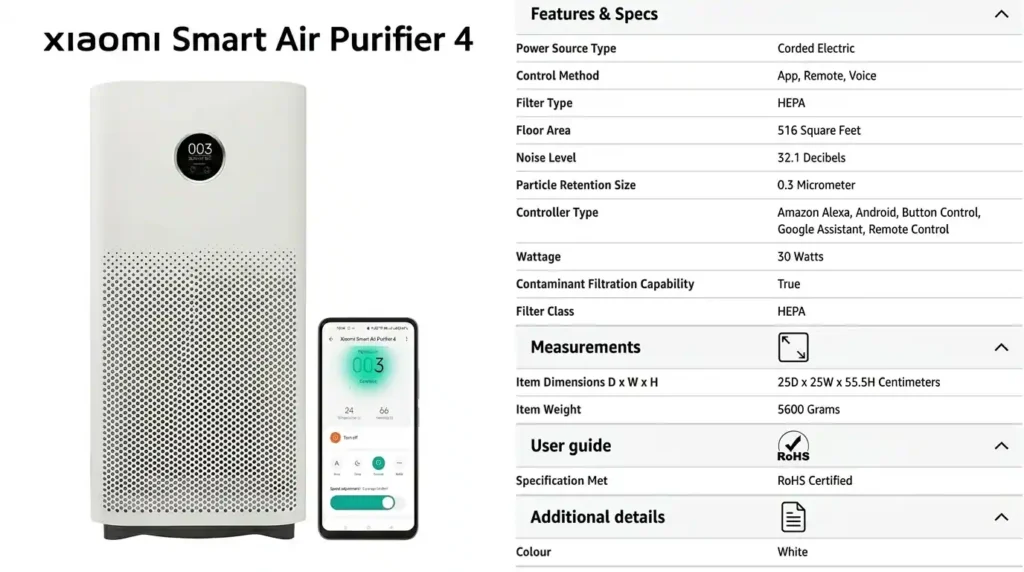
If the budget goes up to around ₹20,000, the Xiaomi Smart Air Purifier 4 becomes the flagship pick in this comparison.
Interestingly, it was previously available at a much lower price, around ₹12,000 a couple of years ago, but pricing has gone significantly higher during peak air pollution season. Even so, in terms of feature set and large-area usability, it remains the most complete product of the three.
Design and Build Quality
Xiaomi follows a vertical, modular design language here. It is clearly bigger than the Philips and Coway units in this comparison, and that larger body also supports a more substantial filter and stronger air handling capability.
CADR and Room Coverage
- CADR: 387 m³/h
- Claimed coverage: up to around 516 sq. ft.
Xiaomi also claims very fast purification for smaller rooms, with effective cleaning in around 10 minutes in compact spaces.
For a room around 100 to 150 sq. ft., that is believable based on practical use. In a larger room too, this purifier performs very well.
Filtration System and Air Cleaning
Xiaomi uses a triple-layer filtration setup:
- Primary filter
- True HEPA filter
- Activated carbon filter
The brand refers to it as a True HEPA filter, though it is not an H13 HEPA filter. The filter itself is fairly large, and the purifier does a good job with:
- Fine dust and PM2.5 particles
- Allergens
- Indoor odors and unwanted smells
There is also a negative air ionization option available inside the app.
Smart Features and App Control
Xiaomi’s smart ecosystem is one of the strongest reasons to consider this model. It works with the Mi Home app on both Android and iPhone.
Through the app, you can:
- Monitor PM2.5 levels
- Control fan speed
- Switch between auto and manual modes
- Check filter life percentage
- See remaining filter days
- Enable child lock
- Use ionization features
In day-to-day use, the app support here feels more polished and genuinely useful than gimmicky.
Display, Noise, and Daily Use
The front display is bright, clear, and easy to read. PM2.5 numbers are visible directly on the unit, and the digits are large enough to check from a distance.
Noise levels are also well controlled. Despite strong performance, it does not become annoyingly loud. That said, in places with very high pollution, there is little reason to run it on low speed. In heavy North Indian winter pollution, high or turbo mode simply makes more sense.
Filter Cost and Long-Term Use
- Replacement filter cost: around ₹3,500
The app gives a clear picture of filter health. You can see remaining life in percentage terms as well as estimated days left.
One practical usage pattern mentioned here is seasonal use, mainly from October to December. With that kind of usage over two years, the filter still had around 85% life remaining. So actual replacement frequency may be much lower if you are not running it year-round.
Sensor Accuracy Compared
This is the best-performing purifier of the three when it comes to PM2.5 reading reliability.
Compared with a separate AQI monitor, the difference was usually around 30 points, which is significantly better than the Philips unit. The readings were also more stable, without wild fluctuations.
That makes the built-in display far more trustworthy for regular use. If you buy this purifier, you do not really need a separate air quality monitor unless you specifically want one for dedicated tracking.
Real-World Performance in Large Rooms
For large spaces, the Xiaomi Smart Air Purifier 4 proved itself very well.
In a 500 to 600 sq. ft. area, it was able to reduce PM2.5 levels from roughly 400 to 500 down to around 100 to 110 in about 30 minutes to 1 hour.That is exactly the kind of result you want from a serious home air purifier.
In a smaller room, the speed is even better. In a typical bedroom, it can clean the air in roughly 15 to 20 minutes.
Who Should Buy the Xiaomi Air Purifier
Buy it if:
- Your room size is large, especially 500 to 600 sq. ft.
- You want the best all-round option in this comparison
- App support and smart controls matter to you
- You want a more accurate built-in PM2.5 reading
- You need strong purification in high-pollution conditions
Skip it if:
- Your budget is tight
- You only need a purifier for a very small room
- You do not want to spend close to ₹20,000
📊 Air Purifier Comparison in India: Philips vs Coway vs Xiaomi
| Category | Philips 900 Series | Coway AirMega Aim | Xiaomi Smart Air Purifier 4 |
|---|---|---|---|
| Best For | Budget buyers, small rooms | Value for money, medium rooms | Large rooms, heavy pollution |
| Price Range | ₹8,000 – ₹10,000 | Around ₹12,000 | Around ₹20,000 |
| Room Size Suitability | Small to medium rooms | Medium to slightly large rooms | Large rooms (500+ sq. ft.) |
| Purification Performance | Good for small spaces | Strong and efficient | Best overall performance |
| Smart Features | App support (Wi-Fi model) | No app (remote control only) | Advanced app + smart controls |
| Sensor Accuracy | Average | Basic (color indicator only) | Best (more reliable PM2.5 readings) |
| Ease of Use | Simple + app control | Very practical (remote-based) | Smart + feature-rich |
| Best Budget Air Purifier | ✅ Yes | ❌ No | ❌ No |
| Best Value for Money | ❌ No | ✅ Yes | ❌ No |
| Best for Large Rooms | ❌ No | ⚠️ Moderate | ✅ Yes |
| Best Smart Features | ⚠️ Good | ❌ No | ✅ Best |
| Best Sensor Accuracy | ❌ No | ❌ No | ✅ Best |
| Best Simple Experience | ⚠️ Decent | ✅ Best | ❌ More complex |
⚖️ Quick Pros and Cons Comparison
| Air Purifier | Pros | Cons |
|---|---|---|
| Philips 900 Series | Compact design, affordable, Wi-Fi option, app support, ideal for small rooms | Not for large rooms, less accurate PM2.5 sensor, slower in bigger spaces |
| Coway AirMega Aim | Strong purification, better coverage, unique airflow design, remote control, great value | No app support, no numeric PM2.5 display, slightly higher filter cost |
| Xiaomi Air Purifier 4 | Best performance, ideal for large rooms, excellent app, accurate PM2.5 readings, fast cleaning | Expensive, may be overkill for small rooms |
🏆 Final Verdict (At a Glance)
- Best Budget Air Purifier in India: Philips 900 Series
- Best Value Air Purifier in India: Coway AirMega Aim
- Best Air Purifier for Large Rooms in India: Xiaomi Smart Air Purifier 4
Which Is the Best Air Purifier in India for You?
If your budget is around ₹8,000 to ₹10,000 and you need something mainly for a bedroom or small room, go with the Philips 900 Series.
If you want the best balance of price and performance, and app support is not a priority, the Coway AirMega Aim is a seriously solid choice.
If you have a bigger room, want better smart features, more reliable PM2.5 tracking, and simply want the best overall air purifier among these three, the Xiaomi Smart Air Purifier 4 is the one to pick.
For heavy pollution seasons, especially in homes where indoor PM2.5 can climb dramatically, purifier size and cleaning efficiency matter far more than fancy branding. Match the machine to your room size, keep an eye on filter costs, and do not underestimate the value of good sensor accuracy.
Done right, an air purifier is one of those purchases that quietly improves day-to-day life in a very real way.
Pricing, Affiliate, and Sponsorship Disclosure:
All prices are subject to change and may be higher or lower than prevailing market prices. We make no guarantees regarding price accuracy. This content may include affiliate links and/or sponsored placements, through which we may receive compensation. Such compensation does not impact pricing or product representation. Consumers are responsible for verifying final prices with the retailer. 😊 Check: Affiliate Disclosure Page. and check out another social media account: Click Here.