How to Choose the Right Air Cooler in 2026: Complete Air Cooler Selection Guide
Confused about which air cooler to buy? Learn Complete Air Cooler Selection Guide, how to choose the right personal, tower, or desert cooler based on room size, climate, CFM, cooling pads, airflow, motor type, and budget. Avoid common mistakes and get efficient cooling in 2026.
Most people shop for an air cooler in summer for one simple reason: they want relief from the heat without spending AC-level money. But this is also where many buyers get disappointed. One person says the cooler barely cools. Another says it feels like a normal fan. Someone else complains about noise, weak airflow, or high electricity usage.
In most cases, the real problem is not that air coolers are useless. The problem is choosing the wrong type of cooler for the room, climate, and usage.
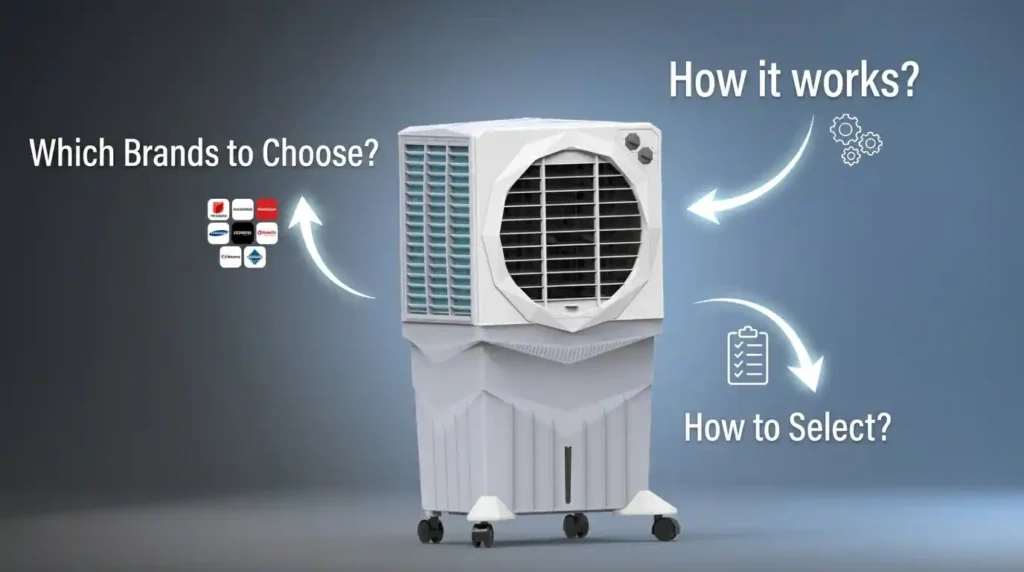
If you want an air cooler that actually performs well, you need to understand how it works, which type suits your space, what features matter, and which specifications are worth paying attention to. Once you know that, it becomes much easier to avoid a bad purchase.
Air Cooler Selection Guide 2026: How an Air Cooler Works and Why It Matters Before You Buy
An air cooler works on evaporative cooling. Inside the cooler, water from the tank is pushed by a pump through pipes to the cooling pads mounted on the sides. Warm outside air passes through these wet pads. As the water evaporates, the air temperature drops. Then the fan or blower pushes that cooler air into the room.
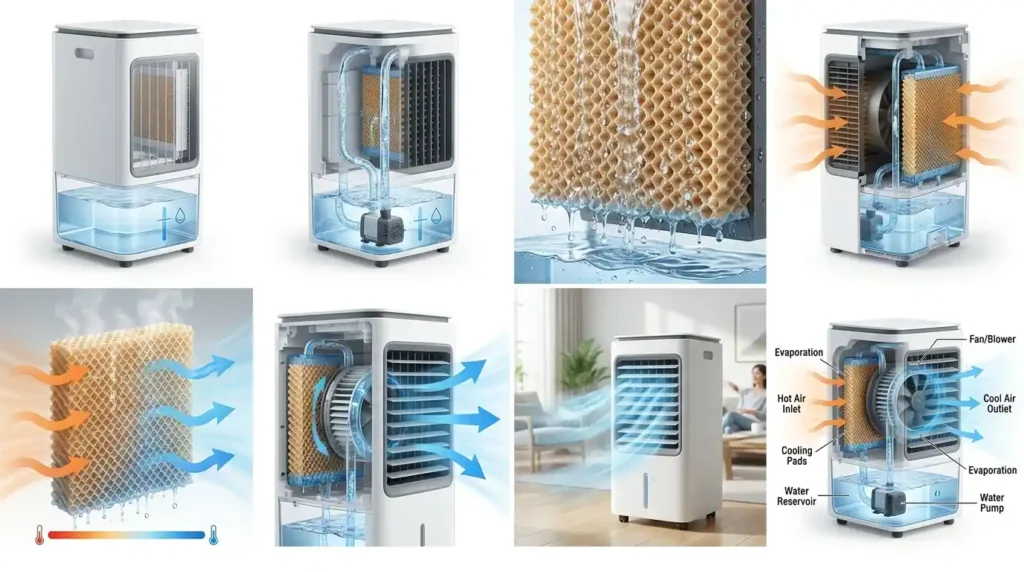
This basic working principle explains three very important things.
1. Why Humidity Affects Air Cooler Performance
Air coolers work best where evaporation happens quickly. In very humid places, evaporation slows down, so cooling becomes less effective. That means coastal cities and humid regions like Mumbai or Kolkata are not ideal for coolers. In those conditions, an AC is usually the better option.
2. Why Proper Ventilation Is Essential for Air Coolers
Unlike an AC, an air cooler should not be used in a sealed room. It needs a proper air path to work efficiently. Keep it near a door or window so fresh air can keep moving through the room. Without ventilation, cooling performance drops.
3. How Cooling Pad Quality Impacts Cooling Efficiency
If the cooling pads are poor quality, evaporation will not happen properly. In that case, the cooler may still move air, but it will feel more like a fan than a cooling appliance. That is why pad quality is one of the most important things to check before buying.
Air Cooler Buying Guide: Understanding the Different Types of Air Coolers
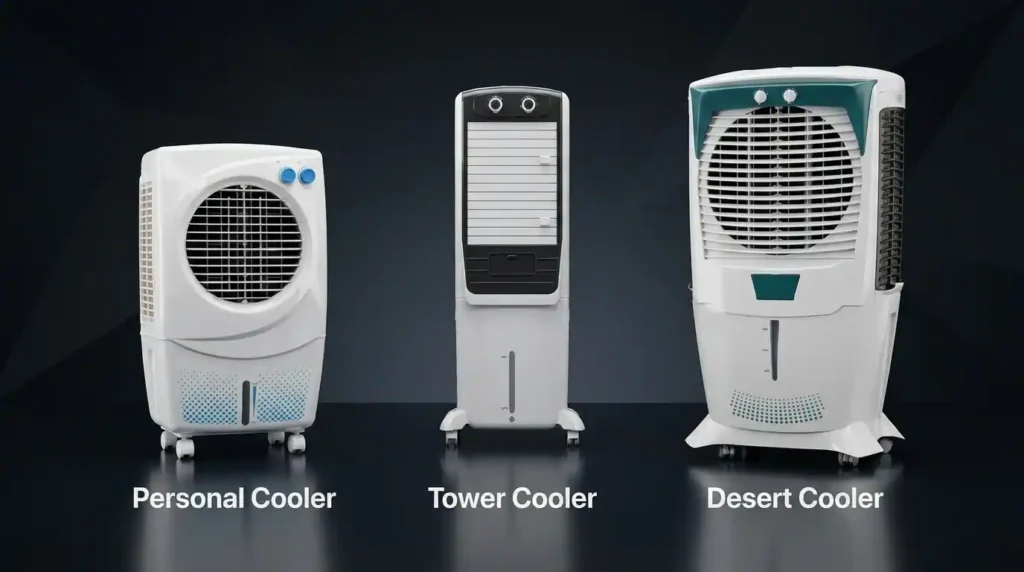
Air coolers are generally divided into three categories: personal coolers, tower coolers, and desert coolers. Choosing the right one depends mainly on room size and where you want to use it.
Personal Coolers: Ideal for Small Rooms and Personal Use
Personal coolers are compact and meant for close-range use. They are a good fit near a study table, work desk, or bedside area. If your room is around 80 to 150 square feet, a personal cooler can work well.
Typical price range: ₹2,500 to ₹7,000
Best for:
- Small bedrooms
- Study rooms
- Work corners
- Budget buyers
Not ideal for:
- Large living rooms
- Halls
- Open spaces
Tower Coolers: Space-Saving Cooling for Modern Homes
Tower coolers have a slim vertical design. They are more powerful than basic personal coolers and are useful where floor space is limited. If you live in an apartment and do not want a bulky cooler taking over the room, this category makes a lot of sense.
They generally suit rooms around 120 to 180 square feet.
Typical price range: ₹4,000 to ₹10,000
Best for:
- Compact apartments
- Bedrooms with limited space
- People who want a cleaner vertical design
Watch out for:
- Some tower models use blower-style airflow, which may be more directional and noisier
Desert Coolers: Powerful Cooling for Large Rooms and Halls
Desert coolers are the most common large-format coolers in India. These are built for bigger rooms and stronger cooling output. If your room or hall is around 200 to 500 square feet, this is usually the right category.
Typical price range: ₹7,000 to ₹16,000
Best for:
- Large bedrooms
- Living rooms
- Halls
- Homes in dry and hot climates
Trade-offs:
- Takes more space
- Higher upfront cost than personal coolers
The Most Common Air Cooler Buying Mistake to Avoid
A lot of people try to save money by buying a smaller personal cooler for a large room or hall. Technically, it will still run. But cooling will be slow and underwhelming. That is when people start saying coolers do not work properly.
The fix is simple: match the cooler type to the room size and usage.
What Is CFM in an Air Cooler and Why Is It Important?
If you want faster cooling, one specification matters a lot: air delivery capacity. This is measured in CFM, or cubic feet per minute. It tells you how much air the cooler can throw in one minute.
As a practical guide:
- Personal coolers: around 800 to 2200 CFM
- Tower coolers: also look in a similar practical range depending on room size
- Desert coolers: choose appropriately higher-capacity models for larger spaces
Do not ignore CFM, but also do not make the mistake of selecting a cooler based only on that number.
Air Throw Pattern: A Key Factor in Air Cooler Performance
Strong airflow alone is not enough. The air also needs to spread properly across the room. This is where air throw pattern becomes important.
In simple terms, ask this: is the cooler throwing air straight in one direction, or is it spreading air more evenly across the room?
Blower Coolers: Focused Airflow for Direct Cooling
Blower-based coolers usually throw air in a more concentrated stream, almost like a torch beam. This means cooling is stronger in one direction, but coverage can be limited. These models also tend to produce more noise.
Pros:
- Focused airflow
- Useful for close or direct cooling
Cons:
- Less even room-wide cooling
- Usually noisier
Fan Coolers: Better Air Distribution Across the Room
Fan-based coolers spread air more widely, which helps create more even cooling throughout the room. If multiple people are using the same room, this is usually the better style.
Many fan coolers come with three-blade or five-blade fans. If possible, go for five-blade models because they generally offer better airflow spread and lower noise.
Pros:
- Wider air distribution
- Better for shared rooms
- Usually less harsh noise than blower models
Cons:
- May feel less forceful at one exact point compared to a blower
Air Cooler Motor Types: BLDC vs Induction Motor
Two common complaints with air coolers are high noise and rising electricity bills. In many models, the motor is the main reason.
There are two common motor types:
- Induction motor
- BLDC motor
Induction Motor Air Coolers: Features, Pros and Cons
These are common in many regular and budget models. They usually consume more power and tend to be noisier.
Typical power usage: around 150 to 200 watts
Best for:
- Tight budgets
- Basic use where noise is not a major concern
BLDC Motor Air Coolers: Energy-Efficient and Quieter Cooling
BLDC motor coolers are the better pick if your budget allows it. They are significantly quieter and more energy efficient.
Typical power usage: around 80 to 100 watts
Key advantages:
- About 50 to 60 percent less noise compared to induction motor models
- Lower electricity consumption
- Better for long hours of daily use
Downside:
- Higher purchase price
If you want a quieter and more efficient cooler, BLDC is worth preferring.
Cooling Pads Explained: Honeycomb vs Wood Wool Pads
This is one of the most important product comparisons in any air cooler buying guide.
Wood Wool Cooling Pads: Advantages and Limitations
These were more common in older coolers. They can still provide decent cooling, but they usually require more maintenance. Their durability is lower, they need replacement more often, and if not maintained properly, they can start developing odor.
Pros:
- Can still cool reasonably well
Cons:
- Lower durability
- Higher maintenance
- Frequent replacement
- Risk of smell over time
Honeycomb Cooling Pads: Better Cooling and Durability
Most modern air coolers now use honeycomb pads, and for good reason. Their structure helps spread water more evenly, which improves evaporation and cooling performance. They also last longer than wood wool pads.
Pros:
- Better cooling efficiency
- Even water distribution
- Longer durability
- Lower maintenance burden
Cons:
- Usually found in slightly better-specced models, which may cost more
Recommendation: Always prefer honeycomb pads if you want better long-term performance.
How to Choose the Right Water Tank Size in an Air Cooler
Many buyers assume a larger water tank means stronger cooling. That is not how it works. Tank size does not directly improve cooling performance. It mainly affects how often you need to refill water.
So yes, a bigger tank is useful, but mostly for convenience.
Typical tank capacities by category:
- Personal coolers: 20 to 30 liters
- Tower coolers: 40 to 45 liters
- Desert coolers: 70 to 100 liters
If you do not want frequent refilling, choose the larger end of the range within your cooler type. Just do not confuse tank size with actual cooling strength.
Air Cooler Build Quality: Features Worth Checking Before You Buy
Build quality complaints are common, especially in budget coolers. Most models use either regular plastic or ABS plastic. In real-world use, the difference is not usually dramatic enough to be the main deciding factor.
The part that deserves more attention is the wheel quality.
Since coolers are moved around often, weak wheels can become a real headache. Cheap wheels can break easily, especially in larger desert coolers filled with water.
What to check:
- Strong wheels
- Smooth movement
- Stable base
Another useful detail is a collapsible louver. When the cooler is off, this helps prevent dust and mosquitoes from entering inside.
Why Inverter Compatibility Is Important in an Air Cooler
Power cuts are common in summer, which is exactly when you need cooling the most. That is why inverter compatibility is a practical feature worth checking before buying.
If a cooler is inverter compatible, it can continue running for long hours more comfortably on backup power. This is especially valuable in areas with frequent outages.
Useful Air Cooler Features That Improve Everyday Convenience
Not every extra feature is necessary, but some genuinely improve day-to-day use.
Auto Water Level Indicator
This is now available in many coolers. It helps you quickly see how much water is in the tank while filling or using the unit.
Auto Water Fill System
This is one of the most useful convenience features. It lets you connect the cooler directly to a water supply so the tank keeps refilling automatically. That means less manual effort and fewer interruptions, especially overnight.
Auto Drain Function
If water remains inside the cooler for too long, odor can develop. Auto drain makes it easier to remove stored water and keep the cooler fresh.
Ice Chamber for Enhanced Cooling
Some coolers come with an ice chamber where you can place ice cubes. This can help deliver cooler air than a standard setup, especially during peak summer heat.
2-Way and 4-Way Swing
Swing control affects how air moves through the room. More directional control can improve cooling coverage depending on room layout.
Remote Control Convenience
A remote is not essential, but it does add convenience, especially for bedroom use.
Which Air Cooler Should You Buy? A Simple Selection Guide
Here is a simple buying recommendation based on need.
Choose a Personal Cooler if:
- Your room is small
- You need close-range cooling
- Your budget is limited
- You want something compact
Choose a Tower Cooler if:
- You have limited floor space
- You want a slim design
- Your room is small to medium sized
- You want more power than a basic personal cooler
Choose a Desert Cooler if:
- You need cooling for a large room or hall
- You live in a hot and dry area
- You want stronger cooling output
- You can accommodate a bigger unit
Avoid an Air Cooler if:
- You live in a highly humid coastal area
- You plan to use it in a sealed room
- You expect AC-like cooling in all conditions
Air Cooler Buying Checklist: Things to Check Before Purchase
Before you buy an air cooler in 2026, check these points:
- Pick the correct cooler type based on room size and usage.
- If you live in a humid coastal area, consider an AC instead.
- Match the room size with the right CFM.
- Do not check only airflow numbers. Also check air throw pattern.
- Prefer fan coolers for wider and more even cooling.
- If possible, choose a five-blade fan for better airflow and lower noise.
- Choose honeycomb cooling pads over wood wool pads.
- If budget allows, buy a BLDC motor cooler for lower noise and lower power use.
- Do not overvalue tank size for cooling. Use it as a convenience factor.
- Check wheel quality and prefer a collapsible louver.
- Look for inverter compatibility if power cuts are common in your area.
- Useful bonus features include auto fill, auto drain, water level indicator, and ice chamber.
Final Verdict: How to Choose the Right Air Cooler for Long-Term Satisfaction
The best air cooler is not the biggest one, the cheapest one, or the one with the flashiest feature list. It is the one that matches your room size, climate, and daily usage pattern.
If you want the safest overall buying formula, this is it:
- Choose the correct size category
- Prefer honeycomb pads
- Pay attention to airflow pattern, not just CFM
- Go for BLDC motor models if your budget allows
- Pick practical features like auto fill and inverter compatibility
Get these basics right, and an air cooler can be a smart, budget-friendly cooling solution for summer instead of a disappointing purchase.
Pricing, Affiliate, and Sponsorship Disclosure:
All prices are subject to change and may be higher or lower than prevailing market prices. We make no guarantees regarding price accuracy. This content may include affiliate links and/or sponsored placements, through which we may receive compensation. Such compensation does not impact pricing or product representation. Consumers are responsible for verifying final prices with the retailer. 😊 Check: Affiliate Disclosure Page. and check out another social media account: Click Here.