Best Dehumidifiers in India 2026: Sharp, HINISO & Power Pye Compared
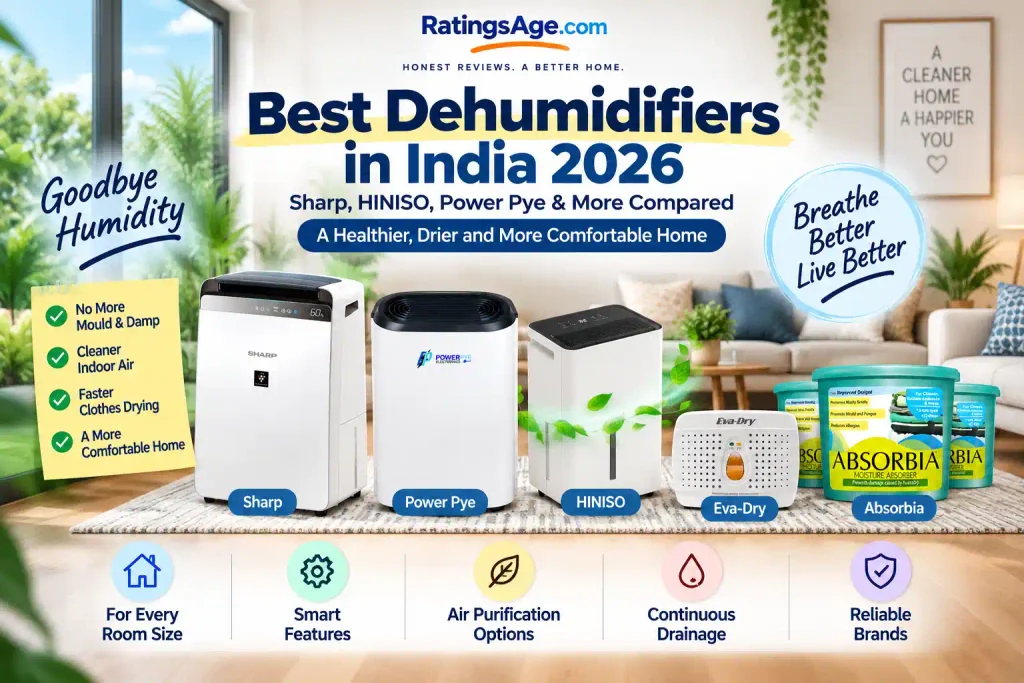
Find the best dehumidifiers in India in 2026. Compare Sharp, HINISO, Power Pye and compact options by capacity, room size, drainage, air purification and features.
Best Dehumidifiers in India: Quick Comparison
- Choose dehumidifier capacity based on humidity level and room size, not tank size alone.
- For large coastal rooms, a 20 L per day Sharp model is the strongest recommendation.
- Continuous drainage prevents frequent tank emptying in persistently humid homes.
- Reusable desiccant units are better suited to cupboards, closets and shoe racks than rooms.
Best Dehumidifier in India 2026: Sharp vs HINISO vs Power Pye
Persistent mould on walls, a damp smell in cupboards, condensation, and increased sneezing can all point to excess indoor humidity. A dehumidifier removes moisture from the air and helps bring humidity back to a more manageable level.
For most homes, the goal is to maintain indoor relative humidity at 45% to 55%. This range helps limit mould growth without making the air uncomfortably dry. The right machine depends on local humidity, room size, daily extraction capacity, drainage options, and whether air purification matters to you.
Table of Contents
- Do You Need a Dehumidifier or an Air Conditioner?
- What Humidity Level Should You Maintain at Home?
- How to Choose the Right Dehumidifier Capacity
- Tank Size vs Continuous Drainage
- Are Air Purification and Smart Controls Worth Paying For?
- Best Dehumidifiers in India for Different Needs
- Warranty and Service Considerations
- How to Use a Dehumidifier Effectively During Monsoon
- Common Dehumidifier Buying Mistakes
- Which Is the Best Dehumidifier for Your Home?
Dehumidifier vs Air Conditioner: Which Is Right for Your Home?
Dehumidifier vs Air Conditioner: Which Is Right for Your Home?
An air conditioner can remove some moisture while cooling a room, but it may not provide enough dehumidification in very humid conditions. The right choice depends on your climate, room type, and humidity problem.
| 🏠 Your Situation | ✅ Recommended Option | 💡 Why It Makes Sense |
|---|---|---|
| 🌊 Hot & very humid coastal areas | AC + Dehumidifier | An AC provides cooling, while a dedicated dehumidifier can provide additional moisture control during very humid periods. |
|
☀️ Low to moderately humid areas Up to ~70% humidity |
Air Conditioner | An AC can provide cooling while also removing some moisture from the air. |
| 🌧️ Cool but humid rooms | Dedicated Dehumidifier | A dehumidifier reduces excess moisture without significantly cooling the room. |
| 👕 Cupboards, wardrobes & shoe cabinets | Moisture Absorber or Mini Dehumidifier | Compact desiccant products are designed for small, enclosed spaces rather than entire rooms. |
Quick Takeaway
- Need cooling + moisture control? → AC + Dehumidifier
- Need cooling with moderate humidity control? → Air Conditioner
- Need moisture control without cooling? → Dedicated Dehumidifier
- Need protection for cupboards or shoe racks? → Mini Dehumidifier or Moisture Absorber
Coastal locations such as Mumbai, Chennai, and Goa are examples of places where both appliances may be useful. Inland cities such as New Delhi, Hyderabad, and Ahmedabad may benefit more from an AC when cooling is also a priority.
What Is the Ideal Indoor Humidity Level for Your Home?
A relative humidity level of roughly 30% to 60% is generally comfortable. However, mould can begin to grow when humidity rises above 65%, a common issue during monsoon conditions.
Set a dehumidifier to 45% to 55% where possible. Going below 30% may leave the air excessively dry and uncomfortable.
How to Check Indoor Humidity Before Buying a Dehumidifier
- Check your local outdoor humidity on a weather app for a broad indication of local conditions.
- Use a hygrometer indoors to measure the actual humidity in the room you want to treat.
- Look for practical warning signs, including mould, musty odours, damp cupboards, and recurring condensation.
Indoor readings are more useful than city-wide weather data when selecting a machine, because humidity can vary significantly between rooms and buildings.
How to Choose the Right Dehumidifier for Your Room Size
A dehumidifier’s capacity tells you how much moisture it can extract in 24 hours. It is commonly stated in litres per day, such as 10 L/day, 16 L/day, or 20 L/day.
Capacity should match both the moisture load and room size. Choosing a machine solely because it has a large water tank can be misleading. A tank only determines how often you need to empty collected water.
Choose Dehumidifier Capacity Based on Humidity
- Above 80% humidity: Choose at least a 14 to 15 L/day dehumidifier.
- About 50% to 80% humidity: A 10 to 12 L/day unit can be sufficient.
- Small enclosed spaces: Portable units extracting up to about 500 ml/day are intended for cupboards and shoe racks.
Dehumidifier Capacity Guide by Room Size
| Dehumidifier capacity | Suggested coverage | Typical use |
|---|---|---|
| Up to 500 ml/day | Very small enclosed spaces | Wardrobes, cupboards, shoe racks |
| 10 L/day | About 200 to 300 sq ft | Bedrooms and medium rooms |
| 20 L/day | About 400 to 500 sq ft | Large rooms and highly humid spaces |
Manufacturer coverage claims should be treated carefully. A high claimed area is not always realistic in a damp home, especially during monsoon or in coastal conditions. Matching capacity to the actual room and humidity level is safer than relying on the largest advertised coverage number.
Tank Size vs Continuous Drainage: Which Matters More?
Water tank capacity affects maintenance. For example, a 20 L/day dehumidifier paired with a 5 L tank may require emptying roughly four times daily if it is extracting moisture at its maximum stated capacity.
For homes with high humidity, continuous drainage is one of the most useful features. A hose can be connected to direct water to a nearby bathroom drain or other suitable drainage point. This avoids repeated manual emptying.
- Choose continuous drain if the unit can sit near an appropriate drain.
- Choose the largest practical tank if drainage is not possible.
- Look for auto shut-off, which stops operation once the tank is full.
Are Air Purification and Smart Features Worth It?
These features can be useful, but they should not take priority over moisture-removal capacity, drainage, and room suitability.
HEPA Filtration vs Ion-Based Air Treatment
Some dehumidifiers combine moisture removal with air purification. A model with a HEPA filter offers a more complete air-purification feature than one that only releases negative ions.
Sharp’s larger recommended unit includes a HEPA 14 filter. Power Pye Electronics offers air purification capability on its recommended model, but the HEPA filter must be purchased separately. Ion-based systems, including Sharp’s Plasmacluster approach on the 10 L model, should primarily be treated as an added freshening feature rather than a replacement for HEPA filtration.
Wi-Fi and Voice Controls: Are They Worth Paying For?
Smart controls can allow remote switching, humidity adjustments, and schedules. HINISO and Power Pye Electronics models covered here offer app-based control, with voice-assistant support on selected units.
These functions are convenient for households that already manage appliances remotely, but they are not essential to effective dehumidification.
Best Dehumidifiers in India for Different Room Sizes and Needs
The following recommendations focus on the stated capacity, useful features, room suitability, and service considerations.
Sharp 10 L Dehumidifier: Best for Smaller Bedrooms
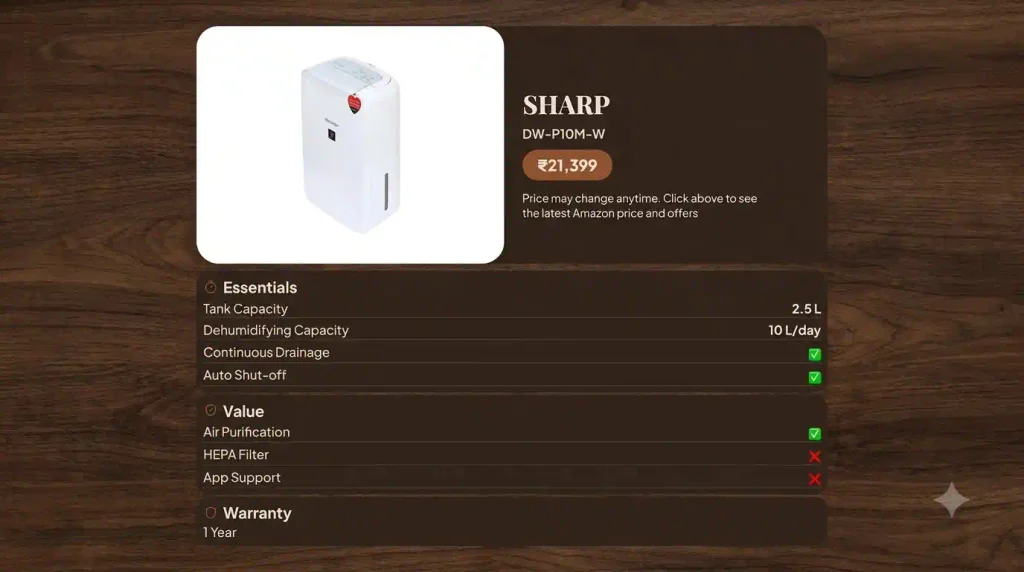
Note: Price may change anytime. Click above to see the latest Amazon price and offers.
The Sharp DW-P10M-W is a strong option for small to medium rooms where reliable dehumidification and low noise matter most.
- Moisture removal: 10 L/day
- Tank capacity: 2.5 L
- Drainage: Continuous drainage supported
- Suitable room size: Bedrooms and living rooms up to about 250 sq ft
- Noise level: About 40 dB
- Air feature: Plasmacluster ion-based technology, not HEPA filtration
Best for: People who want a quiet bedroom dehumidifier from a well-known Japanese brand and have access to a drain or do not mind emptying a smaller tank.
Consider before buying: The 2.5 L tank may fill frequently in very humid weather. Its air treatment is not a substitute for a true HEPA air purifier.
HINISO 16 L Smart Dehumidifier: A Versatile Choice for Medium Rooms
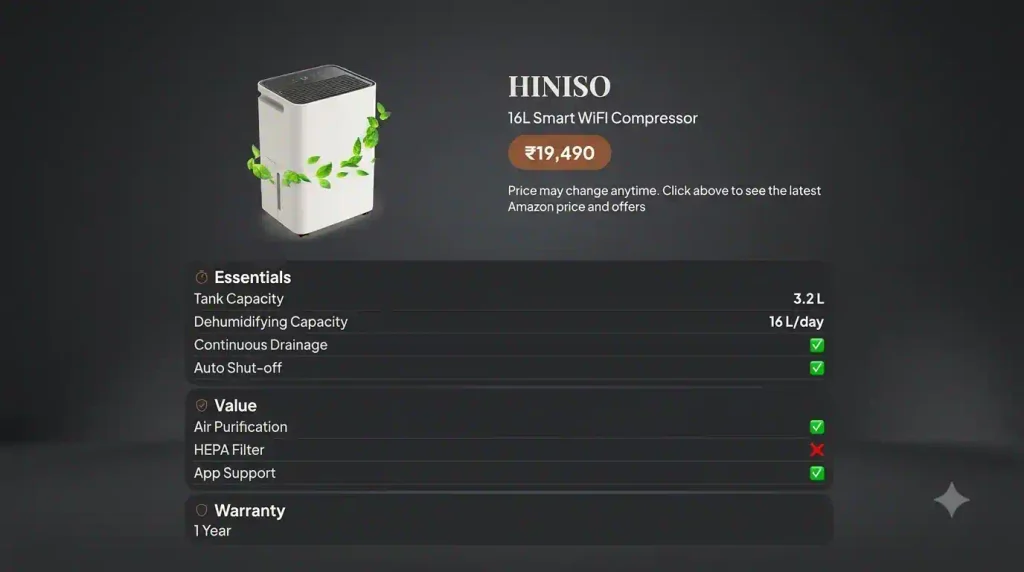
Note: Price may change anytime. Click above to see the latest Amazon price and offers.
The HINISO 16 L Smart Wi-Fi Dehumidifier is positioned as a practical middle ground for most homes. It provides higher extraction capacity than a typical 10 L machine while retaining smart controls and continuous drainage.
- Moisture removal: 16 L/day
- Tank capacity: 3.2 L
- Drainage: Continuous drain supported
- Suitable room size: Up to about 300 sq ft
- Controls: Wi-Fi app control and Alexa support
- Modes: Laundry drying and auto-defrost functions
Best for: Homes needing a capable dehumidifier for a larger bedroom or standard living room, particularly where laundry drying and remote control are useful.
Consider before buying: The brand has published a much larger coverage figure, but around 300 sq ft is a more sensible expectation for reliable performance in typical humid conditions.
Power Pye 12 L Dehumidifier: A Practical Option for Wider Service Coverage
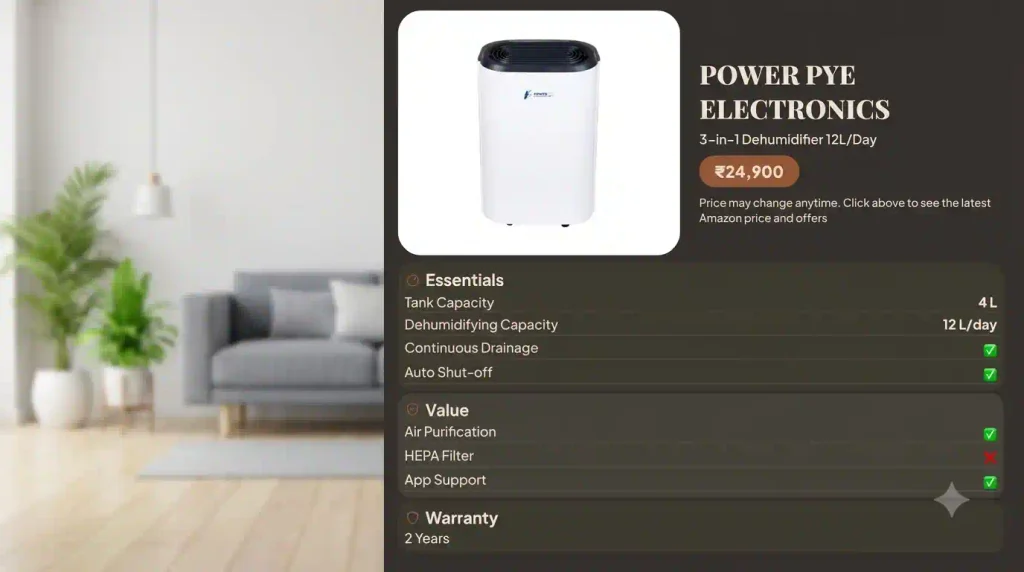
Note: Price may change anytime. Click above to see the latest Amazon price and offers.
The Power Pye Electronics 12 L Dehumidifier combines dehumidification, clothes drying, smart control, and an optional air-purification setup. Its service network is a notable advantage, particularly for buyers outside large metro areas.
- Moisture removal: 12 L/day
- Tank capacity: 4 L
- Drainage: Continuous drainage supported
- Functions: Dehumidifier, clothes dryer, and air purifier with an additional HEPA filter
- Controls: Wi-Fi app, Alexa, and Google Assistant support
- Service: Strong presence in tier 2 and tier 3 cities, including smaller towns
Best for: Buyers who value broader service access, want a larger tank than the Sharp 10 L unit, and may benefit from smart home controls.
Consider before buying: Air purification requires a separately purchased HEPA filter. Without that accessory, it should be evaluated primarily as a dehumidifier.
Sharp 20 L Dehumidifier: Best for Large and Highly Humid Rooms
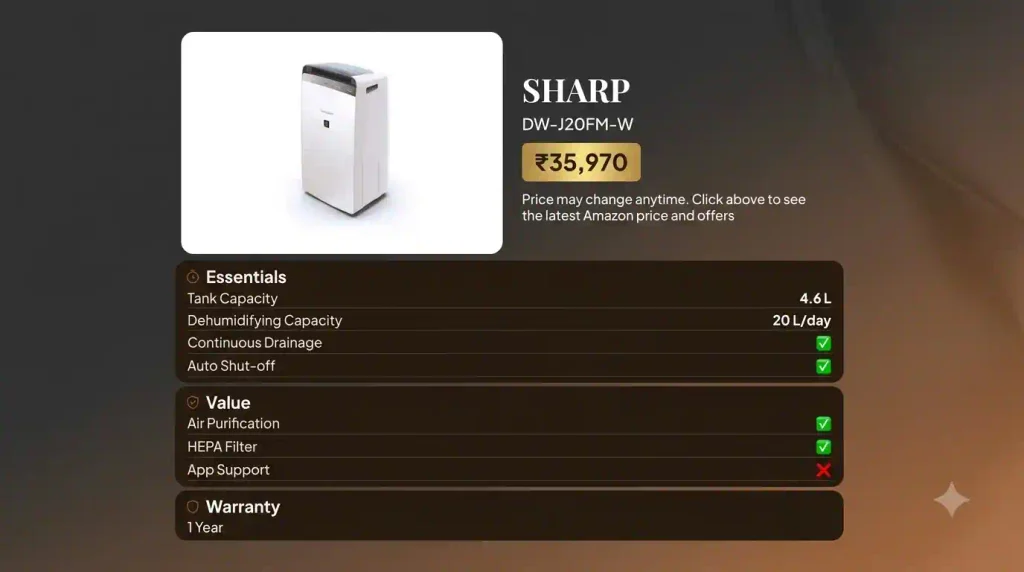
Note: Price may change anytime. Click above to see the latest Amazon price and offers.
The Sharp DW-J20FM-W is the leading recommendation for rooms above 300 sq ft, especially in persistently humid coastal areas. It combines high extraction capacity with integrated HEPA filtration.
- Moisture removal: 20 L/day
- Tank capacity: 4.6 L
- Drainage: Auto-drain capability
- Suitable room size: Up to about 550 sq ft
- Air purification: Integrated HEPA 14 filter
Best for: Large living rooms, coastal homes, and buyers who want both serious dehumidification and proper HEPA-based air purification in one appliance.
Consider before buying: Sharp’s service presence is strongest in metros and tier 1 cities. Service turnaround may take two to three weeks in tier 2 and tier 3 locations.
Eva-Dry, Origin and Absorbia: Options for Cupboards and Shoe Racks
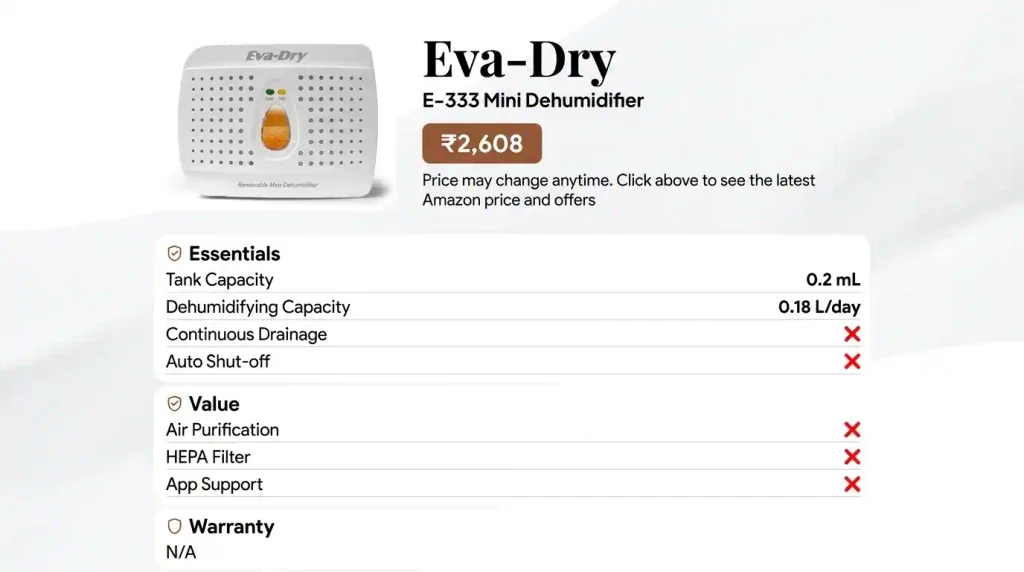
Note: Price may change anytime. Click above to see the latest Amazon price and offers.
Whole-room dehumidifiers are oversized for wardrobes and shoe cabinets. For these compact spaces, portable desiccant units and moisture absorbers are more appropriate.
| Product type | Best use | Main advantage | Main limitation |
|---|---|---|---|
| Eva-Dry portable dehumidifier | Closets, cupboards, shoe racks | Reusable desiccant cartridge that can be reheated through USB | No official service network in India |
| Origin portable dehumidifier | Shoe cabinets and small enclosed storage | Reusable option for small spaces | Not suitable for room-scale humidity control |
| Absorbia moisture absorber | Cupboards and wardrobes | Budget-friendly moisture absorption | Cartridge must be replaced when full |
Eva-Dry has an approximate 500 ml daily capacity and is intended only for enclosed spaces. Its reusable design avoids repeatedly purchasing disposable absorbents, but buyers should not expect formal repairs or local servicing.
Warranty and After-Sales Service: What to Consider
Most dehumidifiers in this category carry a one-year warranty. Some larger Power Pye Electronics models offer a two-year warranty.
Among the reviewed brands, Sharp, HINISO, and Power Pye Electronics had the strongest reported customer satisfaction, with roughly 85% to 90% positive feedback. Service access differs by location:
- Sharp: Stronger presence in metros and tier 1 cities.
- HINISO: Good coverage in tier 1 cities with reasonable reach in tier 2 and tier 3 locations.
- Power Pye Electronics: Particularly strong service coverage in tier 2 and tier 3 cities and smaller towns.
- Eva-Dry: No official India service network.
Service availability matters because a dehumidifier often sees its heaviest use during monsoon, when timely support can be more important than a marginal difference in smart features.
How to Use a Dehumidifier During the Monsoon
- Measure the room humidity. Use a hygrometer rather than guessing from outdoor weather alone.
- Set a target of 45% to 55%. This helps control mould risk while avoiding overly dry air.
- Run it during peak humidity periods. Typical high-humidity windows are around 6:00 a.m. to 10:00 a.m. and 4:00 p.m. to 8:00 p.m.
- Use continuous drainage where possible. This is particularly helpful in coastal areas and during monsoon.
- Empty and clean the tank when using manual collection. Do not allow collected water to sit for extended periods.
- Use laundry mode when needed. A compatible model can help dry clothes in humid conditions.
Running a dehumidifier continuously, 24 hours a day, is often unnecessary. Humidity-based settings and targeted operation during peak moisture periods are generally more sensible.
Common Dehumidifier Buying Mistakes to Avoid
- Buying a mini unit for a bedroom: A 500 ml/day desiccant unit is for a cupboard or shoe rack, not a full room.
- Ignoring drainage: A high-capacity model with a small tank can become inconvenient without hose drainage.
- Choosing based only on claimed room coverage: High humidity and room conditions can reduce practical coverage.
- Assuming ion technology equals HEPA filtration: Ion-based freshening is not equivalent to HEPA air purification.
- Using an AC as the only solution in extreme humidity: In hot coastal climates, supplemental dehumidification may still be needed.
- Setting humidity too low: Below 30% can make the indoor environment uncomfortable.
Which Dehumidifier Is Right for Your Home?
For rooms up to about 250 sq ft where quiet operation and brand assurance matter, the Sharp 10 L Smart Dehumidifier is a sensible choice. For a stronger all-purpose option up to around 300 sq ft, the HINISO 16 L Smart Wi-Fi Dehumidifier offers a useful balance of capacity, drainage, and modes.
The Power Pye Electronics 12 L Dehumidifier stands out for buyers who value broad service coverage and smart-home controls, especially outside major cities. For large rooms and humid coastal homes, the Sharp 20 L Dehumidifier with HEPA 14 air purification is the most complete option in this comparison.
For wardrobes, cupboards, and shoe cabinets, skip full-sized machines and choose a reusable Eva-Dry or Origin unit, or a replaceable Absorbia moisture absorber if low upfront cost is the priority.
Frequently Asked Questions About Dehumidifiers
What Humidity Level Should You Set on a Dehumidifier?
A target setting of 45% to 55% is suitable for controlling excess moisture and discouraging mould growth. Avoid reducing humidity below 30%, as the air may become too dry.
Is a 10 L Dehumidifier Enough for a Bedroom?
A 10 L/day dehumidifier can suit a medium-sized room of roughly 200 to 300 sq ft. The Sharp 10 L model is specifically suited to bedrooms and living rooms up to about 250 sq ft.
Do You Need a Dehumidifier if You Already Have an AC?
An AC can remove some moisture while cooling. In very humid and hot coastal areas, however, an AC alone may not dehumidify sufficiently, making a dedicated dehumidifier useful.
What Is Continuous Drainage in a Dehumidifier?
Continuous drainage lets you attach a hose so collected water flows to a nearby drain instead of filling the internal tank. It is especially useful in high-humidity homes where tanks fill quickly.
Can a Mini Dehumidifier Control Humidity in a Whole Room?
No. Small portable desiccant units with capacities around 500 ml/day are designed for enclosed spaces such as cupboards, closets, and shoe racks rather than bedrooms or living rooms.
Pricing, Affiliate, and Sponsorship Disclosure:
All prices are subject to change and may be higher or lower than prevailing market prices. Ratingsage.com makes no guarantees regarding price accuracy. This content may include affiliate links and/or sponsored placements, through which we may receive compensation. Such compensation does not impact pricing or product representation. Consumers are responsible for verifying final prices with the retailer. 😊 Check: Affiliate Disclosure Page. and Discover more expert product reviews, buying guides, and appliance recommendations on our RatingSage Medium.com profile.