
Best Electric Pressure Cookers in India: NutriCook vs Usha vs Philips
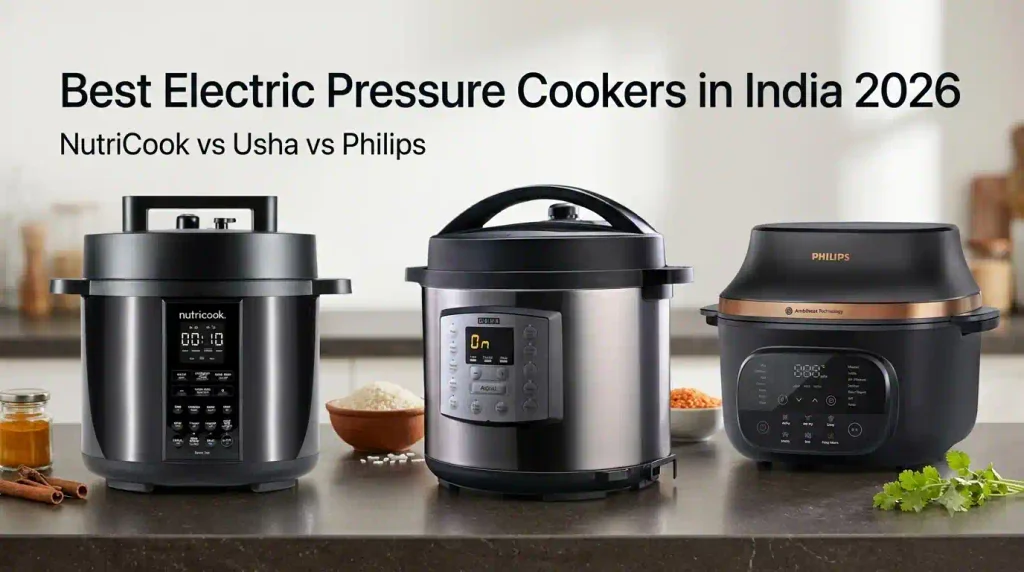
Compare the best electric pressure cookers in India, including NutriCook, Usha iChef and Philips OneChef, with features, pros, cons and buying tips.
An electric pressure cooker can simplify everyday cooking for dal, rice, soups, curries, steaming, sautéing, and slow-cooked meals. Unlike a stovetop pressure cooker, it can manage heat automatically, lock the lid during pressurised cooking, switch to keep-warm mode, and run without constant supervision.
The right choice depends less on a long list of presets and more on three practical questions: Do you need true pressure cooking for foods such as chana and rajma? How many people do you cook for? And would you benefit more from Indian cooking presets or a hybrid appliance with air frying?
How We Compared These Electric Pressure Cookers
We compared these models using published product specifications, cooking functions, capacity, inner-pot material, pressure-cooking capability, presets, warranty information, and current product listings. We also considered practical factors such as counter space and intended use. Unless specifically stated, we do not treat third-party claims or manufacturer marketing language as independent test results.
Quick Summary: Which Electric Pressure Cooker Is Right for You?
- For most Indian households, a 6 litre electric pressure cooker offers the most practical capacity.
- NutriCook Smart Pot suits buyers who want stainless steel construction and straightforward multicooking functions.
- Usha iChef is more suitable when dedicated Indian presets and broader service access matter.
- Philips OneChef adds air frying but does not provide high-pressure cooking for chana or rajma.
Table of Contents
- What Is an Electric Pressure Cooker?
- Electric Pressure Cooker vs Stovetop Pressure Cooker
- How to Choose an Electric Pressure Cooker
- NutriCook Smart Pot: Best for Straightforward Stainless Steel Pressure Cooking
- Usha iChef 6 L: Best for Indian Cooking Presets and Familiar Support Access
- Philips OneChef 6 L: A Hybrid Multicooker and Air Fryer, Not a Pressure Cooker
- NutriCook vs Usha iChef vs Philips OneChef
- Which Electric Cooker Should You Buy?
- Common Buying Mistakes to Avoid
- Electric Pressure Cooker Checklist Before Buying
- Final Recommendation
What Is an Electric Pressure Cooker?
An electric pressure cooker is a countertop appliance that heats food in a sealed cooking chamber and regulates the cooking cycle automatically. Most models combine several cooking modes in one unit, commonly including pressure cooking, rice cooking, sautéing, steaming, slow cooking, soup preparation, yogurt making, food warming, and delayed start.
It is particularly useful for households that value hands-off cooking. Once the ingredients, liquid, and programme are selected, the appliance handles the heating cycle and typically changes to a warming mode after cooking is complete.
However, it is not always a replacement for a full cooking setup. It occupies permanent or semi-permanent counter or cabinet space, and it generally cooks one main preparation at a time. If lunch requires rice, dal, vegetables, and a curry simultaneously, an electric cooker is best treated as one part of the kitchen rather than the only appliance.
Electric Pressure Cooker vs Stovetop Pressure Cooker: What’s the Difference?
| Factor | Electric Pressure Cooker | Stovetop Pressure Cooker |
|---|---|---|
| Heat control | Automated cooking cycle and shutoff functions | Requires manual heat adjustment |
| Supervision | Designed for less hands-on monitoring | Needs attention to flame and pressure behaviour |
| Cooking modes | Often includes sauté, steam, slow cook, rice, and warming modes | Mainly pressure cooking unless used as a regular pot |
| Counter space | Requires storage or countertop room | Usually easier to store in a kitchen cabinet |
| Multiple dishes | Usually sequential cooking in one inner pot | Can be used alongside other pans on a gas stove |
An electric model makes sense when predictable, timed cooking is the priority. A stovetop pressure cooker remains more convenient for cooks who frequently make several dishes at once or have limited counter space.
How to Choose the Best Electric Pressure Cooker
Choose the Right Cooking Capacity
Electric pressure cookers sold in India are commonly available in 3 litre, 6 litre, and 8 litre capacities. The stated capacity is the bowl volume, not necessarily the maximum amount that should be cooked under pressure.
For safe operation, do not fill the pot completely. A practical rule is to use no more than about two-thirds of its capacity, leaving enough room for pressure to build safely.
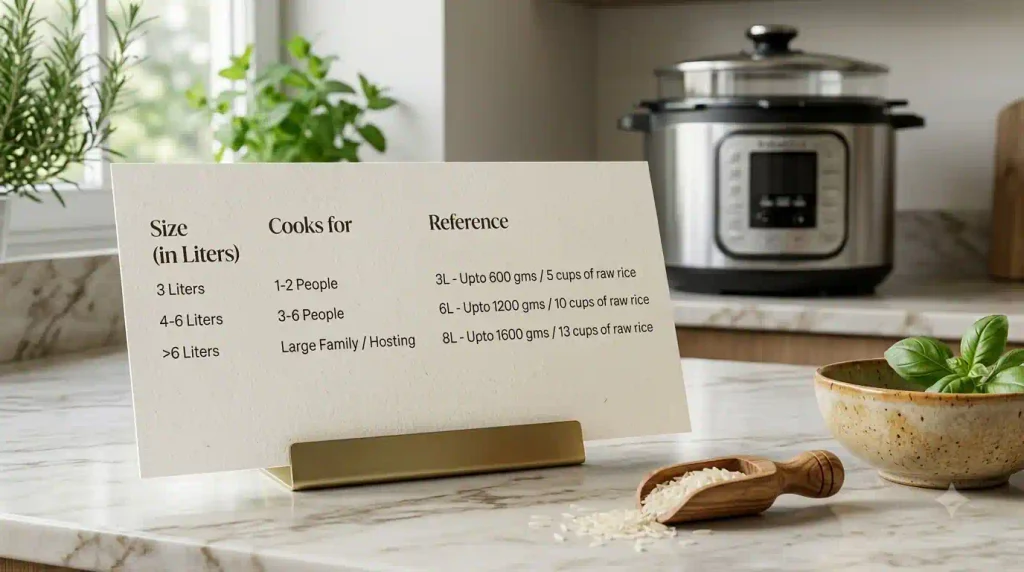
- 3 litre: Suitable for smaller quantities, but do not assume the appliance itself will be dramatically more compact.
- 6 litre: The most widely available size and a practical option for many households.
- 8 litre: Better suited to larger batches, larger families, or meal preparation in bigger quantities.
Capacity should reflect the amount cooked in a single batch, not merely the number of people at home. A small household that prepares rajma, stock, biryani, or meals for several days may still find 6 litres more useful than 3 litres.
Consider the Inner Cooking Pot Material
Stainless steel inner pots are generally the preferred option for buyers seeking a durable, familiar cooking surface. Most electric pressure cookers in this category use stainless steel cooking bowls. Nonstick and anodised alternatives are also available, but may not suit every household’s preferences.
When comparing models, check both the inner pot and the outer body. A stainless steel inner bowl affects the food-contact surface, while a stainless steel exterior changes the appliance’s overall finish and construction.
How Much Wattage Do You Need?
Wattage primarily affects how quickly the cooker heats up. Larger appliances tend to have higher wattage ratings, while smaller models may be below 800 W. For a 6 litre cooker, power in the broad 800 W to 1,200 W range is generally a normal specification.
Higher wattage may shorten heat-up time, but it should not be the deciding factor between otherwise similar cookers. Capacity, pressure capability, usable controls, support access, and pot material are usually more meaningful buying considerations.
Do 7-in-1 and 9-in-1 Functions Really Matter?
Multi-function labels usually count the cooking modes an appliance can perform. A cooker described as 7-in-1, 8-in-1, or 9-in-1 may combine pressure cooking, slow cooking, rice cooking, sautéing, simmering, steaming, soup making, yogurt preparation, warming, and delayed start.
These labels are useful only if the included modes match how you cook. A household that regularly cooks dal and rice may care more about dependable pressure cooking and easy cleaning than a long list of rarely used programmes.
Are Preset Cooking Programs Worth Having?
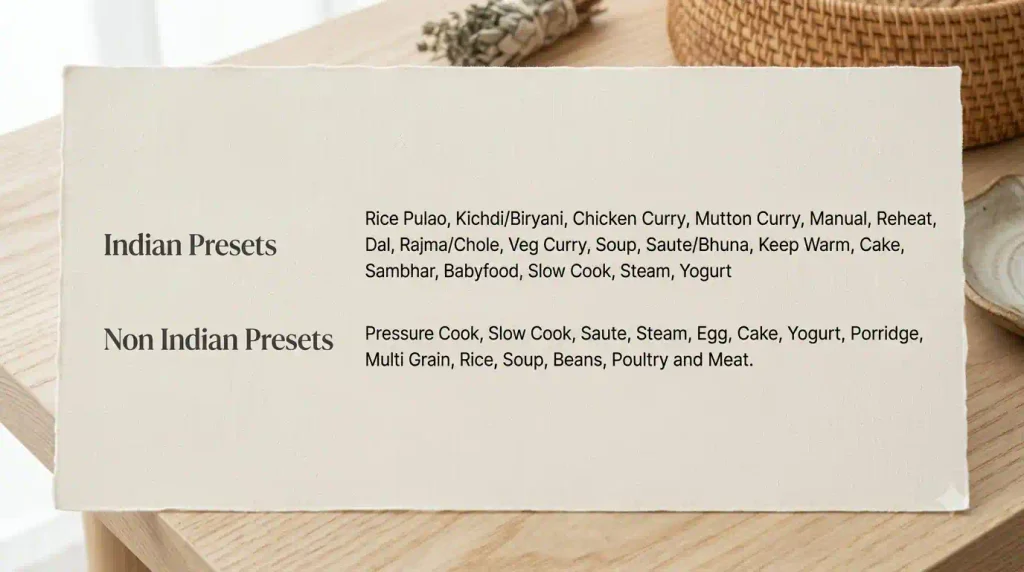
Presets are shortcuts for common dishes and ingredients. Typical labels include rice, dal, soup, chicken, biryani, sambar, and beans. Many products advertise large preset counts, but most electric cookers already include a baseline set of common cooking modes.
Indian presets can be helpful for someone new to electric cooking because they provide a more familiar starting point. They are not essential for experienced cooks who are comfortable selecting time, pressure, or manual settings.
Check Whether It Offers True Pressure Cooking
This is one of the most important distinctions. A multicooker may be capable of cooking dal but still lack the high-pressure function required for tougher legumes such as chana and rajma.
If chickpeas, kidney beans, and similar ingredients are regular parts of your meals, choose a genuine electric pressure cooker rather than assuming every multicooker will produce the same results.
When Is Slow Cooking Useful?
Slow cooking uses gentler, longer cooking to develop flavour and tenderise tougher cuts of meat. It can be useful for preparations such as dum biryani, lamb curry, and chicken tikka masala, where slower cooking supports spice infusion and texture.
Which Safety Features Should You Look For?
Electric pressure cookers commonly include several built-in safety mechanisms. Features to look for include:
- Multiple pressure-release systems
- A lid-locking mechanism that prevents opening under pressure
- Overheat protection
- An anti-block shield to reduce vent clogging
- Pressure indicators
These features are common across the category, so their presence alone may not distinguish one model from another. They remain important to verify in the product listing and instruction manual before purchase.
NutriCook Smart Pot Review: Best for Straightforward Pressure Cooking
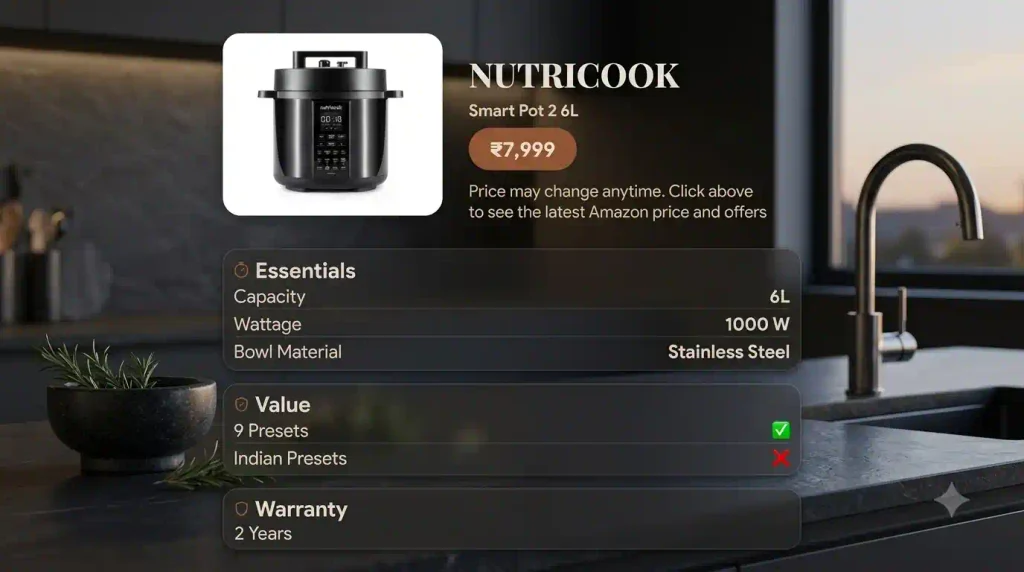
Note: Price may change anytime. Click above to see the latest Amazon price and offers.
The NutriCook Smart Pot is a 6 litre electric pressure cooker aimed at buyers who want a conventional multicooker format with a stainless steel cooking bowl. Its listed specification includes 1,000 W power and nine cooking functions.
Its core functions include pressure cooking, sautéing, slow cooking, rice cooking, soup preparation, steaming, yogurt making, and food warming. That combination covers the main tasks expected from an electric pressure cooker without requiring a separate rice cooker, steamer, or slow cooker for occasional use.
Why Choose the NutriCook Smart Pot?
- 6 litre capacity is practical for regular household cooking and batch preparation.
- Stainless steel body and stainless steel cooking bowl may appeal to buyers avoiding nonstick interiors.
- 1,000 W power sits within the common range for a 6 litre model.
- The included functions cover essential pressure cooking and multicooking tasks.
- The stated warranty is two years.
NutriCook Smart Pot: Pros and Cons
- It does not focus on dedicated Indian dish presets.
- Buyers who depend on programmed settings for dishes such as biryani or sambar may prefer a model with clearly labelled Indian menus.
- Service availability should be confirmed locally, particularly outside metropolitan areas.
Who Should Buy the NutriCook Smart Pot?: Buyers who want stainless steel construction, genuine pressure cooking, and a relatively simple control approach rather than a large collection of recipe-specific buttons.
Who Should Consider Another Cooker?: First-time users who strongly prefer Indian preset labels or buyers who need confirmed local service support before committing.
Check the NutriCook Smart Pot listing for current price, seller details, included accessories, and warranty terms before ordering.
Usha iChef 6-L: Best for Indian Cooking Presets
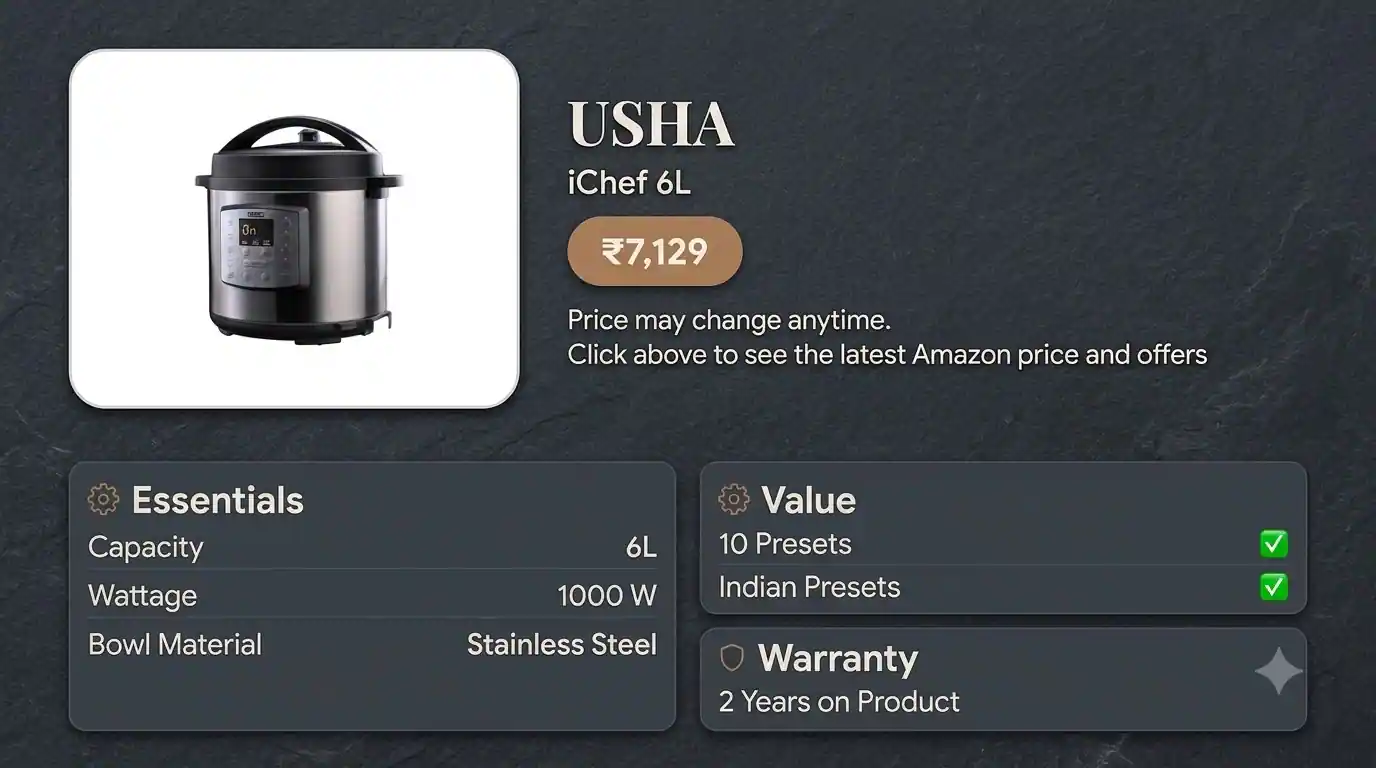
Note: Price may change anytime. Click above to see the latest Amazon price and offers.
The Usha iChef 6 L electric pressure cooker is positioned around convenience for Indian cooking. Its notable feature is a set of 10 dedicated Indian presets, including options for dishes such as dal, rice, biryani, sambar, and khichdi.
It also has a 1,000 W rating, a 6 litre capacity, a stainless steel body, delay timer functionality, and a keep-warm mode. The keep-warm function is intended to maintain food temperature after the main cooking cycle ends rather than continuing active cooking.
Why Choose the Usha iChef?
- Dedicated Indian presets provide a convenient starting point for common meals.
- Delay timer functionality can help with meal scheduling.
- Keep-warm mode is useful when food needs to remain ready after cooking.
- 6 litre capacity and 1,000 W power are suitable for everyday household use.
- The stated warranty is two years.
- Usha has service availability in major Indian cities, though local coverage should still be confirmed.
Usha iChef: Pros and Cons
- A preset is a convenience feature, not a guarantee that every recipe will need no adjustment.
- Cooking results still depend on ingredient quantity, soaking, liquid level, and personal texture preferences.
- It remains a single-pot appliance, so it cannot independently prepare several dishes at once.
Who Should Buy the Usha iChef?: Households that cook Indian staples often and want clearly labelled programmes for dishes they make regularly.
Who Should Consider Another Cooker?: Buyers who prefer manual settings over presets or need an appliance that combines air frying with cooking functions.
Philips OneChef 6-L: Best for Air Frying and Multicooking
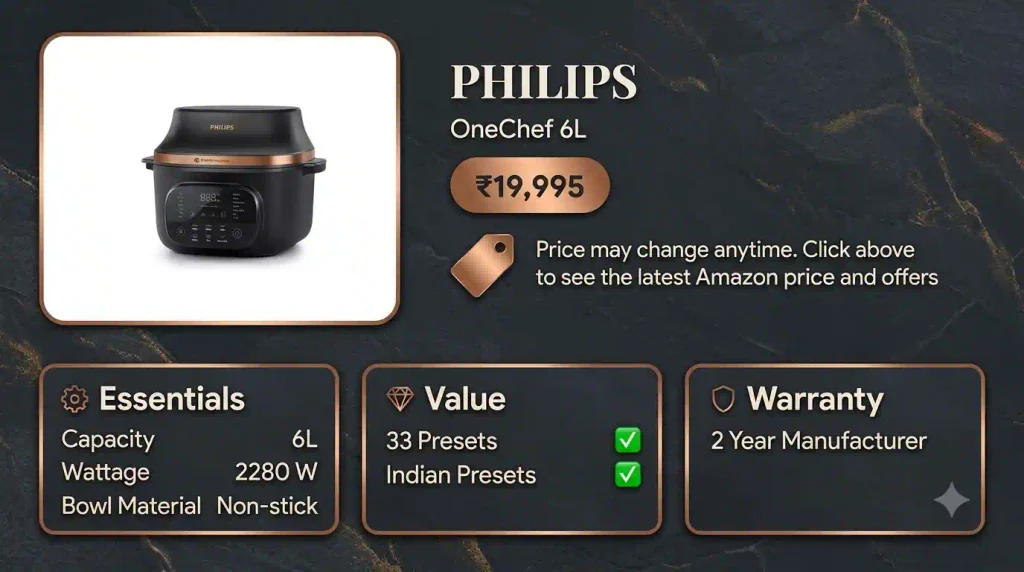
Note: Price may change anytime. Click above to see the latest Amazon price and offers.
The Philips OneChef 6 L is a different type of appliance. It combines electric cooking functions with air frying capability, making it relevant for buyers considering both an air fryer and an electric cooker.
Philips OneChef is a 33-in-1 smart cooking device, not a dedicated electric pressure cooker. Philips lists functions such as air frying, stir-frying, steaming, boiling, curry cooking, baking and roasting, but does not list a pressure-cooking function in its official specifications.
Why Choose the Philips OneChef?
- Combines air frying and cooking functions in one appliance.
- May reduce the need to buy separate appliances for air frying and electric cooking.
- Suitable for buyers who make dal, curries, sautéed dishes, and air-fried foods.
- Philips service support is a relevant consideration for buyers who value an established appliance brand.
Philips OneChef: Pros and Cons
- It cannot replace a high-pressure cooker for chana, rajma, and similar legumes.
- The appliance is bulky and needs substantial counter or storage space.
- It is less appropriate for someone whose primary purpose is pressure cooking beans, legumes, and tougher ingredients.
Who Should Buy the Philips OneChef?: Buyers who were already planning to purchase both an air fryer and an electric cooker, and who do not rely on high-pressure cooking for legumes.
Who Should Avoid It as a Pressure Cooker?: Anyone specifically searching for an electric pressure cooker to cook rajma, chole, or other ingredients that benefit from high pressure.
NutriCook vs Usha iChef vs Philips OneChef: Key Differences
| Feature | NutriCook Smart Pot | Usha iChef 6 L | Philips OneChef 6 L |
|---|---|---|---|
| Product type | Electric pressure cooker | Electric pressure cooker | Hybrid multicooker and air fryer |
| Capacity | 6 litres | 6 litres | 6 litres |
| Power | 1,000 W | 1,000 W | Check current listing |
| High-pressure cooking | Yes | Yes | No |
| Indian cooking support | Not the main focus | 10 dedicated Indian presets | Designed for Indian cooking |
| Air frying | No | No | Yes |
| Stainless steel cooking bowl | Yes | Confirm current listing | Check current listing |
| Stated warranty | Two years | Two years | Confirm current listing |
Which Electric Cooker Should You Buy?
Choose NutriCook Smart Pot if you want a conventional 6 litre electric pressure cooker with a stainless steel cooking bowl, key multicooking modes, and uncomplicated controls. It is a sensible fit when pressure cooking capability matters more than recipe-specific Indian presets.
Choose Usha iChef if you want Indian presets for familiar dishes such as dal, rice, khichdi, biryani, and sambar. It is particularly relevant for new electric cooker owners who want more guidance from the control panel and value the ability to check support through a recognised service network.
Choose Philips OneChef only if air frying is a genuine priority alongside multicooking. Its hybrid format can be practical, but it should not be purchased as a substitute for a true high-pressure cooker when chana and rajma are frequent menu items.
Common Electric Pressure Cooker Buying Mistakes to Avoid
Assuming Every Multicooker Can Pressure Cook
Some products can cook dal and curry but cannot perform high-pressure cooking. Always confirm the pressure-cooking function if you expect to cook chickpeas, kidney beans, or similar ingredients.
Choosing a Cooker Based Only on Capacity
A 3 litre model may not reduce the appliance footprint as much as expected. Compare external dimensions, not just bowl capacity, before assuming it will fit a tight counter.
Ignoring the Recommended Fill Level
Pressure cooking needs headroom. Follow the marked maximum fill level and keep cooking volume at roughly two-thirds capacity for safer operation.
Choosing Too Many Presets Over Useful Features
More presets do not necessarily create more useful cooking capability. Consider whether the cooker has the functions, capacity, pot material, and support access that fit your actual routine.
Ignoring Warranty and Service Support
Warranty periods and service access can vary by seller and location. Confirm the current warranty documentation and the availability of authorised support in your city before purchasing, especially for a countertop appliance that may be used frequently.
Electric Pressure Cooker Buying Checklist
- Capacity: Is 6 litres enough after allowing for safe fill limits?
- Pressure capability: Can it cook chana, rajma, and other legumes under pressure?
- Inner pot: Does the cooking bowl material match your preference?
- Cooking modes: Will you actually use slow cook, steam, sauté, yogurt, and warming functions?
- Presets: Are Indian presets useful for your cooking style, or unnecessary?
- Counter space: Have you checked the appliance dimensions and storage requirements?
- Safety: Does it list lid locking, pressure release, overheating protection, and vent protection?
- Service: Is authorised support available where you live?
- Current terms: Have you checked the latest price, warranty, seller, and stock status?
Final Recommendation: Which Model Offers the Best Fit?
For most households seeking an electric pressure cooker for Indian cooking, a 6 litre model is the most practical starting point. The choice between NutriCook Smart Pot and Usha iChef comes down to whether you prefer a stainless steel-focused, straightforward multicooker or the convenience of dedicated Indian presets.
The Philips OneChef deserves consideration only as a multifunction alternative for buyers who value air frying. Its versatility does not remove its central limitation: it is not a high-pressure cooker for legumes such as chana and rajma.
Before buying any electric cooker, verify the current listing, warranty, dimensions, and local service coverage. Product availability and support terms can change, and those details matter as much as the cooking functions printed on the box.
Frequently Asked Questions About Electric Pressure Cookers
Is a 6 L Electric Pressure Cooker Enough for a Family?
A 6 litre model is a widely available and practical size for many households. Remember that pressure cookers should not be filled to full capacity, so plan for about two-thirds usable cooking volume.
Can an Electric Pressure Cooker Cook Chana and Rajma?
Yes, a true electric pressure cooker can cook ingredients such as chana and rajma. A general multicooker without high-pressure cooking may make dal but may not be suitable for these tougher legumes.
Are Indian Presets Necessary?
No. Indian presets are useful shortcuts for dishes such as dal, rice, biryani, sambar, and khichdi, particularly for beginners. They are less important if you are comfortable using manual cooking controls.
Does Higher Wattage Make an Electric Pressure Cooker Better?
Higher wattage can help an appliance heat up faster, but it should not be the main purchase criterion. For 6 litre models, capacity, pressure capability, pot material, functions, and service support are more important comparisons.
Can the Philips OneChef Replace a Pressure Cooker?
It can replace an electric cooker for some uses, including dal, curry preparation, sautéing, and air frying. It cannot replace a high-pressure cooker for chana, rajma, and other foods that need high-pressure cooking.
Pricing, Affiliate, and Sponsorship Disclosure:
All prices are subject to change and may be higher or lower than prevailing market prices. Ratingsage.com makes no guarantees regarding price accuracy. This content may include affiliate links and/or sponsored placements, through which we may receive compensation. Such compensation does not impact pricing or product representation. Consumers are responsible for verifying final prices with the retailer. 😊 Check: Affiliate Disclosure Page. and Discover more expert product reviews, buying guides, and appliance recommendations on our RatingSage Medium.com profile.