
RO vs UV Water Purifier: How to Choose the Right One
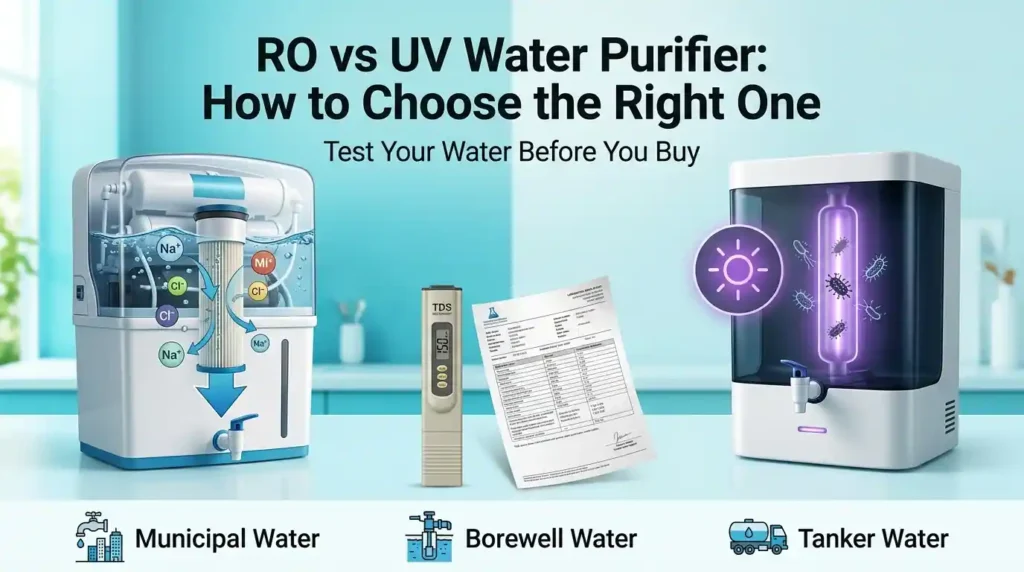
Confused between RO vs UV water purifiers? Learn how TDS, water source, contaminants, maintenance, and testing can help you choose the right purifier.
Most people make one expensive mistake when buying a water purifier: they choose an RO purifier when a UV or UF purifier would have been enough.
Choosing the right purifier is not about buying the most advanced machine. It is about understanding your water supply, checking its TDS level, and knowing when RO filtration is genuinely necessary.
Step 1: RO vs UV Water Purifier: Why RO Is Not Always the Better Choice
RO, or reverse osmosis, is powerful filtration technology. But powerful is not always better.
An RO water purifier can reduce the Total Dissolved Solids, or TDS, in water by around 90%. This is useful when the incoming water has a high level of dissolved contaminants. However, if the water already has low TDS, RO can reduce it far more than needed.
Most municipal water supplies already have relatively low TDS. When such water passes through an RO purifier, its TDS may drop to only 20 to 30 ppm after filtration.
That creates two problems:
- The water can taste flat.
- It may lose naturally occurring minerals, including calcium and magnesium.
If your water does not need RO treatment, using it can mean paying more to remove things that were not a problem in the first place.
Step 2: How UV and UF Water Purifiers Work
UV and UF water purifiers are designed for a different job.
A UV purifier uses ultraviolet light to kill bacteria and viruses. A UF purifier, or ultrafiltration purifier, helps filter impurities without significantly reducing the water’s TDS.
The key advantage is simple: a UV or UF purifier can address microbiological contamination while leaving the dissolved mineral content of the water largely unchanged.
This makes it a practical choice when the water supply is municipal, the TDS is already low, and the primary concern is bacteria or viruses rather than excessive dissolved solids.
Step 3: Test Your Tap Water Before Choosing a Purifierng Anything
Do not guess. Test your water.
A basic TDS meter can help you understand the dissolved solids level in your tap water. This is the first check to make before deciding between an RO and UV water purifier.
If your tap water has a TDS level below roughly 200 to 250 ppm and you receive municipal water, a UV purifier is generally the more sensible option than an RO purifier.
It handles biological contaminants without unnecessarily stripping down the water’s mineral content.
A Quick Decision Guide
- Municipal water with TDS under 200 to 250 ppm: Choose a UV or UF purifier in most cases.
- Water with high TDS: Consider an RO purifier.
- Low-TDS water with potential heavy-metal contamination: RO may still be necessary.
Step 4: Compare RO vs UV Purchase Price and Maintenance Costs
UV and UF purifiers are usually cheaper than RO purifiers, both at the time of purchase and over the long run.
That matters because a purifier is not a one-time cost. Filters, servicing, and ongoing maintenance all add up. If a UV purifier can safely do the job for your water supply, there is little reason to spend more on an RO system.
The smarter purchase is the purifier that fits your water quality, not the one with the biggest list of features.
Step 5: Low TDS Does Not Always Mean Safe Drinking Water
Low TDS does not always mean your water is completely safe.
The main exception is the presence of heavy metals, such as arsenic. If the water contains heavy metals, an RO purifier may be the right choice even when the TDS reading is low.
A TDS meter alone cannot tell you whether arsenic or other heavy metals are present. It only measures the overall level of dissolved solids. That is why a low TDS number should not be treated as a complete water-quality report.
Step 6: Check Your Water for Arsenic and Other Heavy Metals
There are two practical ways to check whether heavy metals may be a concern:
- Get your water professionally tested.
- Refer to water-quality reports published by the Government of India.
If your local water supply has a known risk of arsenic or other heavy metals, an RO water purifier becomes a much more justified investment.
If there is no such risk, your water comes from a municipal source, and the TDS is below 200 to 250 ppm, a UV or UF purifier is likely all you need.
Step 7: Review Official Water-Quality Reports for Your Area
Before buying a water purifier, make the decision in this order:
- Check whether your supply is municipal water.
- Measure your tap water’s TDS using a TDS meter.
- Check whether your area has a documented heavy-metal risk.
- Choose UV or UF for low-TDS municipal water without heavy-metal concerns.
- Choose RO when TDS is high or heavy metals such as arsenic are present.
Final Verdict: RO vs UV Water Purifier
RO is not bad. It is simply not necessary for every household. The right purifier protects your water quality without over-filtering it, removing useful minerals, flattening the taste, or adding needless maintenance costs.
Pricing, Affiliate, and Sponsorship Disclosure:
All prices are subject to change and may be higher or lower than prevailing market prices. Ratingsage.com makes no guarantees regarding price accuracy. This content may include affiliate links and/or sponsored placements, through which we may receive compensation. Such compensation does not impact pricing or product representation. Consumers are responsible for verifying final prices with the retailer. 😊 Check: Affiliate Disclosure Page. and Discover more expert product reviews, buying guides, and appliance recommendations on our RatingSage Medium.com profile.